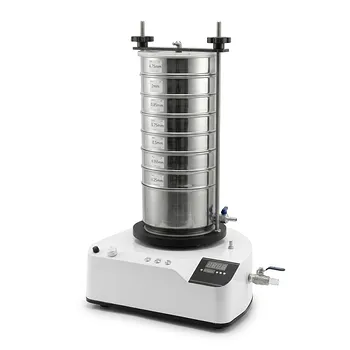
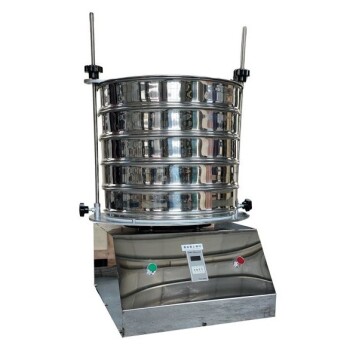
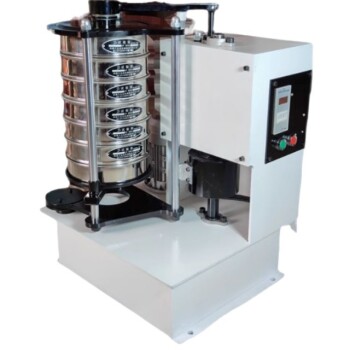
Standard sieving equipment is the critical final step in the salt bath chromium plating process to ensure the physical consistency of the diamond powder. It is necessary to mechanically separate and remove agglomerates (clumps of particles) or residual large impurities that form or persist after the cleaning and drying stages.
Core Takeaway Sieving is not merely a cleaning process; it is a structural necessity for composite manufacturing. By eliminating agglomerates, sieving ensures the diamond particles can mix evenly with metal powders, which is the absolute prerequisite for achieving consistent strength and microstructure in the final material.
The Physical Necessity of Sieving
Removing Process Artifacts
After the diamond particles undergo salt bath plating at high temperatures and subsequent cleaning, they rarely emerge as perfectly discrete units.
The drying process often causes particles to bind together, forming agglomerates. Standard sieving is the mechanical intervention required to break up these clusters or filter out large impurities that would otherwise compromise the powder's quality.
Establishing Particle Uniformity
The primary output of the sieving process is a defined, uniform particle size distribution.
Without this step, the batch would contain a mix of single particles and fused clusters. This inconsistency makes it impossible to predict how the material will behave during subsequent processing steps.
The Downstream Impact on Composites
Ensuring Mixing Uniformity
Diamond particles are typically destined to be combined with a matrix metal powder.
For this mixture to be effective, the diamond must be dispersed perfectly evenly throughout the metal. If the diamond powder contains agglomerates, it will segregate rather than mix, leading to distinct pockets of diamond and pockets of metal rather than a homogeneous blend.
Achieving Consistent Microstructure
The ultimate goal of the plating process is to create a composite material with reliable physical properties.
The microstructure of the final product—its internal density and grain structure—relies entirely on the uniformity of the initial mix. Sieving ensures that every cubic millimeter of the final composite contains the correct ratio of diamond to metal, preventing weak spots or structural failures.
Risks of Skipping the Sieve
Compromised Structural Integrity
If large particles or agglomerates are allowed to remain, they act as defects in the final composite material.
These inconsistencies can create stress concentrators, leading to premature failure of the tool or component under load.
Inefficient Material Utilization
Using unsieved powder results in unpredictable processing.
You may find that standard sintering or pressing parameters fail to produce a dense part because the packing density of the powder was thrown off by the presence of large agglomerates.
Making the Right Choice for Your Goal
To ensure your diamond composite meets performance standards, apply the sieving process with the final application in mind.
- If your primary focus is Mixing Homogeneity: Ensure your sieve mesh size is strictly calibrated to the target diamond grit size to prevent any clustered particles from entering the metal matrix blend.
- If your primary focus is Microstructural Reliability: View sieving as a mandatory quality control gate; verify that no large-particle impurities remain to disrupt the density of the final sintered product.
Sieving is the bridge between a raw coated particle and a high-performance composite material.
Summary Table:
| Factor | Impact of Sieving | Risk of Skipping |
|---|---|---|
| Particle Consistency | Removes agglomerates and fused clusters | Inconsistent particle size distribution |
| Mixing Quality | Enables homogeneous blending with metal powder | Material segregation and uneven diamond pockets |
| Microstructure | Ensures uniform density and grain structure | Formation of structural defects and weak spots |
| Performance | Guarantees reliable physical properties | Premature tool failure under stress |
Elevate Your Material Consistency with KINTEK
Don't let particle agglomeration compromise your high-performance composites. KINTEK specializes in precision laboratory solutions, including professional sieving equipment, crushing and milling systems, and hydraulic presses designed for advanced material research.
Whether you are processing diamond particles or developing metal matrix composites, our comprehensive range of high-temperature furnaces and sieving tools ensures your powders meet the strictest uniformity standards.
Ready to optimize your production quality? Contact KINTEK today to discover how our expertise can enhance your laboratory efficiency.
Related Products
- Three-dimensional electromagnetic sieving instrument
- Laboratory Vibratory Sieve Shaker Machine for Dry and Wet Three-Dimensional Sieving
- Laboratory Test Sieves and Sieving Machines
- Laboratory Wet Three-Dimensional Vibratory Sieve Shaker Machine
- Laboratory Test Sieves and Vibratory Sieve Shaker Machine
People Also Ask
- Why is sieving equipment essential for the classification of processed bio-activated carbon? Optimize Performance
- What are the limitations of sieving? Understanding the Constraints of Particle Size Analysis
- What are advantages and disadvantages of sieving method? A Guide to Reliable & Cost-Effective Particle Sizing
- How is sieving important? The Critical Role of Particle Size Analysis in Quality Control
- What is sieving and how does it work? A Guide to Accurate Particle Size Analysis