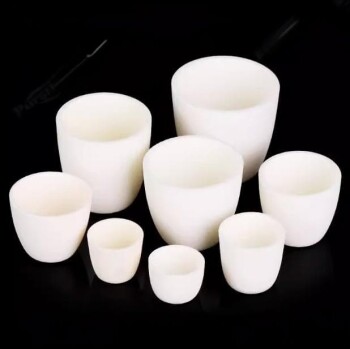
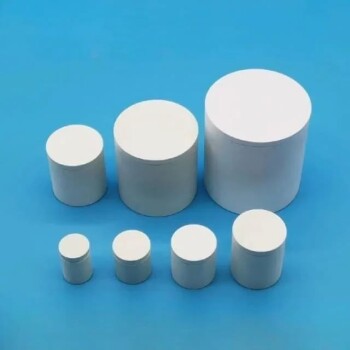
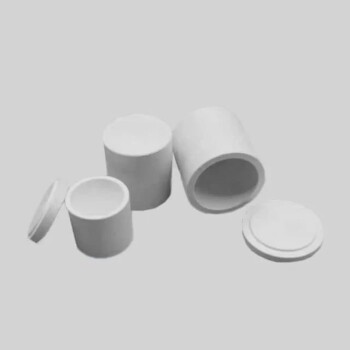
The design of laboratory-grade ceramic crucibles is a critical variable in the accurate determination of volatile matter content in flax straw. It serves two essential functions: providing structural integrity against extreme heat up to 950°C and establishing a controlled atmosphere that strictly isolates thermal decomposition from combustion.
Accurate flax straw characterization relies on isolating volatile extraction from oxidative combustion. A properly designed ceramic crucible acts as both a thermal shield and an atmospheric lock, ensuring data reflects true volatile content rather than sample burning or equipment failure.
The Role of Thermal Resilience
Withstanding Extreme Heat
Determining volatile matter requires subjecting flax straw to intense processing temperatures. High-quality ceramic crucibles are engineered to operate effectively at temperatures up to 950°C.
Resisting Thermal Shock
The analysis process involves rapid transitions in temperature. The crucible material must possess high thermal shock resistance to prevent cracking or shattering during these fluctuations.
Any structural failure during this phase would not only destroy the sample but also compromise the safety of the laboratory environment.
Controlling the Micro-Environment
The Critical Function of the Lid
The most significant design feature for analytical accuracy is the crucible lid. Its primary role is to physically prevent external air infiltration into the sample chamber.
Creating Oxygen Deficiency
By sealing the vessel, the crucible creates a micro-oxygen-deficient environment. This isolation is mandatory for the specific chemical process required for this analysis.
Ensuring Pure Thermal Decomposition
In this oxygen-starved state, the flax straw undergoes pure thermal decomposition. This releases volatile compounds without burning the biomass structure.
If oxygen were allowed to enter, the process would shift to oxidative combustion (burning). Combustion fundamentally alters the mass loss profile, leading to severe data distortion and rendering the volatile matter indicators invalid.
Understanding Potential Sources of Error
The Consequence of Poor Seals
Even a high-quality ceramic material will fail analytically if the lid design does not ensure a tight fit. A "leaky" crucible introduces oxygen, creating a hybrid environment of decomposition and combustion that produces unreliable data.
Material Inconsistency
Not all ceramics are rated for repeated exposure to 950°C. Using lower-grade crucibles may result in micro-fractures over time, altering thermal conductivity and potentially contaminating the sample.
Making the Right Choice for Your Analysis
To ensure the validity of your flax straw characterization, prioritize equipment features based on your specific analytical requirements.
- If your primary focus is equipment longevity: Select high-grade ceramics specifically rated to withstand severe thermal shocks at 950°C to minimize replacement costs.
- If your primary focus is data precision: Prioritize a crucible design with a precision-fitted lid to guarantee the oxygen-deficient environment required for pure decomposition.
Ultimately, the crucible is not merely a container, but an active instrument in securing the scientific validity of your biomass analysis.
Summary Table:
| Feature | Critical Function | Impact on Analysis |
|---|---|---|
| Thermal Resilience | Operating temperatures up to 950°C | Prevents structural failure and safety hazards. |
| Thermal Shock Resistance | withstands rapid temperature shifts | Prevents cracking/shattering during high-heat transitions. |
| Precision Lid Fit | Establishes an atmospheric lock | Prevents air infiltration to ensure pure decomposition. |
| Oxygen-Deficient Environment | Isolates thermal decomposition from combustion | Ensures accurate mass loss data without oxidative burning. |
Elevate Your Biomass Analysis with KINTEK Precision
Ensure the scientific validity of your volatile matter characterization with laboratory-grade solutions from KINTEK. Whether you are analyzing flax straw or complex biomass, our high-performance ceramic crucibles and precision-engineered muffle furnaces provide the thermal stability and atmospheric control necessary for pure decomposition without data distortion.
From high-temperature consumables like PTFE and ceramics to advanced crushing, milling, and furnace systems, KINTEK specializes in providing researchers with the tools needed for uncompromising accuracy. Don't let equipment failure compromise your results—leverage our expertise in laboratory equipment and consumables to optimize your lab's workflow.
Ready to upgrade your thermal processing accuracy? Contact us today to find the perfect crucible and furnace solution for your lab!
References
- Bahareh Vafakish, Bishnu Acharya. Pyrolysis and Combustion Behavior of Flax Straw as Biomass: Evaluation of Kinetic, Thermodynamic Parameters, and Qualitative Analysis of Degradation Products. DOI: 10.3390/en16196932
This article is also based on technical information from Kintek Solution Knowledge Base .
Related Products
- Engineering Advanced Fine Ceramics Alumina Crucibles (Al2O3) for Thermal Analysis TGA DTA
- Engineering Advanced Fine Ceramics Alumina Al2O3 Crucible With Lid Cylindrical Laboratory Crucible
- Arc-Shaped Alumina Ceramic Crucible High Temperature Resistant for Engineering Advanced Fine Ceramics
- Ceramic Evaporation Boat Set Alumina Crucible for Laboratory Use
- Alumina Al2O3 Ceramic Crucible Semicircle Boat with Lid for Engineering Advanced Fine Ceramics
People Also Ask
- Why Use Alumina Crucibles for TGA of Bicyclic Carbonates? Ensure Data Purity & Chemical Inertness
- Why are alumina crucibles and mother powder essential for LATP sintering? Optimize Your Solid Electrolyte Performance
- Why are high-purity alumina crucibles used for liquid lead corrosion experiments? Ensure Data Accuracy at 550°C
- What is the primary purpose of using alumina crucibles for LLTO ceramics? Optimize Your High-Temperature Sintering
- Why Use Alumina Crucibles & Powder Burial for NaSICON? Ensure Phase Purity and Prevent Elemental Volatilization