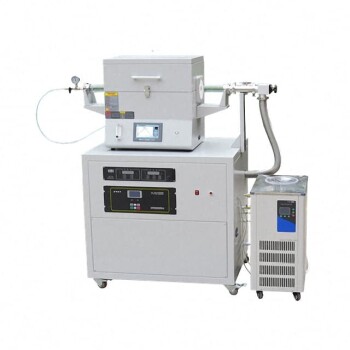
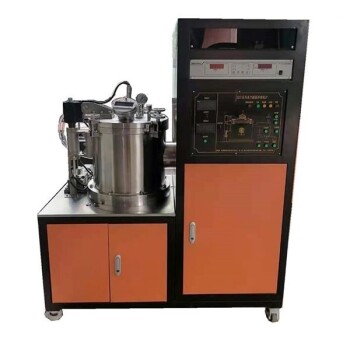
Vacuum evacuation is the essential prerequisite for controlled catalyst reduction. Using a vacuum pump to reach a low base pressure—typically around 0.5 Pa—removes residual air, oxygen, and moisture from the furnace chamber. This process ensures that the subsequent reduction occurs in a pure, controlled atmosphere, preventing unwanted side reactions that would degrade the catalyst's performance.
Pre-evacuating a tube furnace eliminates atmospheric contaminants that compete with reducing gases, such as hydrogen. This step is critical for engineering the specific defect structures and photoelectric properties required for high-efficiency photocatalysis.
Eliminating Atmospheric Interference
The Role of Residual Oxygen and Moisture
Residual oxygen and moisture within a furnace chamber can actively interfere with the reduction process. Even trace amounts of oxygen can lead to the re-oxidation of the catalyst surface, neutralizing the effects of the reducing gas.
Moisture is particularly problematic as it can adsorb onto the internal surfaces of porous materials. If not removed via deep vacuum, this moisture can cause inconsistent reaction rates and lead to the formation of unintended chemical phases.
Establishing a Pure Reaction Environment
By evacuating the furnace to a low base pressure before introducing gases like argon-hydrogen, you establish a known baseline. This ensures that the chemical potential of the atmosphere is dictated solely by the introduced gases rather than random atmospheric fluctuations.
A pure environment is necessary for the smooth diffusion of gases into the internal pores of the catalyst. This deep penetration is vital for achieving uniform modification across the entire surface area of the material.
Engineering Material Properties
Stabilizing Defect Structures
The performance of a photocatalyst often depends on the presence of specific defect structures, such as oxygen vacancies. If oxygen is present during the heating cycle, these vacancies may be filled or fail to form entirely.
Vacuum evacuation allows for the precise "stripping" of oxygen atoms from the crystal lattice under a hydrogen atmosphere. This controlled removal creates stable defects that are essential for trapping charge carriers and enhancing catalytic activity.
Optimizing Photoelectric Performance
The electronic band structure of a photocatalyst is highly sensitive to its chemical purity. Atmospheric nitrogen or carbon contaminants can introduce mid-gap states that act as recombination centers for electrons and holes.
Ensuring a high-vacuum start prevents the formation of continuous oxide films or impurity layers. This purity is what allows the final material to achieve its intended photoelectric properties and maintain long-term stability.
Understanding the Trade-offs
Time vs. Base Pressure
Achieving an ultra-low base pressure requires high-performance vacuum pumps and extended evacuation times. While a deeper vacuum (e.g., < 0.1 Pa) provides maximum purity, it increases the processing time and energy consumption of the synthesis.
Pump Selection and Contamination Risks
Different pumps provide different levels of "cleanliness." For example, standard oil-sealed rotary pumps may introduce oil backstreaming into the furnace if not properly trapped. Using dry pumps or specialized turbomolecular pumps can mitigate this but at a significantly higher capital cost.
Optimizing Your Evacuation Protocol
How to Apply This to Your Project
Proper evacuation is not just a safety step; it is a critical variable in material synthesis. Your target pressure should be dictated by the sensitivity of your specific photocatalyst to oxidation.
- If your primary focus is maximizing catalytic activity: Ensure the furnace reaches at least 0.5 Pa to guarantee the formation of stable oxygen vacancies and defect sites.
- If your primary focus is processing porous MOFs or powders: Use a longer evacuation hold time to ensure that adsorbed moisture deep within the pores is fully removed before heating begins.
- If your primary focus is preventing product degradation: Prioritize the removal of all oxygen to prevent the oxidative degradation of the catalyst or any organic precursors used in the process.
Precise atmospheric control through vacuum evacuation is the only way to ensure the reproducible synthesis of high-performance photocatalytic materials.
Summary Table:
| Feature | Requirement/Effect |
|---|---|
| Target Base Pressure | ~0.5 Pa (removes residual air/O₂/moisture) |
| Core Benefit | Prevents re-oxidation and inconsistent chemical phases |
| Material Engineering | Enables precise creation of oxygen vacancies and defects |
| Performance Impact | Enhances photoelectric properties & reduces recombination |
| Recommended Setup | High-purity tube furnace paired with a dry or turbo pump |
Elevate Your Materials Synthesis with KINTEK Precision
Achieving the perfect defect structure in photocatalysts requires more than just a vacuum—it requires absolute atmospheric control. KINTEK specializes in high-performance laboratory solutions designed for rigorous research environments. From advanced tube furnaces and vacuum systems to specialized high-temperature high-pressure reactors and autoclaves, we provide the tools you need for reproducible, high-efficiency results.
Why choose KINTEK?
- Precision Control: Our furnaces offer industry-leading temperature uniformity and vacuum integrity.
- Comprehensive Portfolio: Access everything from crushing systems and hydraulic presses to essential PTFE and ceramic consumables.
- Expert Support: We help researchers optimize their protocols for maximum catalytic activity and long-term stability.
Ready to upgrade your lab's capabilities? Contact KINTEK today to find the ideal equipment for your next breakthrough.
References
- Xijuan Li, Kongjun Zhu. Synergistic Effect of Y Doping and Reduction of TiO2 on the Improvement of Photocatalytic Performance. DOI: 10.3390/nano13152266
This article is also based on technical information from Kintek Solution Knowledge Base .
Related Products
- Vacuum Sealed Continuous Working Rotary Tube Furnace Rotating Tube Furnace
- Laboratory High Pressure Vacuum Tube Furnace
- Laboratory Vacuum Tilt Rotary Tube Furnace Rotating Tube Furnace
- Split Chamber CVD Tube Furnace with Vacuum Station Chemical Vapor Deposition System Equipment Machine
- 1200℃ Controlled Atmosphere Furnace Nitrogen Inert Atmosphere Furnace
People Also Ask
- What are the process advantages of using a rotary tube furnace for WS2 powder? Achieve Superior Material Crystallinity
- What are the advantages of using a rotary tube furnace for MoVOx catalysts? Elevate Uniformity and Crystallinity
- Why is a vacuum tube furnace with argon protection required for RGO/Cu? Ensure Conductivity and Material Purity
- Why is a rotary tube furnace preferred over a fixed tube furnace for the carbonization of asphaltenes? Superior Quality
- What is a rotary tube furnace? Achieve Superior Uniformity for Powders and Granules