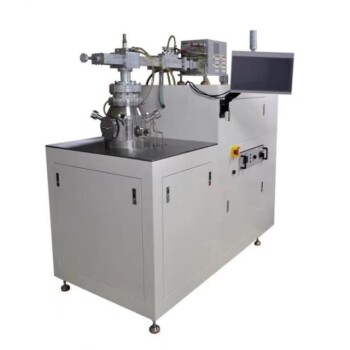
MPCVD machine stands for Microwave Plasma Chemical Vapor Deposition. It is a tool used for growing high-quality diamond films in laboratories by using a carbon-containing gas and a microwave plasma. The MPCVD system comprises a vacuum chamber, a microwave generator, and a gas delivery system. The microwave generator produces microwaves in the range of 2.45 GHz, while the gas delivery system controls the flow of gas into the vacuum chamber. The substrate temperature is controlled by the position of the plasma, and the temperature is monitored by a thermocouple. MPCVD is a promising technology for producing low-cost, high-quality large diamonds.
Toggle Categories
Get Instant Support
Choose your preferred way to connect with our team
-
Get Free Quote Fill out form for detailed pricing
-
Send Email Detailed inquiry support
-
WhatsApp Quick mobile chat
Response Time
Within 8 hours on working days, 24 hours on holidays
mpcvd machine






Laboratory Planetary Ball Mill Cabinet Planetary Ball Milling Machine
Item Number: KT-CPBM

915MHz MPCVD Diamond Machine Microwave Plasma Chemical Vapor Deposition System Reactor
Item Number: MP-CVD-101
method for producing high-quality diamonds. Our MPCVD equipment boasts a 3-inch substrate growing area, with a maximum batch load of up to 45 pieces of diamonds. With adjustable output microwave power, our MPCVD machine consumes less electricity, making it an efficient and eco-friendly option for diamond production. Plus, our experienced research team provides frontier diamond-growing recipe support, and our exclusive technical support program ensures that even teams with zero diamond growing experience can operate our MPCVD machines with ease.
Applications of MPCVD Machine
- Production of high-quality diamond films for large-size diamond substrates in the semiconductor industry.
- Production of diamond gemstones and films for use in the jewelry industry.
- Creation of superconducting diamond through the introduction of dopants like boron.
- Production of diamond with interesting photo-luminescence properties for use in quantum information systems by introducing nitrogen vacancies.
- Manufacturing of diamond cutting or drilling tools for the construction and mining industries.
- Creation of diamond coatings for use in medical implants and tools due to its biocompatibility and hardness.
- Production of diamond heat sinks for high-power electronic devices due to its high thermal conductivity.
- Manufacturing of diamond windows for use in high-pressure experiments due to its chemical inertness.
Advantages of MPCVD Machine
- Produces diamonds of higher purity compared to HPHT method
- Consumes less energy during production process
- Facilitates production of larger diamonds
- 1-10Kw adjustable output microwave power for less electricity consumption
- Rich experienced researching team with frontier diamond growing recipe support
- Exclusive technical support program for Zero diamond growing experience team
- Exceptional stability, reliability, repeatability, and cost-effectiveness
- Free from impurities during diamond growth process
- Ideal for applications in semiconductor, optics, and jewelry diamond market needs
- Suitable for producing low-cost, high-quality large diamonds
- Capable of growing monocrystal or poly-crystalline diamond films
- Used extensively in semiconductor industry for large-size diamond substrates and diamond cutting or drilling tools industry.
Our MPCVD machine provides a cost-effective solution which is advantageous in terms of price compared to other methods. Our product line offers standard solutions that fit your needs, and for more unique applications, our custom design service will help cater to your specific requirements. Our MPCVD equipment has been running steadily for over 40,000 hours, demonstrating exceptional stability, reliability, and repeatability. Our accumulated advanced technology has enabled us to implement multiple rounds of upgrades and improvements, resulting in significantly improved efficiency and reduced equipment costs. Welcome to consult with us.
FAQ
What Is Mpcvd?
MPCVD stands for Microwave Plasma Chemical Vapor Deposition and it is a process of depositing thin films onto a surface. It uses a vacuum chamber, microwave generator, and gas delivery system to create a plasma made up of reacting chemicals and necessary catalysts. MPCVD is heavily used in the ANFF network to deposit layers of diamond using methane and hydrogen to grow new diamond on a diamond-seeded substrate. It is a promising technology for producing low-cost, high-quality large diamonds and is extensively used in the semiconductor and diamond cutting industry.
What Is Mpcvd Machine?
The MPCVD (Microwave Plasma Chemical Vapor Deposition) machine is a laboratory equipment used to grow high-quality diamond films. It uses a carbon-containing gas and a microwave plasma to create a plasma ball above the diamond substrate, which heats it to a specific temperature. The plasma ball doesn't contact the cavity wall, making the diamond growth process free from impurities and enhancing the diamond's quality. The MPCVD system consists of a vacuum chamber, a microwave generator, and a gas delivery system that controls the flow of gas into the chamber.
What Are The Advantages Of Mpcvd?
MPCVD has several advantages over other methods of diamond production, such as higher purity, less energy consumption, and the ability to produce larger diamonds.
Are CVD Diamonds Real Or Fake?
CVD diamonds are real diamonds and not fake. They are grown in a laboratory through a process called Chemical Vapor Deposition (CVD). Unlike natural diamonds that are mined from under the earth's surface, CVD diamonds are created using advanced technology in labs. These diamonds are 100% carbon and are the purest form of diamonds known as Type IIa diamonds. They have the same optical, thermal, physical, and chemical properties as natural diamonds. The only difference is that CVD diamonds are created in a lab and not mined from the earth.
REQUEST A QUOTE
Our professional team will reply to you within one business day. Please feel free to contact us!
Related Articles

Pressure and Heat: Forging Certainty into Matter
A hot press doesn't just shape materials; it eliminates hidden flaws and forges atomic-level trust. Learn the physics of material integrity.
Read more
Why Your FTIR/XRF Results Are Inconsistent—And How to Fix It for Good
Stop blaming your spectrometer. Discover the hidden culprit behind inconsistent FTIR/XRF results and learn how to achieve perfect analytical data every time.
Read more
The Geometry of Pressure: Why Your Part's Shape Dictates Its Sintering Method
Explore the critical difference between uniaxial hot pressing and isostatic HIP. Learn how pressure geometry impacts density, performance, and cost.
Read more
Density Without Destruction: The Quiet Power of Hot Press Sintering
Hot press sintering uses simultaneous heat and pressure to achieve near-perfect material density while inhibiting the grain growth that weakens components.
Read more
The Quiet Force: Forging Superior Metal Components with Controlled Pressure
Discover how hot press forging uses slow, continuous pressure to refine a metal's grain structure, creating parts with unparalleled strength and reliability.
Read more
The Heart of the Void: Why Your Vacuum Furnace's Heating Element Defines Your Results
A guide to choosing between graphite, molybdenum, and CFC heating elements for vacuum furnaces, balancing purity, cost, and process speed.
Read more
When Failure is Not an Option: The Physics of Hot Press Forging
Hot press forging trades dimensional precision for superior strength, creating complex, failure-resistant metal parts for critical applications.
Read more
Beyond Brute Force: The Quiet Strength of Uniform Density
Discover why Cold Isostatic Pressing overcomes hidden material flaws by applying uniform pressure, a key for advanced ceramics and complex metals.
Read more
Why Your Lab Press Results are Warped, Bubbled, and Inconsistent—And How to Fix It for Good
Stop wasting materials. Learn why inconsistent heat and pressure ruin lab press results and how the right equipment ensures flawless bonding and molding.
Read more
Forging Perfection: The Hidden Battle Against Material Flaws with CIP and HIP
Explore the difference between Cold (CIP) and Hot (HIP) Isostatic Pressing, two critical processes for forming and perfecting materials.
Read more
The Fragile Edge of 1450°C: When Durable Tools Become Consumables
Operating a vacuum tube furnace at 1450°C transforms the work tube into a consumable. Explore the limits of size, speed, and material science.
Read more
The Pressure-Temperature Dialogue: Mastering Material Consolidation
Learn why hot pressing isn't about fixed values, but a precise dialogue between temperature, pressure, and your material's unique properties.
Read more
The Geometry of Control: Why Millimeters Dictate Experimental Destiny
In electrochemistry, the difference between success and failure often lies in aperture size. Explore the engineering logic behind Φ 6.2mm and Φ 3.2mm standards.
Read more
Engineered Certainty: Why Your Lab Bench Isn't Made of Solid Oak
Explore the engineering of hot pressed boards like MDF and HDF, and why their stability and consistency often trump solid wood in precision environments.
Read more
Why Your "Bargain" Hydraulic Press Is Costing You More Than You Think
A cheap hydraulic press seems like a good deal, but frame flex and lack of control lead to failure. Learn how to choose a press based on engineering, not just price.
Read more
The Alchemy of Force and Fire: How Hot Pressing Forges Tomorrow's Materials
Discover how the synergy of heat and pressure in hot pressing eliminates porosity to create ultra-dense, high-performance materials.
Read more
Beyond Sintering: How Vacuum Hot Pressing Forges Perfect Solids from Powder
Explore how vacuum hot pressing uses heat, pressure, and vacuum to transform powder into fully dense solids with superior properties.
Read more
Your Diamond Tester Might Be Lying: Why Moissanite Fools It and How to Get Accurate Results
Is your diamond tester giving false positives? Learn why common testers fail to spot moissanite and discover the dual-test method that ensures accuracy.
Read more
Why Your Molding & Curing Results Are Inconsistent—And How to Fix It
Frustrated with warped parts and failed molding? Discover the hidden reason your hydraulic press may be the problem and how the right tool ensures consistent results.
Read more
Beyond Glue: The Controlled Alchemy of Hot Press Lamination
Hot press lamination is not just adhesion; it's a controlled transformation using heat and pressure to forge structurally superior materials.
Read more