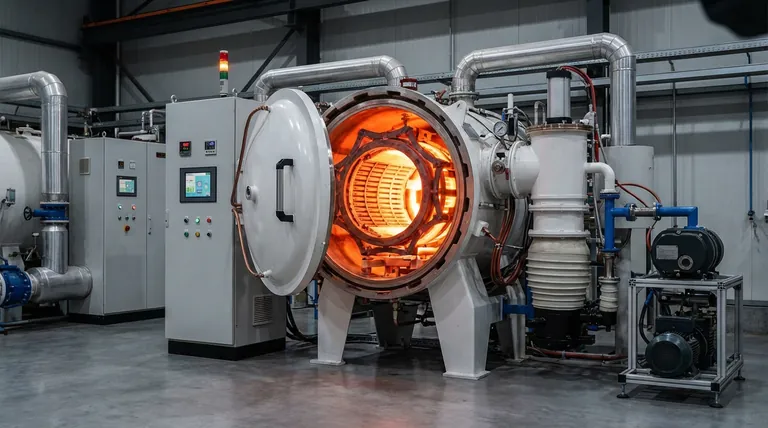
An aerospace engineer inspects a new batch of turbine blades. The heat treatment cycle was flawless, the vacuum deep. Yet, metallurgical analysis reveals microscopic embrittlement in the titanium alloy. The entire batch, worth a fortune, is now scrap.
The failure wasn't in the temperature curve or the vacuum level. It was caused by the furnace's own heart—the heating element—which had silently altered the chemistry of the "void" itself.
The Choice: A Universe of Carbon or Metal
Selecting a heating element for a vacuum furnace is not a simple component choice. It's a foundational decision about the environment you are creating. You are choosing between a universe rich in carbon and one forged purely from refractory metal.
This decision dictates the chemical reality of your process. It's the difference between success and a costly failure.
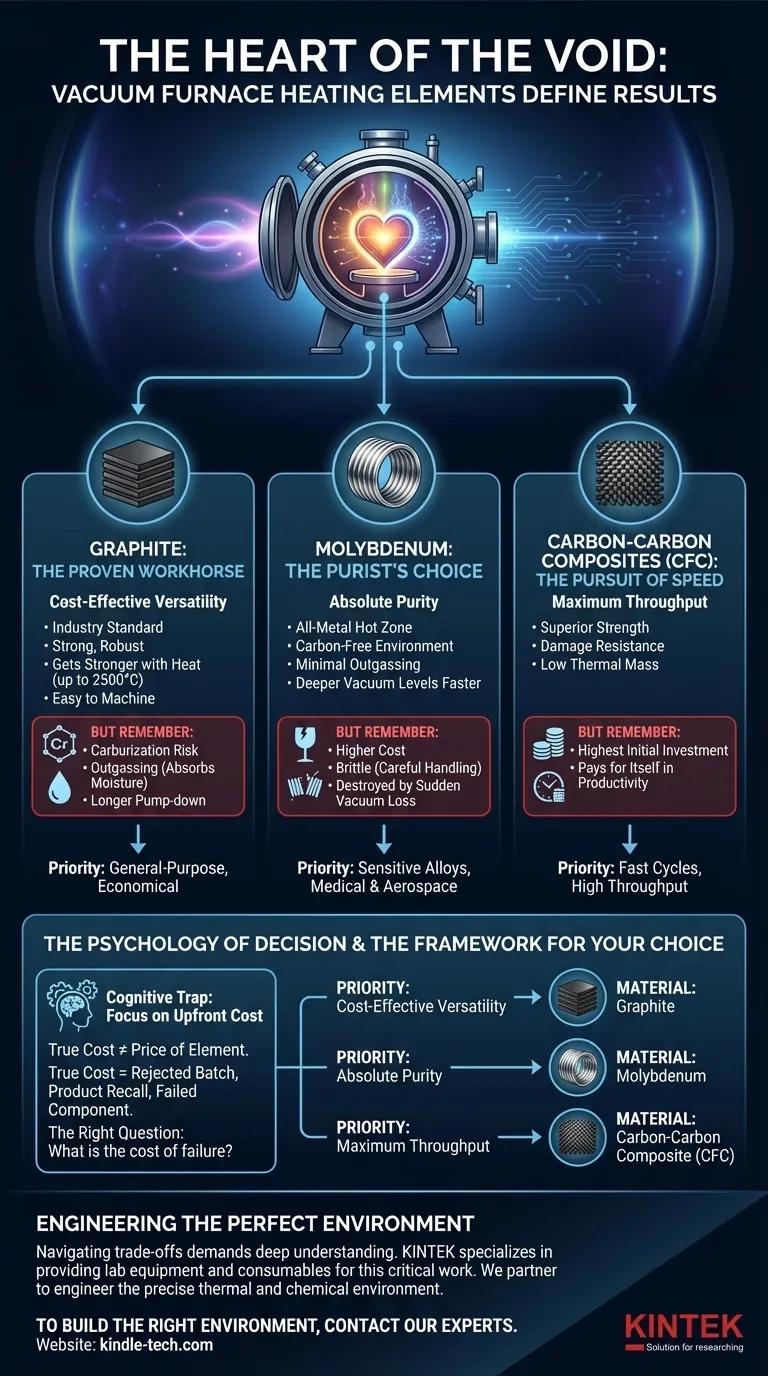
Graphite: The Proven Workhorse
Graphite is the industry standard for a reason. It's robust, easy to machine, and uniquely gets stronger as it gets hotter (up to about 2500°C). For general-purpose heat treating, it is the most cost-effective and reliable option.
But graphite is carbon. It can introduce trace amounts of carbon into the furnace atmosphere—a process called carburization. For most steels, this is negligible. For materials like titanium or certain medical alloys, it is a deal-breaker.
Its porous nature also means it absorbs moisture from the air when the door is open. During pump-down, this moisture "outgasses," forcing your vacuum pumps to work harder and longer to achieve the required vacuum level.
Molybdenum: The Purist’s Choice
When purity is non-negotiable, an all-metal hot zone is the only answer. Here, molybdenum is the dominant material for heating elements.
Molybdenum creates an exceptionally clean, carbon-free environment. This is essential for processing the most sensitive materials in the medical and aerospace fields. It allows you to achieve deeper vacuum levels faster because its non-porous surface results in minimal outgassing.
But this purity demands a price. Molybdenum is more expensive and becomes brittle after repeated heat cycles, requiring careful handling. A sudden loss of vacuum at high temperature will instantly destroy it. It is precise, but unforgiving.
Carbon-Carbon Composites (CFC): The Pursuit of Speed
The most advanced option is Carbon-Carbon Composite (CFC). By reinforcing a graphite matrix with carbon fibers, CFC offers superior strength and damage resistance.
Its key advantage, however, is its incredibly low thermal mass. It doesn't store much heat.
This means it heats up and—more importantly—cools down dramatically faster than graphite or metal. For high-throughput operations, this is a revolutionary feature. Shorter cycle times mean more batches per day. The initial cost is higher, but the investment pays for itself in productivity.
The Psychology of a Technical Decision
It's human nature to focus on upfront cost. Graphite is the cheapest. Molybdenum is expensive. CFC is a significant investment. This creates a cognitive trap, biasing us toward the most immediate and obvious number.
But the true cost isn't the price of the element. The true cost is a rejected batch, a product recall, or a failed component.
The most expensive piece of equipment in any lab is the one that doesn't produce the right result. The right question is not "What is the cheapest option?" but "What is the cost of failure?"
A Framework for Your Choice
Your primary goal should dictate your material. There is no single "best" material, only the one that is fit for purpose.
| If Your Priority Is... | Your Material Is... | Because... | But Remember... |
|---|---|---|---|
| Cost-Effective Versatility | Graphite | It's the industry standard—strong, robust, and economical for most tasks. | You must accept a carbon-rich atmosphere and longer pump-down times. |
| Absolute Purity | Molybdenum | It creates a completely carbon-free environment for sensitive alloys. | It carries a higher price and requires careful handling to avoid breakage. |
| Maximum Throughput | Carbon-Carbon Composite (CFC) | Its low thermal mass allows for the fastest heating and cooling cycles. | This performance comes with the highest initial investment. |
Engineering the Perfect Environment
Navigating these trade-offs is where engineering becomes an art. It demands a deep understanding of materials science, process goals, and operational economics.
At KINTEK, we specialize in providing the lab equipment and consumables that form the foundation of this critical work. We don't just sell furnaces; we partner with you to engineer the precise thermal and chemical environment your research demands. Whether you need the workhorse reliability of graphite, the uncompromising purity of molybdenum, or the sheer speed of CFC, our focus is on ensuring the heart of your furnace is perfectly matched to your ambition.
To build the right environment for your most critical processes, Contact Our Experts
Visual Guide
Related Products
- Vacuum Hot Press Furnace Heated Vacuum Press Machine Tube Furnace
- 600T Vacuum Induction Hot Press Furnace for Heat Treat and Sintering
- Vacuum Hot Press Furnace Machine Heated Vacuum Press
- Vacuum Heat Treat Furnace and Levitation Induction Melting Furnace
- 2200 ℃ Tungsten Vacuum Heat Treat and Sintering Furnace
Related Articles
- The Purity Paradox: Choosing the Heart of Your Vacuum Hot Press Furnace
- Comprehensive Guide to Vacuum Hot Press Furnace Application
- Vacuum Hot Press Furnace: A Comprehensive Guide
- Forging Perfection in a Void: The Physics of Ultra-Dense Materials
- Defeating the Void: The Quiet Power of Vacuum Hot Pressing



















