Blog The Quiet Force: Forging Superior Metal Components with Controlled Pressure
The Quiet Force: Forging Superior Metal Components with Controlled Pressure

The Quiet Force: Forging Superior Metal Components with Controlled Pressure

1 week ago

The Hidden Weakness in Strong Metal

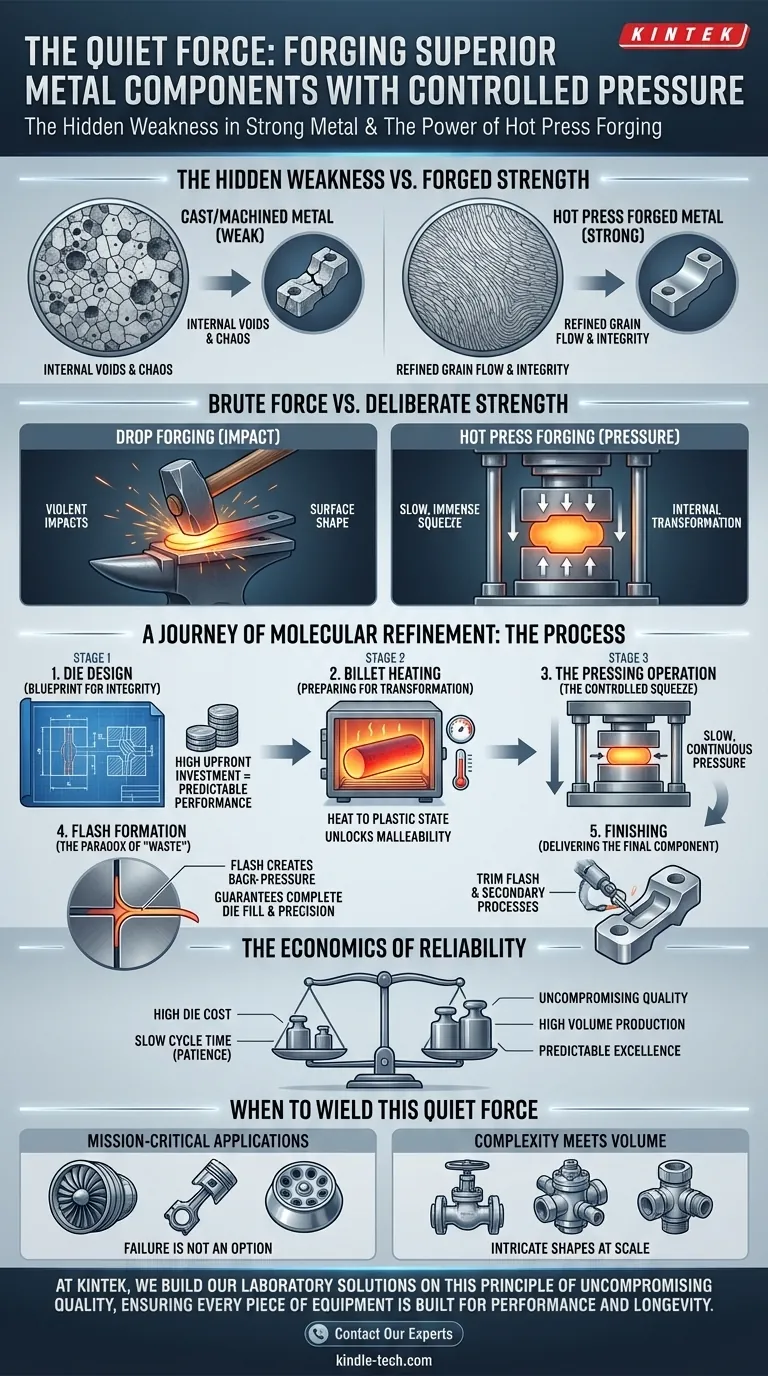
Imagine a critical component inside a high-speed laboratory centrifuge or a structural fitting on an industrial press. To the naked eye, it appears solid, a monolith of strength. Yet, its true vulnerability lies hidden deep within its crystalline structure—a microscopic landscape of grain boundaries and potential voids.

Catastrophic failure often begins at this invisible level. This is why the method used to shape a piece of metal is as important as the metal itself. It’s not about just creating a shape; it's about instilling integrity from the inside out.

Brute Force vs. Deliberate Strength

When we think of forging, we often picture the violent, percussive blows of a hammer. That's one way, known as drop forging. But there is a quieter, more methodical approach: hot press forging.

Instead of a series of impacts, hot press forging applies a single, continuous, and immense pressure. It’s the difference between punching dough and slowly kneading it. One creates a surface shape, but the other transforms the internal structure entirely. This slow application of force is the key to forging superior mechanical properties.

A Journey of Molecular Refinement

The journey from a raw metal billet to a high-fatigue component is a masterclass in controlled metallurgy. Each step is deliberate, designed to organize the metal’s internal chaos into a uniform, resilient structure.

H3: The Blueprint for Integrity: Tool & Die Design

The process begins not with heat or pressure, but with engineering. The dies—hardened steel molds—are meticulously designed. They are the blueprint for the part's final form and, more importantly, for its internal grain flow.

The significant upfront cost of these dies isn't just for a mold; it's an investment in the part's final, predictable performance.

H3: Preparing for Transformation: Billet Heating

Next, a billet of raw metal is heated in a furnace. The goal isn't to melt it, but to bring it to a precise temperature where it becomes plastic and malleable.

This is the moment the metal's rigid crystalline lattice unlocks, making it receptive to change without cracking or weakening. It’s prepared for its transformation.

H3: The Controlled Squeeze: The Pressing Operation

The heated billet is placed in the lower die. A hydraulic or mechanical press then drives the upper die down with a slow, powerful, continuous squeeze.

This pressure penetrates deep into the core of the metal, forcing the grains to reorient and refine themselves along the contours of the die. Voids are compressed and eliminated. The result is a dense, uniform grain structure that gives the part its exceptional fatigue resistance and tensile strength.

H3: The Paradox of "Waste": The Role of Flash

As the dies close, a small amount of excess material squeezes out into a thin ribbon around the part. This is called "flash."

Far from being a defect, flash is a crucial, planned feature. As this thin ribbon cools and resists flow, it creates back-pressure inside the die cavity. This pressure ensures the metal completely fills every intricate detail of the mold, creating a near-net-shape part with incredible precision. What appears to be waste is actually a guarantee of quality.

The Economics of Reliability

Choosing hot press forging is a strategic decision, driven by a clear understanding of its trade-offs.

  • The High Cost of Certainty: The robust, heat-resistant dies are expensive. This makes the process best suited for medium-to-high volume production runs where the cost can be amortized over thousands of reliable parts. It's the price paid for predictable excellence.
  • Patience as an Engineering Virtue: The slow cycle time is a direct trade-off for quality. Speed is sacrificed to ensure the pressure has time to work its magic deep within the material, a compromise that is non-negotiable for critical applications.
Key Stage Primary Action Core Outcome
Die Design Engineer high-strength tooling Defines part geometry and internal integrity
Billet Heating Heat metal to a plastic state Unlocks the material's malleability
Pressing Apply slow, continuous pressure Refines and aligns the grain structure
Flash Formation Manage excess material flow Ensures complete die fill and sharp detail
Finishing Trim flash and perform secondary processes Delivers the final, precise component

When to Wield This Quiet Force

Ultimately, the decision to use hot press forging is a psychological one, rooted in how much risk you are willing to accept.

  • Choose it when failure is not an option. For mission-critical parts in aerospace, automotive, or high-performance lab equipment, the refined grain structure provides a safety margin that other processes cannot.
  • Choose it when complexity must meet volume. For intricate shapes that need to be produced reliably and consistently at scale, the process justifies its initial investment.

In a laboratory, the integrity of every part—from a centrifuge rotor to a valve in a high-pressure system—is paramount. The equipment is only as reliable as its weakest component. Understanding the deep metallurgical discipline behind a process like hot press forging is what separates dependable tools from potential liabilities.

At KINTEK, we build our laboratory solutions on this very principle of uncompromising quality, ensuring every piece of equipment is built for performance and longevity. Contact Our Experts

Visual Guide
The Quiet Force: Forging Superior Metal Components with Controlled Pressure Visual Guide

Related Products

Related Articles

Related Products

Touchscreen Automatic Vacuum Heat Press

Touchscreen Automatic Vacuum Heat Press

Precision vacuum heat press for labs: 800°C, 5-ton pressure, 0.1MPa vacuum. Ideal for composites, solar cells, aerospace.

Manual High Temperature Heated Hydraulic Press Machine with Heated Plates for Lab

Manual High Temperature Heated Hydraulic Press Machine with Heated Plates for Lab

The High Temperature Hot Press is a machine specifically designed for pressing, sintering and processing materials in a high temperature environment. It is capable of operating in the range of hundreds of degrees Celsius to thousands of degrees Celsius for a variety of high temperature process requirements.

Vacuum Hot Press Furnace Machine for Lamination and Heating

Vacuum Hot Press Furnace Machine for Lamination and Heating

Experience clean and precise lamination with Vacuum Lamination Press. Perfect for wafer bonding, thin-film transformations, and LCP lamination. Order now!

Automatic Heated Hydraulic Press Machine with Heated Plates for Laboratory Hot Press 25T 30T 50T

Automatic Heated Hydraulic Press Machine with Heated Plates for Laboratory Hot Press 25T 30T 50T

Efficiently prepare your samples with our Automatic Heated Lab Press. With a pressure range up to 50T and precise control, it's perfect for various industries.

Double Plate Heating Press Mold for Lab

Double Plate Heating Press Mold for Lab

Discover precision in heating with our Double Plate Heating Mold, featuring high-quality steel and uniform temperature control for efficient lab processes. Ideal for various thermal applications.

Warm Isostatic Press WIP Workstation 300Mpa for High Pressure Applications

Warm Isostatic Press WIP Workstation 300Mpa for High Pressure Applications

Discover Warm Isostatic Pressing (WIP) - A cutting-edge technology that enables uniform pressure to shape and press powdered products at a precise temperature. Ideal for complex parts and components in manufacturing.

1700℃ Laboratory High Temperature Tube Furnace with Alumina Tube

1700℃ Laboratory High Temperature Tube Furnace with Alumina Tube

Looking for a high-temperature tube furnace? Check out our 1700℃ Tube Furnace with Alumina Tube. Perfect for research and industrial applications up to 1700C.

Single Punch Electric Tablet Press Machine TDP Tablet Punching Machine

Single Punch Electric Tablet Press Machine TDP Tablet Punching Machine

The electric tablet punching machine is a laboratory equipment designed for pressing various granular and powdery raw materials into discs and other geometric shapes. It is commonly used in pharmaceutical, healthcare products, food, and other industries for small batch production and processing. The machine is compact, lightweight, and easy to operate, making it suitable for use in clinics, schools, laboratories, and research units.

Single Punch Electric Tablet Press Machine Laboratory Powder Tablet Punching TDP Tablet Press

Single Punch Electric Tablet Press Machine Laboratory Powder Tablet Punching TDP Tablet Press

The single-punch electric tablet press is a laboratory-scale tablet press suitable for corporate laboratories in pharmaceutical, chemical, food, metallurgical and other industries.

Single Punch Tablet Press Machine and Mass Production Rotary Tablet Punching Machine for TDP

Single Punch Tablet Press Machine and Mass Production Rotary Tablet Punching Machine for TDP

Rotary tablet punching machine is an automatic rotating and continuous tableting machine. It is mainly used for tablet manufacturing in the pharmaceutical industry, and is also suitable for industrial sectors such as food, chemicals, batteries, electronics, ceramics, etc. to compress granular raw materials into tablets.

Metallographic Specimen Mounting Machine for Laboratory Materials and Analysis

Metallographic Specimen Mounting Machine for Laboratory Materials and Analysis

Precision metallographic mounting machines for labs—automated, versatile, and efficient. Ideal for sample prep in research and quality control. Contact KINTEK today!

Single Punch Manual Tablet Press Machine TDP Tablet Punching Machine

Single Punch Manual Tablet Press Machine TDP Tablet Punching Machine

Single punch manual tablet punching machine can press various granular, crystal or powdery raw materials with good fluidity into disc-shaped, cylindrical, spherical, convex, concave and other various geometric shapes (such as square, triangle, ellipse, capsule shape, etc.), and can also press products with text and patterns.

Laboratory Sterilizer Lab Autoclave Herbal Powder Sterilization Machine for Plant

Laboratory Sterilizer Lab Autoclave Herbal Powder Sterilization Machine for Plant

The herbal powder sterilization autoclave machine for Chinese medicine uses saturated steam for effective sterilization. It utilizes the heat and penetrative properties of steam, achieves sterilization after heat preservation, and maintains a good drying effect with a dedicated drying system.

Inclined Rotary Plasma Enhanced Chemical Vapor Deposition PECVD Equipment Tube Furnace Machine

Inclined Rotary Plasma Enhanced Chemical Vapor Deposition PECVD Equipment Tube Furnace Machine

Introducing our inclined rotary PECVD furnace for precise thin film deposition. Enjoy automatic matching source, PID programmable temperature control, and high accuracy MFC mass flowmeter control. Built-in safety features for peace of mind.

Laboratory Vibratory Sieve Shaker Machine for Dry and Wet Three-Dimensional Sieving

Laboratory Vibratory Sieve Shaker Machine for Dry and Wet Three-Dimensional Sieving

KT-VD200 can be used for sieving tasks of dry and wet samples in the laboratory. The screening quality is 20g-3kg. The product is designed with a unique mechanical structure and an electromagnetic vibrating body with a vibration frequency of 3000 times per minute.

Desktop Fast Laboratory Autoclave Sterilizer 35L 50L 90L for Lab Use

Desktop Fast Laboratory Autoclave Sterilizer 35L 50L 90L for Lab Use

The desktop fast steam sterilizer is a compact and reliable device used for rapid sterilization of medical, pharmaceutical, and research items. It efficiently sterilizes surgical instruments, glassware, medicines, and resistant materials, making it suitable for various applications.

Ultra-Vacuum Electrode Feedthrough Connector Flange Power Electrode Lead for High-Precision Applications

Ultra-Vacuum Electrode Feedthrough Connector Flange Power Electrode Lead for High-Precision Applications

Discover the Ultra-Vacuum Electrode Feedthrough Connector Flange, perfect for high-precision applications. Ensure reliable connections in ultra-vacuum environments with advanced sealing and conductive technology.

Lab Plastic PVC Calender Stretch Film Casting Machine for Film Testing

Lab Plastic PVC Calender Stretch Film Casting Machine for Film Testing

The cast film machine is designed for the molding of polymer cast film products and has multiple processing functions such as casting, extrusion, stretching, and compounding.

Small Injection Molding Machine for Lab Use

Small Injection Molding Machine for Lab Use

The small injection molding machinehas fast and stable movements; good controllability and repeatability, super energy saving; the product can be automatically dropped and formed; the machine body is low, convenient for feeding, easy to maintain, and no height restrictions on the installation site.

High Energy Planetary Ball Mill Machine for Laboratory Horizontal Tank Type

High Energy Planetary Ball Mill Machine for Laboratory Horizontal Tank Type

The KT-P2000H uses a unique Y-axis planetary trajectory, and utilizes the collision, friction and gravity between the sample and the grinding ball.


Leave Your Message