The Wrong First Question
Engineers and researchers often start by asking, "What's the right temperature and pressure for hot pressing?"
This feels like a logical first step, but it's fundamentally the wrong question. It’s like asking a chef for "the" cooking time without mentioning if you're preparing a delicate fish or a tough cut of meat.
The true art and science of hot pressing lies not in knowing a universal number, but in understanding the delicate dialogue between heat, force, and the unique personality of your material. It's a process of persuasion, not command.
The Physics of Persuasion
Hot pressing consolidates powders into a dense, solid form. To achieve this, we need to convince individual particles to abandon their boundaries and fuse into a monolithic structure. This requires a careful application of two key forces.
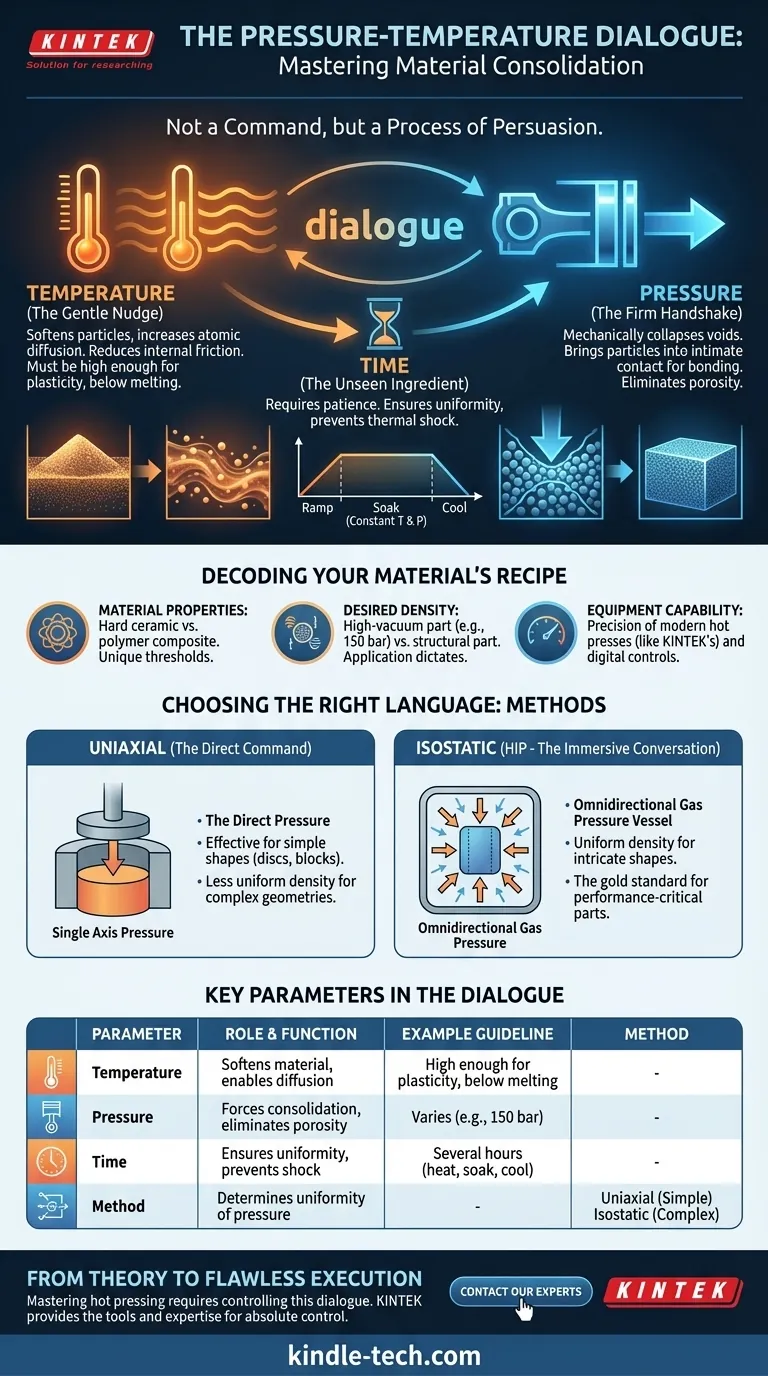
Temperature: The Gentle Nudge
Heat is the element that makes a material receptive to change. Its primary role is to soften the particles, increasing atomic diffusion and lowering their resistance to deformation.
Think of it as reducing the material's internal friction. The temperature must be high enough to make the material pliable but must remain safely below its melting or decomposition point. Exceed this threshold, and you destroy the very thing you're trying to create.
Pressure: The Firm Handshake
If temperature opens the door, pressure walks the particles through it. It’s the driving force for consolidation, mechanically collapsing the voids and pores between particles.
This force brings the softened particles into intimate contact, allowing strong atomic bonds to form where empty space once existed. The goal is a final part with high density and structural integrity, free from the internal weaknesses caused by porosity.
Time: The Unseen Ingredient
This process is never instantaneous. A successful cycle requires patience, often lasting several hours. This includes a gradual heating ramp, a "soaking" period where temperature and pressure are held constant, and a controlled cooling phase.
Rushing this process is a recipe for disaster. It can induce thermal shock, create internal stresses, and result in a cracked or weakened final product. Time ensures the persuasion is uniform and complete.
Decoding Your Material's Recipe
The ideal parameters are a function of your specific goals and your material's character.
- Material Properties: A hard ceramic powder requires a vastly different approach than a polymer composite. Each has a unique thermal and mechanical threshold that defines the operating window.
- Desired Density: The end-use application dictates the required level of consolidation. A component for a high-vacuum system requires near-perfect density (e.g., 150 bar for an inorganic composite), while a structural part might tolerate slightly more porosity.
- Equipment Capability: The precision of your equipment sets the boundaries of what's possible. Modern hot presses from specialists like KINTEK use advanced heating elements and digital controls to ensure the instructions you give the machine are the ones the material actually receives.
Choosing the Right Language: Uniaxial vs. Isostatic
The way you apply pressure changes the nature of the conversation with your material.
Uniaxial: The Direct Command
Conventional hot pressing is uniaxial. Pressure is applied along a single axis, like a piston in a cylinder. This is highly effective for simple shapes like discs, blocks, or cylinders. However, for complex geometries, it can result in less uniform density.
Hot Isostatic Pressing (HIP): The Immersive Conversation
Hot Isostatic Pressing (HIP) is a more sophisticated technique. The part is heated in a vessel and subjected to high-pressure inert gas from all directions simultaneously. This isostatic pressure ensures every surface, corner, and internal feature experiences the exact same force.
The result is exceptionally uniform density, even in the most intricate shapes—the gold standard for performance-critical components.
Summary: Key Parameters in the Dialogue
| Parameter | Role & Function | Example Guideline |
|---|---|---|
| Temperature | Softens material, enables atomic diffusion | High enough for plasticity, below melting point |
| Pressure | Forces consolidation, eliminates porosity | Varies by material & density goal (e.g., 150 bar) |
| Time | Ensures uniformity, prevents thermal shock | Several hours, including heating, soak, & cool |
| Method | Determines uniformity of pressure application | Uniaxial for simple shapes, Isostatic (HIP) for complex |
From Theory to Flawless Execution
Mastering hot pressing is about controlling the dialogue between your equipment and your material to achieve a specific outcome. The process is a balancing act, and the right laboratory equipment provides the control and precision necessary to succeed. At KINTEK, we provide the tools that enable this critical conversation.
Whether you are developing advanced composites, ceramics, or alloys, achieving the perfect density and microstructure starts with a deep understanding of the process and equipment that gives you absolute control over it. Let's translate your material goals into a successful process. Contact Our Experts
Visual Guide
Related Products
- Automatic Heated Hydraulic Press Machine with Heated Plates for Laboratory Hot Press 25T 30T 50T
- Manual High Temperature Heated Hydraulic Press Machine with Heated Plates for Lab
- Touchscreen Automatic Vacuum Heat Press
- Vacuum Hot Press Furnace Machine Heated Vacuum Press
- 30T 40T Split Automatic Heated Hydraulic Press Machine with Heated Plates for Laboratory Hot Press
Related Articles
- Why Your Composite and Polymer Parts Keep Failing: The Secret Is Simultaneous Heat and Pressure
- The Physics of Flawless Materials: Deconstructing the Hydraulic Hot Press
- Precision Under Pressure: The Physics and Psychology of the Hydraulic Hot Press
- Hydraulic Hot Press: Principles, Components, Features, Advantages, and Applications
- Comprehensive Guide to Hydraulic Hot Press: Function, Features and Applications