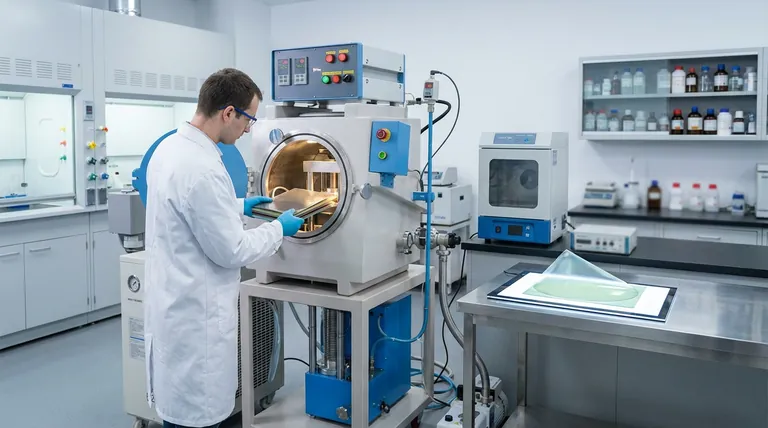
It’s a familiar story in many labs. You’ve spent hours, maybe even days, meticulously preparing a multi-layer composite or a delicate polymer sample. You place it in the hydraulic hot press, dial in the settings you think are right, and wait. But when you open the press, that familiar sinking feeling hits you: the sample is warped, riddled with tiny bubbles, or the layers are delaminating at the edges. Another sample, and another day’s work, is destined for the scrap bin.
The Vicious Cycle of Guesswork and Wasted Resources
If this sounds like your lab, you are not alone. This struggle is one of the most common and costly sources of frustration in materials R&D and quality control.
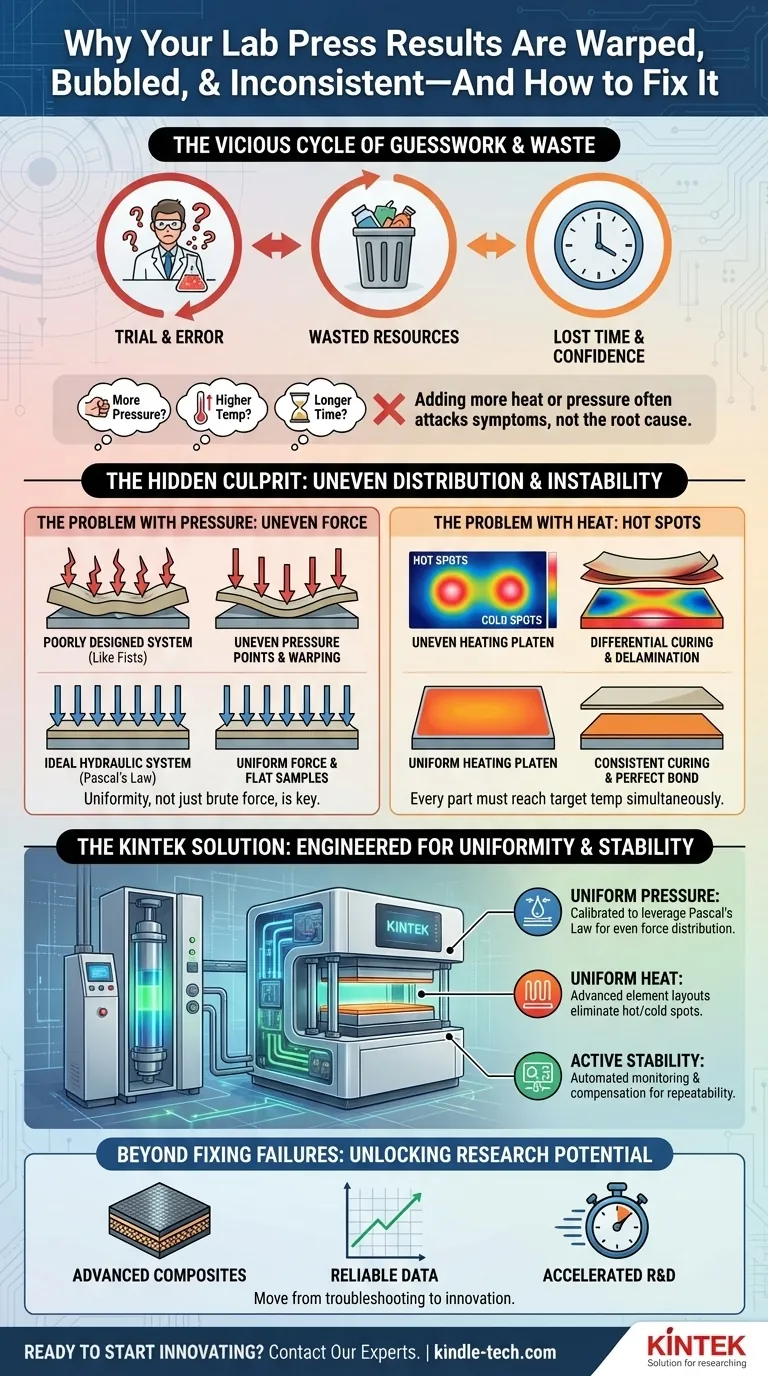
Faced with these failures, the typical response is a frustrating cycle of trial and error:
- "Maybe we need more pressure? Let's crank it up."
- "Perhaps it wasn't hot enough? Let's increase the temperature by 10 degrees."
- "Let's try holding it in the press for longer."
Each attempt is a shot in the dark, and the results remain stubbornly inconsistent. One sample might seem okay, but the next five fail. This isn't just a technical headache; it's a significant drain on your operation. The direct costs of wasted high-value materials, lost man-hours, and delayed project timelines quickly add up. More importantly, it erodes confidence in your R&D process. How can you develop the next generation of materials if you can't even trust your basic fabrication and testing results?
The Hidden Culprit: Why More Heat and Pressure Often Make Things Worse
The frustrating truth is that these attempts often fail because they misdiagnose the problem entirely. The root cause of inconsistent results is rarely the amount of heat or pressure, but rather the uneven distribution and instability of those forces.
The Problem with Pressure: It's About Uniformity, Not Just Brute Force
The "hydraulic" part of a hot press operates on a simple principle of physics called Pascal's Law. In an ideal system, this law guarantees that pressure applied to the hydraulic fluid is transmitted perfectly and equally in all directions.
Imagine trying to flatten a piece of dough with your fists. You would create high-pressure spots directly under your knuckles and low-pressure areas in between, resulting in an uneven sheet. A perfect hydraulic system, however, acts like a giant, flawless rolling pin, applying the exact same force to every square millimeter of your sample simultaneously.
Many presses, however, fail to deliver this ideal. If the system is poorly designed or maintained, the force applied by the platen can be uneven. Simply "adding more pressure" in this scenario is like pressing harder with your fists—it only exaggerates the unevenness, creating internal stress that leads directly to warping and defects.
The Problem with Heat: Why "Hot Spots" Ruin Everything
The same principle applies to heat. The "hot press" works by using thermal energy to make materials pliable or to activate adhesives. But if your oven at home has hot spots, your food cooks unevenly. Your lab press is no different.
For a perfect bond or mold, every part of your sample needs to reach the target temperature at the same time. If the heating platen has "hot spots" and "cold spots"—even with just a few degrees of variance—one part of your material will cure faster than another. This differential curing creates internal tension, causing delamination and warping as the sample cools.
This is why the common "solutions" fail: they are attacking the symptoms, not the underlying disease of non-uniformity.
The Right Tool for the Job: Engineering for Uniformity
To truly solve this problem once and for all, you don't need a machine that just gets hotter or presses harder. You need a system that has been meticulously engineered to deliver absolute uniformity and stability from the start.
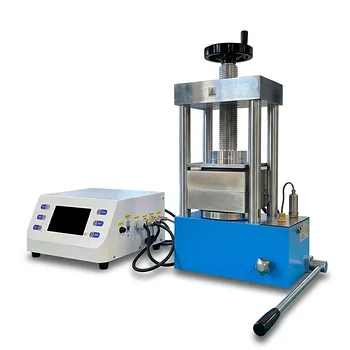
This is the exact design philosophy behind KINTEK's laboratory hydraulic hot presses. Our machines are not just an assembly of parts; they are integrated systems built from the ground up to master the physics of pressing.
- To solve the pressure problem: Our hydraulic power units are designed and calibrated to fully leverage Pascal's Law. This ensures that the force generated is distributed with exceptional uniformity across the entire platen surface, eliminating the uneven pressure points that cause warping and internal stress.
- To solve the heat problem: KINTEK platens feature advanced heating element layouts and control logic to guarantee outstanding temperature uniformity. We eliminate the "hot spots" and "cold spots" that lead to inconsistent curing and flawed samples.
- To solve the stability problem: Our automated control systems do more than just hit a target. They constantly monitor and maintain both pressure and temperature throughout the entire cycle, automatically compensating for any fluctuations. This guarantees that every single run is identical, delivering the repeatability your research demands.
Beyond Fixing Failures: Unlocking New Research Potential
When you no longer have to worry about the fundamental reliability of your press, you move beyond simply avoiding failure. You unlock the potential for genuine innovation.
With the confidence that every press cycle is uniform and repeatable, you can:
- Develop advanced composites with ultra-thin layers, knowing they will bond perfectly without voids.
- Test novel thermosetting adhesives with the certainty that your data reflects the material's properties, not the press's flaws.
- Accelerate material qualification from weeks of guesswork to days of efficient, predictable work.
- Create complex molded parts with fine details, trusting the press to deliver perfect replication every time.
Perfecting a single sample is one thing; building a reliable, repeatable process that accelerates your R&D is another. The right equipment moves you from fighting daily frustrations to confidently exploring new frontiers in material science. If you're ready to stop troubleshooting and start innovating, our team can help you identify the precise system your projects demand. Contact Our Experts to discuss your unique challenges and goals.
Visual Guide
Related Products
- Hydraulic Diaphragm Lab Filter Press for Laboratory Filtration
- Laboratory Hydraulic Press Split Electric Lab Pellet Press
- Laboratory Hydraulic Press Lab Pellet Press Machine for Glove Box
- Automatic Laboratory Hydraulic Pellet Press Machine for Lab Use
- Laboratory Manual Hydraulic Pellet Press for Lab Use