The Engineer's Dilemma: A Flaw You Cannot See
Imagine designing a turbine blade for a next-generation jet engine. Its shape is a complex, organic curve, optimized by countless hours of fluid dynamics simulation. The stresses it will endure are immense, cycling from extreme heat to cryogenic cold, all while spinning at thousands of RPM.
In this world, failure is not an option. A single, microscopic void hidden deep within the metal—a flaw you cannot see—can become the starting point for a catastrophic fracture. Your job isn’t just to manufacture a part; it's to forge perfection. It's to eliminate every shadow of a doubt.
This pursuit of material integrity brings us to a fundamental choice between two powerful technologies: Hot Pressing and Hot Isostatic Pressing (HIP). The decision is not merely technical; it's a strategic choice about risk, purpose, and the very geometry of the forces we use to create.
The Unyielding Piston vs. The Perfect Embrace
At its heart, the difference between these two methods is a story of how pressure is applied. One is a direct, linear force. The other is a uniform, all-encompassing embrace. This single distinction dictates everything that follows—from the shapes you can create to the trust you can place in them.
Hot Pressing: The Power of Uniaxial Force
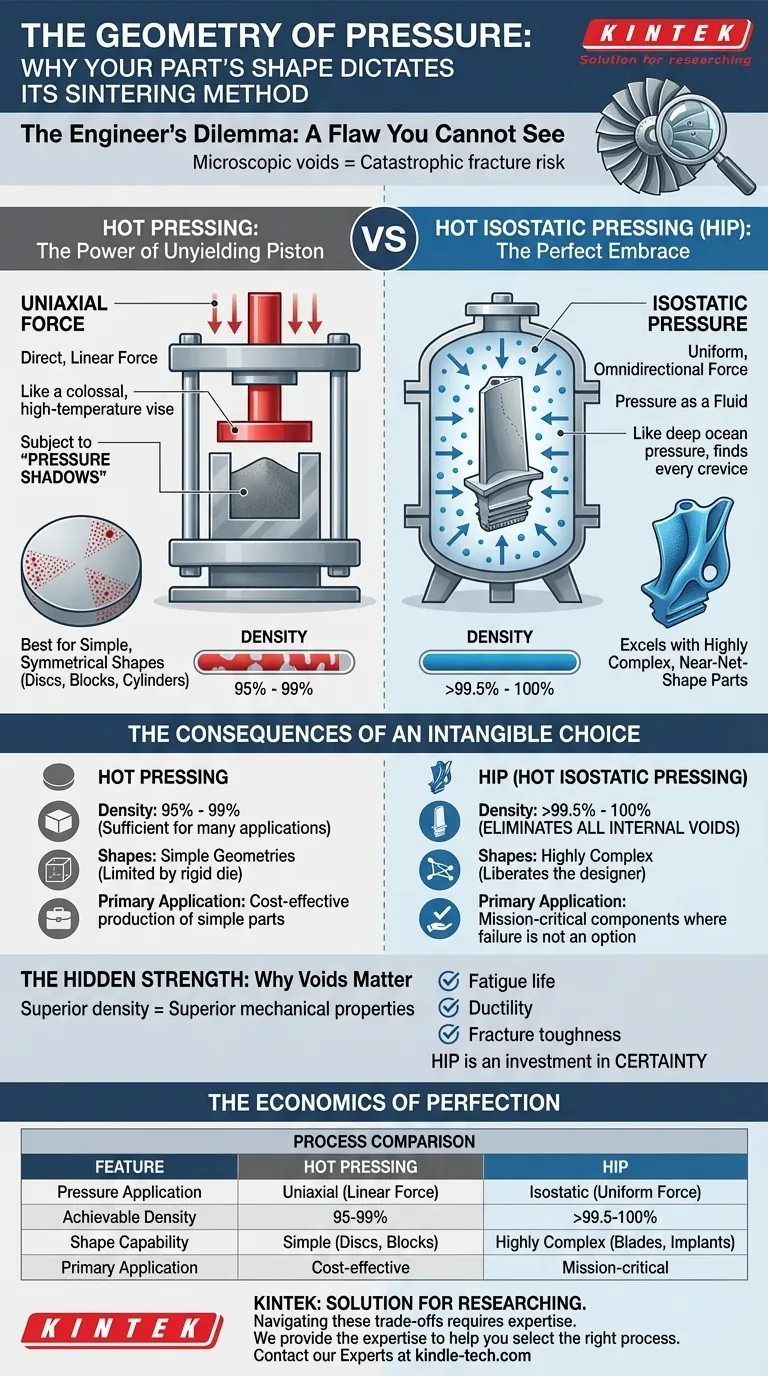
Hot pressing is beautifully straightforward. Powder is placed in a die, heated, and compressed by a punch along a single axis. It’s like a colossal, high-temperature vise.
This method is powerful, fast, and economical. It excels at consolidating materials into simple, symmetrical shapes—discs, blocks, and cylinders.
But its strength is also its limitation. Because the force is uniaxial, it can create "pressure shadows." Areas not directly in line with the force may not consolidate as completely, leaving residual porosity. It's a tool that thinks in straight lines.
Hot Isostatic Pressing: Pressure as a Fluid
HIP operates on a principle of elegant sophistication. The component is placed in a high-pressure vessel, which is then heated and filled with an inert gas like argon.
This gas acts like a fluid, pressing on the part with perfectly uniform, isostatic pressure from every direction at once. Think of the immense, crushing pressure at the bottom of the ocean—it finds every surface and every crevice equally.
This omnidirectional force is HIP’s magic. It collapses internal voids and pores without distorting the part’s geometry, no matter how complex. It is the perfect, flawless embrace.
The Consequences of an Intangible Choice
The philosophical difference in pressure application leads to starkly different real-world outcomes. Your material requirements will point you clearly to one path.
The Last 1%: A Story of Density
- Hot Pressing consistently achieves high relative densities, typically between 95% and 99%. For many applications, this is more than sufficient.
- Hot Isostatic Pressing reliably achieves >99.5% to 100% theoretical density. It effectively eliminates all internal voids.
That last percentage point is not a trivial detail. It’s the difference between "very good" and "flawless." It’s where the risk of internal-flaw-induced failure lives. For a sputtering target, 98% density might be fine. For an orthopedic implant, that remaining 2% porosity is an unacceptable risk.
From Bricks to Blades: The Dictatorship of Geometry
The method you choose dictates the shapes you can create.
- Hot Pressing is limited to simple geometries that can be easily ejected from a rigid die.
- HIP excels with highly complex, near-net-shape parts. Because the gas pressure conforms perfectly to any surface, it can densify intricate designs that are impossible to press uniaxially. It liberates the designer from the constraints of the press.
The Hidden Strength: Why Voids Matter
Superior density directly translates to superior mechanical properties. By eliminating the microscopic voids that act as stress concentrators, HIP dramatically improves a material's:
- Fatigue life
- Ductility
- Fracture toughness
Choosing HIP is an investment in certainty. You are paying a premium to remove doubt about the material’s internal integrity.
The Economics of Perfection
Perfection is rarely cheap. The final decision often comes down to a pragmatic balance of performance, complexity, and cost.
Hot pressing is generally faster and more cost-effective for high-volume production of simple shapes. The equipment and tooling are less complex. HIP, by contrast, is a more expensive, batch-based process with longer cycle times, but it delivers a level of quality that is unattainable otherwise.
| Feature | Hot Pressing | Hot Isostatic Pressing (HIP) |
|---|---|---|
| Pressure Application | Uniaxial (Force from one direction) | Isostatic (Uniform pressure from all directions) |
| Achievable Density | 95% - 99% Theoretical | >99.5% - 100% Theoretical |
| Shape Capability | Simple (Discs, Blocks, Cylinders) | Highly Complex (Turbine Blades, Medical Implants) |
| Primary Application | Cost-effective production of simple parts | Mission-critical components where failure is not an option |
Navigating these trade-offs requires not just knowledge, but experience. Understanding the nuances of powder metallurgy, die design, and pressure vessel physics is critical. At KINTEK, we don't just supply laboratory equipment; we provide the expertise to help you select the right process for your specific material and application, ensuring your project is built on a foundation of integrity.
Whether you're prototyping simple ceramic armor or developing next-generation aerospace components, our team can help you equip your lab for success. Contact Our Experts
Visual Guide
Related Products
- Heated Hydraulic Press Machine with Heated Plates Split Manual Laboratory Hot Press
- Automatic Heated Hydraulic Press Machine with Heated Plates for Laboratory Hot Press 25T 30T 50T
- Automatic Heated Hydraulic Press Machine with Heated Plates for Laboratory Hot Press
- Heated Hydraulic Press Machine with Heated Plates for Vacuum Box Laboratory Hot Press
- Manual High Temperature Heated Hydraulic Press Machine with Heated Plates for Lab
Related Articles
- How to choose a laboratory hot press
- Why Your Composite and Polymer Parts Keep Failing: The Secret Is Simultaneous Heat and Pressure
- Choosing the Right Press for Your Laboratory Needs
- More Than a Squeeze: The Physics and Psychology of the Hydraulic Hot Press
- Comprehensive Guide to Hydraulic Hot Press: Function, Features and Applications