Blog A Controlled Universe: The Physics of Forging Materials at 2200°C
A Controlled Universe: The Physics of Forging Materials at 2200°C

A Controlled Universe: The Physics of Forging Materials at 2200°C

4 hours ago

The Challenge Isn't Just Heat; It's Control

Imagine an aerospace engineer tasked with creating a new alloy for a turbine blade. This component must withstand temperatures that would melt steel and forces that could tear a building apart. To create it, they can't just melt metals in a crucible. Any stray oxygen atom could introduce a microscopic flaw, a seed of catastrophic failure.

The engineer doesn't just need a hot box. They need a small, artificial universe—a perfect void where the laws of atmospheric chemistry are suspended.

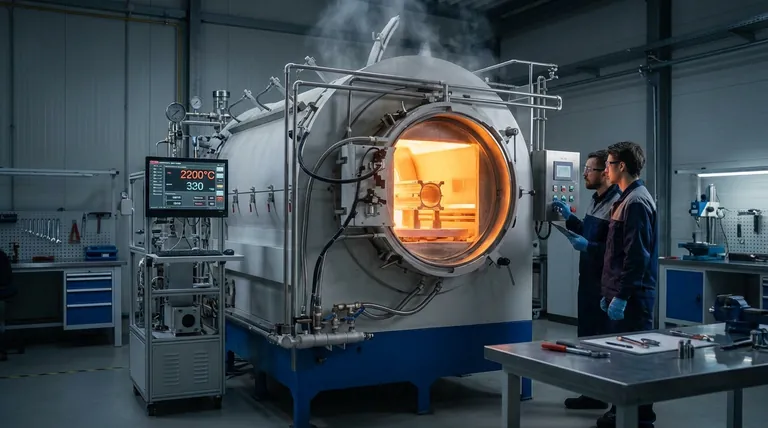
This is the central challenge solved by high-temperature vacuum furnaces. Reaching 2200°C (3992°F) is an impressive feat of engineering, but the true accomplishment is achieving that heat with absolute control.

The Anatomy of a Void

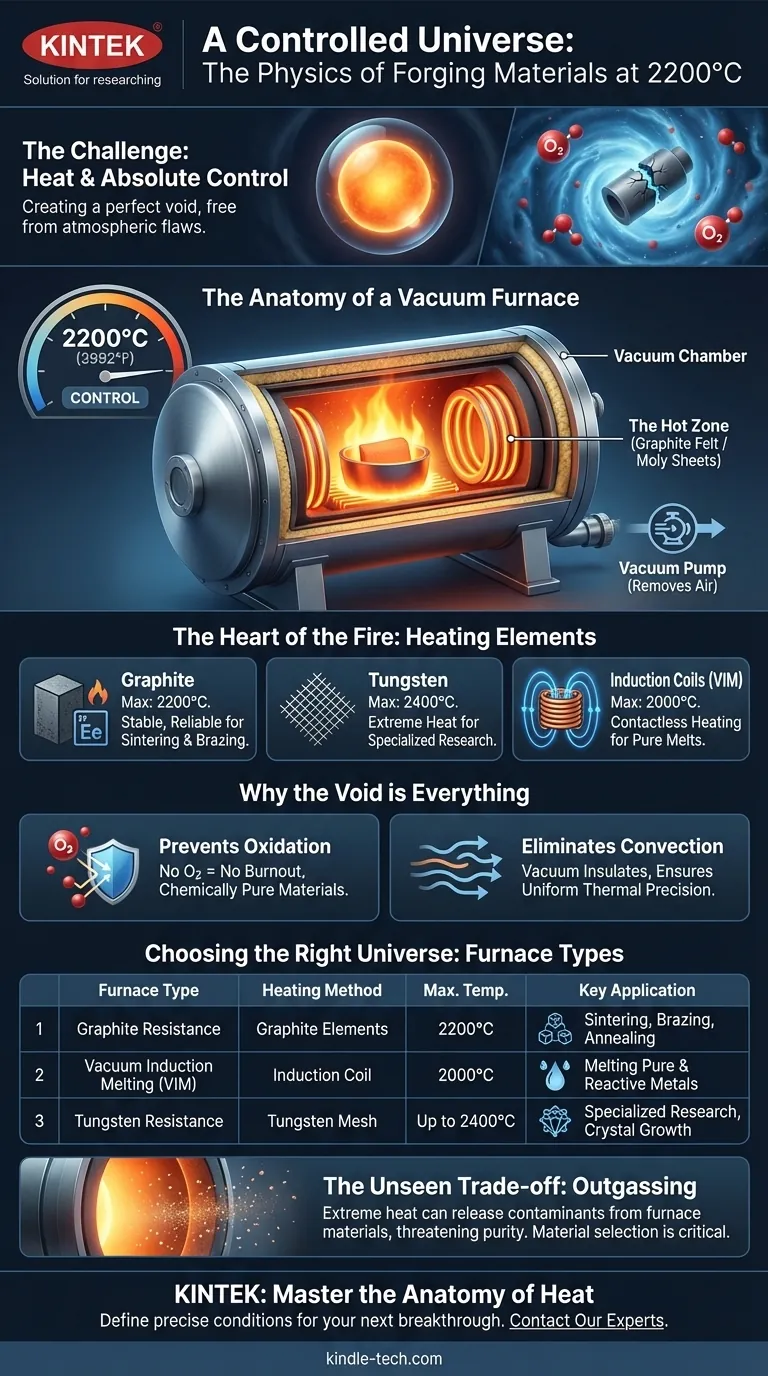
A vacuum furnace's ability to create and sustain these conditions is a delicate interplay between two core systems, both operating within a near-perfect vacuum.

The Heart of the Fire: The Heating Element

The temperature ceiling is set by the material that generates the heat. This component, the heating element, must endure the very environment it creates. The choice of material is everything.

  • Graphite: The workhorse for high-temperature applications. It’s stable, reliable, and can operate consistently up to 2200°C, making it ideal for processes like sintering and brazing.
  • Refractory Metals: For even more extreme demands, engineers turn to metals like Tungsten, which can push temperatures toward 2400°C for highly specialized applications.
  • Induction Coils: Used in Vacuum Induction Melting (VIM) furnaces, these coils don't get hot themselves. Instead, they generate a powerful electromagnetic field that heats the conductive material directly, enabling clean melts up to 2000°C.

The Guardian of the Heat: The "Hot Zone"

The heating elements are housed within a chamber called the "hot zone." This is more than just an insulated box; it's a thermal fortress.

Constructed from materials like rigid graphite felt or reflective molybdenum sheets, the hot zone's job is twofold: keep the immense heat focused on the workload and protect the rest of the furnace from that energy. It ensures the thermal environment is both potent and stable.

Why the Void is Everything

Removing air from the chamber does two critical things.

First, it prevents oxidation. Without oxygen, the heating elements don't burn out, and the material being processed remains chemically pure.

Second, it eliminates convection. Heat can no longer be carried away by moving air, making the heating process vastly more efficient and uniform. The vacuum itself becomes an insulator, allowing for a level of thermal precision that is impossible in an open atmosphere.

Choosing the Right Universe for Your Work

Different scientific goals require different types of controlled universes. The name of the furnace often reveals its purpose.

For Sintering and Heat Treatment: Graphite Resistance Furnaces

These are the quintessential high-temperature systems. By passing current through graphite elements, they generate consistent, controllable heat up to 2200°C. They are the standard for processes that transform powders into solid objects (sintering) or alter a material's internal structure (annealing).

For Ultimate Purity in Metals: Vacuum Induction Melting (VIM)

When the goal is to melt and purify reactive metals or superalloys, a VIM furnace is the instrument of choice. The contactless heating method, reaching 2000°C, minimizes contamination, ensuring the final alloy is pristine.

Furnace Type Primary Heating Method Typical Max. Temp. Key Application
Graphite Resistance Furnace Graphite Elements 2200°C (3992°F) Sintering, Brazing, Annealing
Vacuum Induction Melting (VIM) Induction Coil 2000°C (3632°F) Melting Pure & Reactive Metals
Tungsten Resistance Furnace Tungsten Mesh Elements Up to 2400°C Specialized Research, Crystal Growth

The Unseen Trade-offs of Pushing the Limits

Simply achieving a high number on a temperature gauge is a hollow victory. The real challenge is maintaining control as the energy intensifies.

As temperatures climb, the furnace itself can become a source of contamination. This phenomenon, known as outgassing, occurs when atoms escape from the furnace's own internal components—the insulation, the fixtures, the walls. The very act of creating extreme heat threatens the purity of the void you've worked so hard to establish.

This is the engineer's paradox: the solution to one problem (oxidation) introduces a new, more subtle one (outgassing) that requires even greater mastery to solve. It's why material selection and furnace design are so critical.

Selecting a furnace is not just a choice of temperature range; it's a commitment to a specific level of atmospheric purity and operational stability. Whether developing next-generation alloys or performing critical heat treatments, the furnace is the foundational tool where the future of materials is forged. KINTEK provides the specialized vacuum furnaces that give researchers and engineers this fundamental control.

Understanding the anatomy of heat is the first step. The next is choosing a partner who has mastered it. If you're ready to define the precise conditions for your next breakthrough, Contact Our Experts.

Visual Guide
A Controlled Universe: The Physics of Forging Materials at 2200°C Visual Guide

Related Products

Related Articles

Related Products

Vacuum Hot Press Furnace Heated Vacuum Press Machine Tube Furnace

Vacuum Hot Press Furnace Heated Vacuum Press Machine Tube Furnace

Reduce forming pressure & shorten sintering time with Vacuum Tube Hot Press Furnace for high-density, fine-grain materials. Ideal for refractory metals.

600T Vacuum Induction Hot Press Furnace for Heat Treat and Sintering

600T Vacuum Induction Hot Press Furnace for Heat Treat and Sintering

Discover the 600T Vacuum Induction Hot Press Furnace, designed for high-temperature sintering experiments in vacuum or protected atmospheres. Its precise temperature and pressure control, adjustable working pressure, and advanced safety features make it ideal for nonmetal materials, carbon composites, ceramics, and metal powders.

Vacuum Heat Treat Furnace with Ceramic Fiber Liner

Vacuum Heat Treat Furnace with Ceramic Fiber Liner

Vacuum furnace with polycrystalline ceramic fiber insulation liner for excellent heat insulation and uniform temperature field. Choose from 1200℃ or 1700℃ max. working temperature with high vacuum performance and precise temperature control.

Vacuum Heat Treat and Pressure Sintering Furnace for High Temperature Applications

Vacuum Heat Treat and Pressure Sintering Furnace for High Temperature Applications

Vacuum pressure sintering furnaces are designed for high temperature hot pressing applications in metal and ceramic sintering. Its advanced features ensure precise temperature control, reliable pressure maintenance, and a robust design for seamless operation.

Vacuum Heat Treat Furnace and Levitation Induction Melting Furnace

Vacuum Heat Treat Furnace and Levitation Induction Melting Furnace

Experience precise melting with our Vacuum Levitation Melting Furnace. Ideal for high melting point metals or alloys, with advanced technology for effective smelting. Order now for high-quality results.

Vacuum Hot Press Furnace Machine Heated Vacuum Press

Vacuum Hot Press Furnace Machine Heated Vacuum Press

Discover the advantages of Vacuum Hot Press Furnace! Manufacture dense refractory metals & compounds, ceramics, and composites under high temp and pressure.

Molybdenum Vacuum Heat Treat Furnace

Molybdenum Vacuum Heat Treat Furnace

Discover the benefits of a high-configuration molybdenum vacuum furnace with heat shield insulation. Ideal for high-purity, vacuum environments like sapphire crystal growth and heat treatment.

Lab-Scale Vacuum Induction Melting Furnace

Lab-Scale Vacuum Induction Melting Furnace

Get precise alloy composition with our Vacuum Induction Melting Furnace. Ideal for aerospace, nuclear energy, and electronic industries. Order now for effective smelting and casting of metals and alloys.

Graphite Vacuum Furnace IGBT Experimental Graphitization Furnace

Graphite Vacuum Furnace IGBT Experimental Graphitization Furnace

IGBT experimental graphitization furnace, a tailored solution for universities and research institutions, with high heating efficiency, user-friendliness, and precise temperature control.

2200 ℃ Tungsten Vacuum Heat Treat and Sintering Furnace

2200 ℃ Tungsten Vacuum Heat Treat and Sintering Furnace

Experience the ultimate refractory metal furnace with our Tungsten vacuum furnace. Capable of reaching 2200℃, perfect for sintering advanced ceramics and refractory metals. Order now for high-quality results.

Vacuum Heat Treat Sintering Brazing Furnace

Vacuum Heat Treat Sintering Brazing Furnace

A vacuum brazing furnace is a type of industrial furnace used for brazing, a metalworking process that joins two pieces of metal using a filler metal that melts at a lower temperature than the base metals. Vacuum brazing furnaces are typically used for high-quality applications where a strong, clean joint is required.

2200 ℃ Graphite Vacuum Heat Treat Furnace

2200 ℃ Graphite Vacuum Heat Treat Furnace

Discover the power of the KT-VG Graphite Vacuum Furnace - with a maximum working temperature of 2200℃, it's perfect for vacuum sintering of various materials. Learn more now.

Vacuum Sealed Continuous Working Rotary Tube Furnace Rotating Tube Furnace

Vacuum Sealed Continuous Working Rotary Tube Furnace Rotating Tube Furnace

Experience efficient material processing with our vacuum-sealed rotary tube furnace. Perfect for experiments or industrial production, equipped with optional features for controlled feeding and optimized results. Order now.

Ultra-High Temperature Graphite Vacuum Graphitization Furnace

Ultra-High Temperature Graphite Vacuum Graphitization Furnace

The ultra-high temperature graphitization furnace utilizes medium frequency induction heating in a vacuum or inert gas environment. The induction coil generates an alternating magnetic field, inducing eddy currents in the graphite crucible, which heats up and radiates heat to the workpiece, bringing it to the desired temperature. This furnace is primarily used for graphitization and sintering of carbon materials, carbon fiber materials, and other composite materials.

Small Vacuum Heat Treat and Tungsten Wire Sintering Furnace

Small Vacuum Heat Treat and Tungsten Wire Sintering Furnace

The small vacuum tungsten wire sintering furnace is a compact experimental vacuum furnace specially designed for universities and scientific research institutes. The furnace features a CNC welded shell and vacuum piping to ensure leak-free operation. Quick-connect electrical connections facilitate relocation and debugging, and the standard electrical control cabinet is safe and convenient to operate.

Vacuum Heat Treat and Molybdenum Wire Sintering Furnace for Vacuum Sintering

Vacuum Heat Treat and Molybdenum Wire Sintering Furnace for Vacuum Sintering

A vacuum molybdenum wire sintering furnace is a vertical or bedroom structure, which is suitable for withdrawal, brazing, sintering and degassing of metal materials under high vacuum and high temperature conditions. It is also suitable for dehydroxylation treatment of quartz materials.

Vacuum Arc Induction Melting Furnace

Vacuum Arc Induction Melting Furnace

Discover the power of Vacuum Arc Furnace for melting active & refractory metals. High-speed, remarkable degassing effect, and free of contamination. Learn more now!

Non Consumable Vacuum Arc Induction Melting Furnace

Non Consumable Vacuum Arc Induction Melting Furnace

Explore the benefits of Non-Consumable Vacuum Arc Furnace with high melting point electrodes. Small, easy to operate & eco-friendly. Ideal for laboratory research on refractory metals & carbides.

Horizontal High Temperature Graphite Vacuum Graphitization Furnace

Horizontal High Temperature Graphite Vacuum Graphitization Furnace

Horizontal Graphitization Furnace: This type of furnace is designed with the heating elements placed horizontally, allowing for uniform heating of the sample. It's well-suited for graphitizing large or bulky samples that require precise temperature control and uniformity.

Vertical High Temperature Graphite Vacuum Graphitization Furnace

Vertical High Temperature Graphite Vacuum Graphitization Furnace

Vertical high temperature graphitization furnace for carbonization and graphitization of carbon materials up to 3100℃.Suitable for shaped graphitization of carbon fiber filaments and other materials sintered in a carbon environment.Applications in metallurgy, electronics, and aerospace for producing high-quality graphite products like electrodes and crucibles.


Leave Your Message