The Universe in a Box
An aerospace engineer holds a newly brazed turbine blade. To the naked eye, it's perfect. But deep within the alloy, a microscopic pocket of oxidation—a flaw born from a few stray oxygen molecules—could lead to catastrophic failure at 30,000 feet.
This isn't a failure of heat, but a failure of environment.
The vacuum furnace isn't just a box that gets hot. It is a self-contained universe, meticulously engineered to perform two functions in perfect sequence: first, to achieve a profound silence by removing the atmosphere, and second, to apply precise energy within that silence. Understanding it requires seeing beyond its steel shell and appreciating the symphony of systems within.
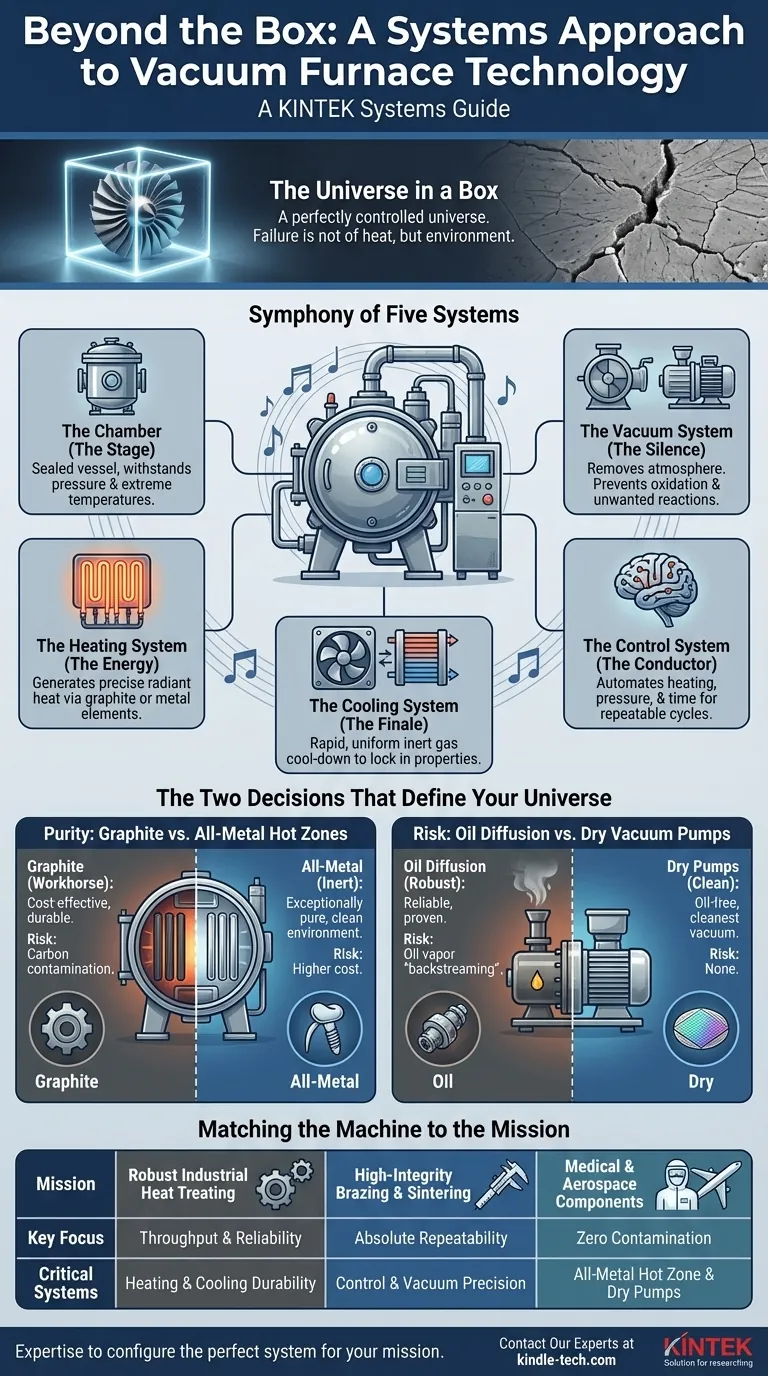
The Symphony of Five Systems
Thinking of a furnace as a list of parts is like describing a symphony as a list of instruments. The magic is in their integration. Each system plays a critical role, conducted in perfect time.
- The Chamber (The Stage): This is the vessel, the physical boundary of your controlled universe. It must be strong enough to withstand over 2,000 pounds per square foot of atmospheric pressure trying to crush it, all while containing extreme temperatures.
- The Vacuum System (The Silence): The heart of the furnace. A series of pumps—first a "roughing" pump, then a "high-vacuum" pump—act as the gatekeepers, systematically evicting air and volatile gases to create an environment where unwanted chemical reactions like oxidation simply cannot occur.
- The Heating System (The Energy): Often called the "hot zone," this is the engine. It uses graphite or refractory metal elements to generate immense heat, transferring it primarily through radiation—the purest form of thermal transfer in a vacuum.
- The Control System (The Conductor): The brain. Using thermocouples as its senses and a PLC as its intellect, this system dictates the entire performance. It manages heating rates, pressure levels, and soak times with unwavering precision, ensuring every cycle is identical to the last.
- The Cooling System (The Finale): After the thermal process is complete, a controlled cool-down is crucial. A powerful fan and a heat exchanger use inert gas to rapidly and uniformly remove heat, locking in the desired material properties.
The Two Decisions That Define Your Universe
While all five systems are critical, two specific design choices have an outsized impact on the furnace's capability. These aren't just technical specifications; they are philosophical commitments to the level of control and purity your process requires.
The Question of Purity: Graphite vs. All-Metal Hot Zones
The material of the hot zone itself influences the environment.
- Graphite-based hot zones are the industry workhorse. They are cost-effective, durable, and excellent for general-purpose heat treating. However, graphite is a "talkative" material in a vacuum; it can be a source of carbon, which is unacceptable for certain sensitive alloys.
- All-metal hot zones (molybdenum or tungsten) are the alternative. They are chemically inert, providing an exceptionally clean, pure environment. This is non-negotiable for medical implants or mission-critical aerospace components where even trace contamination is a catastrophic risk.
The choice is a deliberate trade-off between practicality and absolute purity.
The Fear of the Unseen: Oil Diffusion vs. Dry Vacuum Pumps
The high-vacuum pump is responsible for achieving the lowest pressures, but its technology introduces another critical choice.
- Oil diffusion pumps are a robust, proven technology. They are reliable and cost-effective. Their one psychological drawback is the small but real risk of oil vapor "backstreaming" into the chamber—an invisible contaminant that can compromise the most sensitive surfaces.
- Dry pumps (cryogenic or turbomolecular) eliminate this fear entirely. They use no oil, guaranteeing the cleanest possible vacuum. For medical, electronic, or semiconductor applications, this isn't a luxury; it's a foundational requirement for trust in the process.
This decision is about managing invisible risk. It's about deciding whether to mitigate a potential contaminant or to engineer it out of existence from the start.
Matching the Machine to the Mission
The right vacuum furnace is not the one with the most impressive specifications, but the one whose systems are perfectly aligned with your goal.
| System | Key Components | Primary Function |
|---|---|---|
| Vacuum Chamber | Shell, Door, Seals | Creates a sealed vessel to withstand pressure and heat |
| Vacuum System | Roughing Pump, High-Vacuum Pump, Gauges | Removes air to create an oxygen-free environment |
| Heating System | Graphite or Metal Heating Elements | Generates precise thermal energy for processing |
| Control System | PLC, Thermocouples | Automates and manages temperature, pressure, and time |
| Cooling System | Gas Quench Fan, Heat Exchanger | Cools the workload in a controlled manner |
- For robust industrial heat treating, the mission is throughput and reliability. The durability of the heating system and the speed of the cooling system are paramount.
- For high-integrity brazing and sintering, the mission is absolute repeatability. The precision of the control system and the quality of the vacuum system are the heroes.
- For medical and aerospace components, the mission is zero contamination. An all-metal hot zone and an oil-free dry pumping system are the only acceptable choices.
Building a process that delivers perfect results requires more than just equipment; it requires a deep understanding of the interplay between these systems. At KINTEK, we provide not just the hardware, but the expertise to help you configure a vacuum furnace where every component works in concert to achieve your specific mission.
To ensure your components are forged in a perfectly controlled universe, Contact Our Experts.
Visual Guide
Related Products
- Vacuum Hot Press Furnace Heated Vacuum Press Machine Tube Furnace
- 600T Vacuum Induction Hot Press Furnace for Heat Treat and Sintering
- Vacuum Heat Treat Furnace with Ceramic Fiber Liner
- Vacuum Heat Treat and Pressure Sintering Furnace for High Temperature Applications
- Vacuum Heat Treat Furnace and Levitation Induction Melting Furnace
Related Articles
- The Purity Paradox: Choosing the Heart of Your Vacuum Hot Press Furnace
- Comprehensive Guide to Vacuum Hot Press Furnace Application
- Vacuum Hot Press Furnace: A Comprehensive Guide
- Forging Perfection in a Void: The Physics of Ultra-Dense Materials
- Defeating the Void: The Quiet Power of Vacuum Hot Pressing