Blog Beyond the Spec Sheet: The Physics and Psychology of a Vacuum Furnace's True Limit
Beyond the Spec Sheet: The Physics and Psychology of a Vacuum Furnace's True Limit

Beyond the Spec Sheet: The Physics and Psychology of a Vacuum Furnace's True Limit

2 hours ago

The Seduction of a Single Number

We have a natural cognitive bias towards simple metrics. When evaluating complex machinery, we look for a single number to tell us which is "best." For a car, it might be horsepower. For a vacuum furnace, it's often the maximum temperature.

This impulse is understandable. It simplifies a complex decision. But it's also a trap.

The real question isn't "How hot does it get?" but rather, "What is the precise thermal environment my process requires to succeed?" The answer reveals that the maximum temperature isn't a feature—it's the result of a carefully balanced engineering system.

A System in Harmony, Not a Brute Force Machine

A vacuum furnace isn't just a box that gets hot. It's an ecosystem of components working in concert. Its ultimate temperature limit is not defined by its most powerful part, but by its most vulnerable one.

Think of it as a chain. The entire system is only as strong as its weakest link. This philosophy is at the heart of robust furnace design.

The Heart of the Heat: The Element

The heating element is the engine of the furnace, and its material composition dictates the achievable temperature range. Each material is a specialist, chosen for a specific mission.

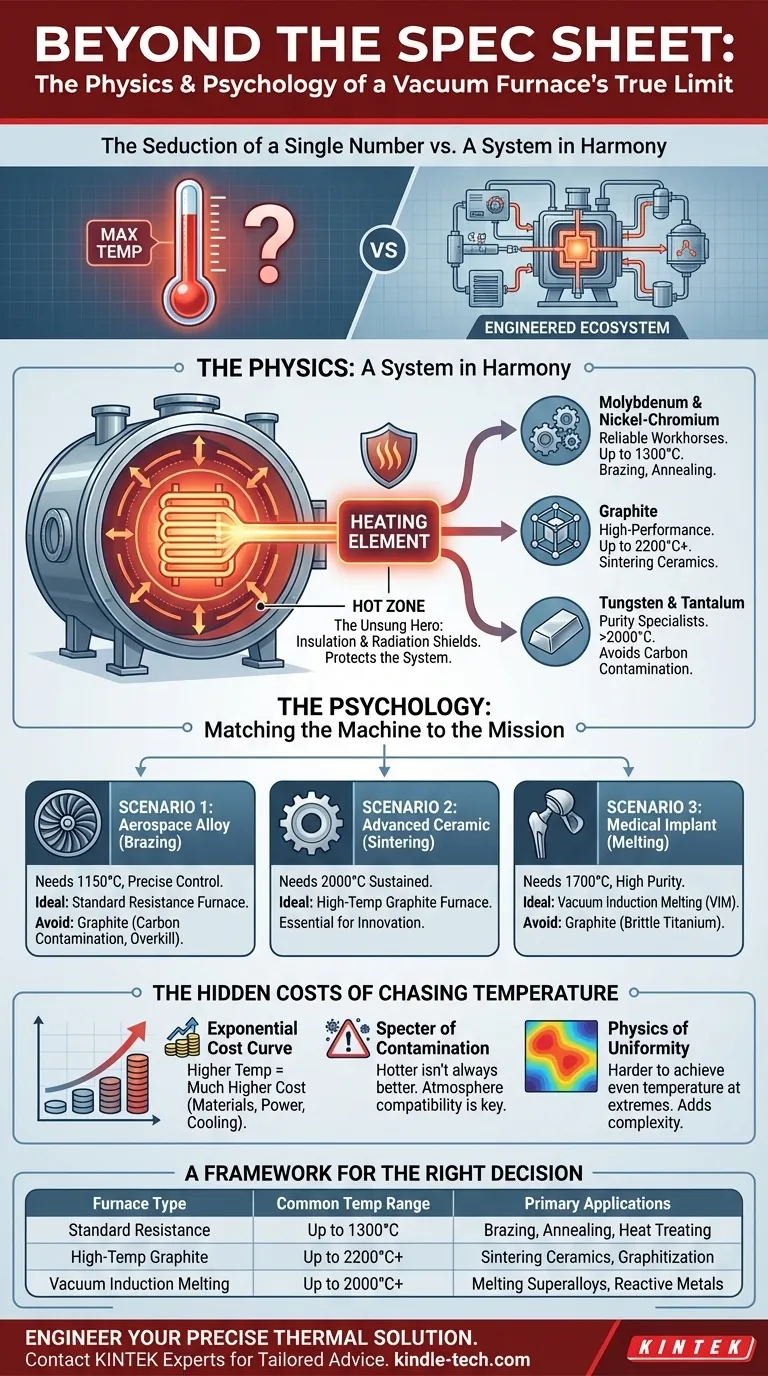
  • Molybdenum & Nickel-Chromium: The reliable workhorses. They are perfect for general-purpose applications like brazing and annealing, typically reaching up to 1300°C.
  • Graphite: The high-performance choice for extreme heat. Capable of reaching 2200°C and beyond, it's essential for sintering advanced ceramics and materials research.
  • Tungsten & Tantalum: The specialists for purity. These refractory metals operate above 2000°C and are used when the carbon atmosphere from a graphite element would contaminate the workpiece.

The Unsung Hero: The Hot Zone

Containing this immense energy is the job of the "hot zone"—the insulation package surrounding the elements. Composed of high-grade ceramic fibers or metallic radiation shields, it reflects heat inward, protecting the furnace's structural integrity.

A failure in the hot zone is a catastrophic failure of the entire system. Its design is as critical as the heating elements themselves.

Matching the Machine to the Mission

The right furnace is an extension of the process itself. Let's consider three different engineering challenges.

Scenario 1: The Aerospace Alloy

An engineering team is brazing a new superalloy for a jet engine turbine. The process requires precise control and a peak temperature of 1150°C. For this, a standard molybdenum-element resistance furnace is the perfect tool. Choosing a 2200°C graphite furnace would be like using a sledgehammer to crack a nut—unnecessarily expensive, complex, and it could even introduce carbon contamination, ruining the alloy.

Scenario 2: The Advanced Ceramic

A materials science lab is sintering a new technical ceramic designed for extreme wear resistance. This process requires sustained temperatures of 2000°C to achieve the necessary density and strength. Here, the high-temperature graphite furnace isn't a luxury; it's the only tool that can do the job. Its capability directly enables innovation.

Scenario 3: The Medical Implant

A company is melting a batch of high-purity titanium for a medical implant. The process needs temperatures around 1700°C in an impeccably clean environment. A Vacuum Induction Melting (VIM) furnace is ideal. Using a graphite furnace would be a critical mistake, as carbon would readily dissolve into the molten titanium, making it brittle and unsafe for medical use. An all-metal hot zone is required.

The Hidden Costs of Chasing Temperature

Choosing a furnace based solely on its maximum temperature rating ignores the critical trade-offs that engineers must balance.

  • The Exponential Cost Curve: The relationship between temperature and cost is not linear. A 2200°C furnace is substantially more expensive to buy, operate, and maintain than a 1300°C model due to exotic materials and complex power and cooling systems.
  • The Specter of Contamination: As seen with titanium, "hotter" is not always "better." The furnace's internal atmosphere must be compatible with your material. The wrong choice creates new problems that are harder to solve than the original heating challenge.
  • The Physics of Uniformity: Achieving a perfectly even temperature across a large part becomes exponentially harder at extreme temperatures. It requires sophisticated design, which adds complexity and cost.

A Framework for the Right Decision

The most effective path is to define your process first. The ideal furnace is the one that meets your requirements for temperature, uniformity, and purity with the greatest efficiency and reliability.

Furnace Type Common Temperature Range Primary Applications
Standard Resistance Up to 1300°C Brazing, annealing, general heat treating
High-Temperature Graphite Up to 2200°C+ Sintering ceramics, graphitization
Vacuum Induction Melting Up to 2000°C+ Melting superalloys, reactive metals

Choosing the right vacuum furnace is about engineering a precise thermal solution for your unique challenge. At KINTEK, we specialize in moving beyond the spec sheet to understand your process goals. We provide tailored vacuum furnace solutions that deliver the control, purity, and thermal performance your application truly needs, ensuring your focus remains on innovation, not on the limitations of your equipment.

To find the system perfectly matched to your mission, Contact Our Experts.

Visual Guide
Beyond the Spec Sheet: The Physics and Psychology of a Vacuum Furnace's True Limit Visual Guide

Related Products

Related Articles

Related Products

Vacuum Hot Press Furnace Heated Vacuum Press Machine Tube Furnace

Vacuum Hot Press Furnace Heated Vacuum Press Machine Tube Furnace

Reduce forming pressure & shorten sintering time with Vacuum Tube Hot Press Furnace for high-density, fine-grain materials. Ideal for refractory metals.

600T Vacuum Induction Hot Press Furnace for Heat Treat and Sintering

600T Vacuum Induction Hot Press Furnace for Heat Treat and Sintering

Discover the 600T Vacuum Induction Hot Press Furnace, designed for high-temperature sintering experiments in vacuum or protected atmospheres. Its precise temperature and pressure control, adjustable working pressure, and advanced safety features make it ideal for nonmetal materials, carbon composites, ceramics, and metal powders.

Vacuum Hot Press Furnace Machine Heated Vacuum Press

Vacuum Hot Press Furnace Machine Heated Vacuum Press

Discover the advantages of Vacuum Hot Press Furnace! Manufacture dense refractory metals & compounds, ceramics, and composites under high temp and pressure.

Vacuum Heat Treat Furnace and Levitation Induction Melting Furnace

Vacuum Heat Treat Furnace and Levitation Induction Melting Furnace

Experience precise melting with our Vacuum Levitation Melting Furnace. Ideal for high melting point metals or alloys, with advanced technology for effective smelting. Order now for high-quality results.

2200 ℃ Tungsten Vacuum Heat Treat and Sintering Furnace

2200 ℃ Tungsten Vacuum Heat Treat and Sintering Furnace

Experience the ultimate refractory metal furnace with our Tungsten vacuum furnace. Capable of reaching 2200℃, perfect for sintering advanced ceramics and refractory metals. Order now for high-quality results.

Vacuum Heat Treat and Pressure Sintering Furnace for High Temperature Applications

Vacuum Heat Treat and Pressure Sintering Furnace for High Temperature Applications

Vacuum pressure sintering furnaces are designed for high temperature hot pressing applications in metal and ceramic sintering. Its advanced features ensure precise temperature control, reliable pressure maintenance, and a robust design for seamless operation.

Molybdenum Vacuum Heat Treat Furnace

Molybdenum Vacuum Heat Treat Furnace

Discover the benefits of a high-configuration molybdenum vacuum furnace with heat shield insulation. Ideal for high-purity, vacuum environments like sapphire crystal growth and heat treatment.

Graphite Vacuum Furnace IGBT Experimental Graphitization Furnace

Graphite Vacuum Furnace IGBT Experimental Graphitization Furnace

IGBT experimental graphitization furnace, a tailored solution for universities and research institutions, with high heating efficiency, user-friendliness, and precise temperature control.

Vacuum Sealed Continuous Working Rotary Tube Furnace Rotating Tube Furnace

Vacuum Sealed Continuous Working Rotary Tube Furnace Rotating Tube Furnace

Experience efficient material processing with our vacuum-sealed rotary tube furnace. Perfect for experiments or industrial production, equipped with optional features for controlled feeding and optimized results. Order now.

2200 ℃ Graphite Vacuum Heat Treat Furnace

2200 ℃ Graphite Vacuum Heat Treat Furnace

Discover the power of the KT-VG Graphite Vacuum Furnace - with a maximum working temperature of 2200℃, it's perfect for vacuum sintering of various materials. Learn more now.

Lab-Scale Vacuum Induction Melting Furnace

Lab-Scale Vacuum Induction Melting Furnace

Get precise alloy composition with our Vacuum Induction Melting Furnace. Ideal for aerospace, nuclear energy, and electronic industries. Order now for effective smelting and casting of metals and alloys.

Vacuum Heat Treat Sintering Brazing Furnace

Vacuum Heat Treat Sintering Brazing Furnace

A vacuum brazing furnace is a type of industrial furnace used for brazing, a metalworking process that joins two pieces of metal using a filler metal that melts at a lower temperature than the base metals. Vacuum brazing furnaces are typically used for high-quality applications where a strong, clean joint is required.

Ultra-High Temperature Graphite Vacuum Graphitization Furnace

Ultra-High Temperature Graphite Vacuum Graphitization Furnace

The ultra-high temperature graphitization furnace utilizes medium frequency induction heating in a vacuum or inert gas environment. The induction coil generates an alternating magnetic field, inducing eddy currents in the graphite crucible, which heats up and radiates heat to the workpiece, bringing it to the desired temperature. This furnace is primarily used for graphitization and sintering of carbon materials, carbon fiber materials, and other composite materials.

Small Vacuum Heat Treat and Tungsten Wire Sintering Furnace

Small Vacuum Heat Treat and Tungsten Wire Sintering Furnace

The small vacuum tungsten wire sintering furnace is a compact experimental vacuum furnace specially designed for universities and scientific research institutes. The furnace features a CNC welded shell and vacuum piping to ensure leak-free operation. Quick-connect electrical connections facilitate relocation and debugging, and the standard electrical control cabinet is safe and convenient to operate.

Vacuum Heat Treat Furnace with Ceramic Fiber Liner

Vacuum Heat Treat Furnace with Ceramic Fiber Liner

Vacuum furnace with polycrystalline ceramic fiber insulation liner for excellent heat insulation and uniform temperature field. Choose from 1200℃ or 1700℃ max. working temperature with high vacuum performance and precise temperature control.

Vacuum Heat Treat and Molybdenum Wire Sintering Furnace for Vacuum Sintering

Vacuum Heat Treat and Molybdenum Wire Sintering Furnace for Vacuum Sintering

A vacuum molybdenum wire sintering furnace is a vertical or bedroom structure, which is suitable for withdrawal, brazing, sintering and degassing of metal materials under high vacuum and high temperature conditions. It is also suitable for dehydroxylation treatment of quartz materials.

Vacuum Arc Induction Melting Furnace

Vacuum Arc Induction Melting Furnace

Discover the power of Vacuum Arc Furnace for melting active & refractory metals. High-speed, remarkable degassing effect, and free of contamination. Learn more now!

Horizontal High Temperature Graphite Vacuum Graphitization Furnace

Horizontal High Temperature Graphite Vacuum Graphitization Furnace

Horizontal Graphitization Furnace: This type of furnace is designed with the heating elements placed horizontally, allowing for uniform heating of the sample. It's well-suited for graphitizing large or bulky samples that require precise temperature control and uniformity.

Non Consumable Vacuum Arc Induction Melting Furnace

Non Consumable Vacuum Arc Induction Melting Furnace

Explore the benefits of Non-Consumable Vacuum Arc Furnace with high melting point electrodes. Small, easy to operate & eco-friendly. Ideal for laboratory research on refractory metals & carbides.

Vacuum Dental Porcelain Sintering Furnace

Vacuum Dental Porcelain Sintering Furnace

Get precise and reliable results with KinTek's Vacuum Porcelain Furnace. Suitable for all porcelain powders, it features hyperbolic ceramic furnace function, voice prompt, and automatic temperature calibration.


Leave Your Message