The Illusion of Strength
Imagine building a sculpture from sand. You can press it into a block, but it remains fragile, each grain an individual holding weakly to its neighbor. You could then bake it, fusing the outer layers, but the core might stay loose, riddled with invisible voids. The final piece looks solid, but it holds a hidden weakness.
This is the fundamental challenge in powder metallurgy. The goal isn't just to create a shape; it's to forge a truly unified, dense, and powerful new entity from a collection of individual particles. Most methods approach this in two separate acts. Hot pressing does it in one decisive, simultaneous motion.
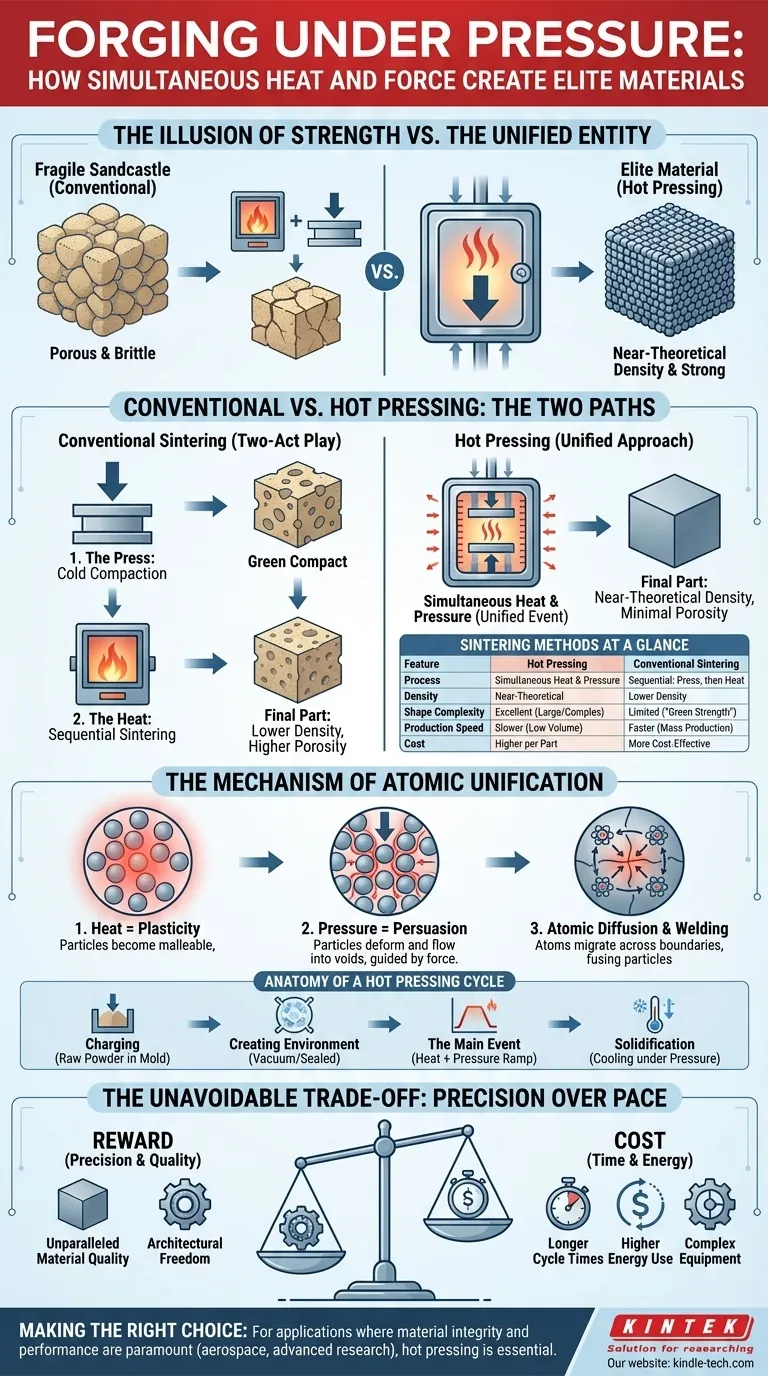
The Conventional Path: A Two-Act Play
The standard industrial playbook for sintering is a sequential process.
- The Press: Powder is compressed at room temperature into a "green compact." This part has the right shape but possesses all the structural integrity of a tightly packed sandcastle—brittle and porous.
- The Heat: The fragile compact is then carefully moved to a furnace and heated. The high temperature encourages atoms to migrate across particle boundaries, slowly fusing them together.
This method is fast and economical. But the separation of steps creates a legacy of imperfection. The voids locked in during the initial cold pressing are difficult to fully eliminate later. The material's final density is a compromise.
The Hot Pressing Intervention: A Unified Approach
Hot pressing rejects this two-step compromise. It posits that to truly persuade particles to form a perfect bond, you cannot simply command them; you must create the ideal environment for them to transform. It combines the shaping force of pressure with the catalytic energy of heat in a single, unified event.
The Psychology of Particles Under Pressure
Think of a material's particles at a microscopic level. At room temperature, they are rigid and uncooperative. Applying pressure alone just forces them against each other, leaving gaps and creating stress points.
Heat changes their psychology. As the temperature rises (below the melting point), the particles become plastic and malleable. They are now receptive to change. At this exact moment of peak receptiveness, hot pressing applies immense mechanical pressure.
This isn't a brute-force collision. It's a highly efficient persuasion. The softened particles deform and flow into the voids between them, not because they are being crushed, but because they are being guided into a more stable, lower-energy state.
The Mechanism of Atomic Unification
This simultaneous action accelerates a process called atomic diffusion. The heat energizes atoms, and the pressure provides a powerful incentive for them to move. They abandon the boundaries of their original grains and migrate, effectively welding the particles together from the inside out.
The result is a structure with minimal porosity—a solid mass that approaches the material's true theoretical density.
Anatomy of a Hot Pressing Cycle
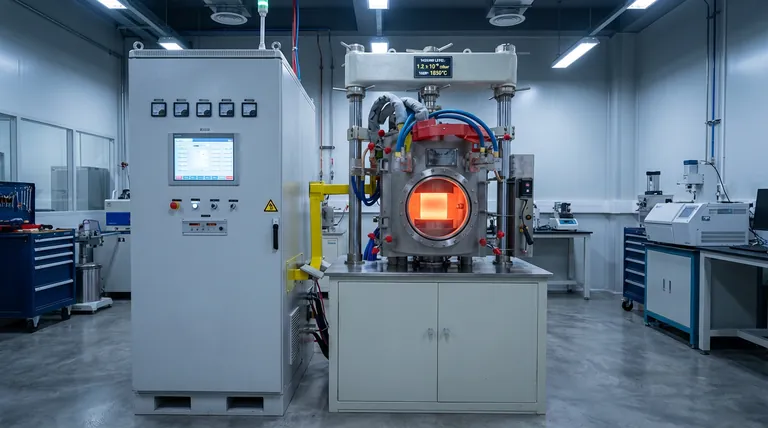
The elegance of the concept is matched by the precision of its execution, typically within a vacuum furnace.
- Step 1: Charging: The raw powder is loaded into a mold, often made of graphite, which can withstand the extreme conditions.
- Step 2: Creating the Environment: The furnace is sealed and evacuated. Removing air and impurities is like clearing the noise from a conversation—it ensures the particles can bond without interference or contamination.
- Step 3: The Main Event: Temperature and pressure ramp up in concert. This is the critical stage where the material is heated to plasticity and simultaneously compacted to its final density.
- Step 4: Solidification: After a specified hold time, the system cools. Pressure is often maintained during the initial cooling to prevent any internal defects from forming as the part solidifies.
The Unavoidable Trade-Off: Precision Over Pace
Hot pressing is a philosophy of manufacturing that chooses ultimate performance over mass production. The choice to use it is a conscious trade-off.
The Reward: Near-Perfect Density and Performance
The primary advantage is unparalleled material quality. By virtually eliminating porosity, hot pressing produces components with exceptional mechanical strength, hardness, thermal conductivity, and overall performance. This is non-negotiable for advanced ceramics, superalloys, and other high-performance materials.
The Reward: Architectural Freedom
Because the material is shaped while hot and pliable, less pressure is often needed than in cold pressing. This enables the formation of very large components or parts with intricate geometries that would crack or warp under other methods.
The Cost: Time and Energy
This precision comes at a price. Cycle times are long. The equipment is complex and expensive. The energy required is significant. Hot pressing is not a tool for high-volume manufacturing; it is a tool for creating objects where quality cannot be compromised.
Sintering Methods at a Glance
| Feature | Hot Pressing | Conventional Sintering |
|---|---|---|
| Process | Simultaneous heat and pressure | Sequential: press, then heat |
| Density | Near-theoretical, minimal porosity | Lower density, higher porosity |
| Shape Complexity | Excellent for large/complex parts | Limited by "green strength" |
| Production Speed | Slower, not for high volume | Faster, for mass production |
| Cost | Higher cost per part | More cost-effective |
Making the Right Choice
Choosing hot pressing means you've decided that the hidden voids left by conventional methods represent an unacceptable risk. It's for applications where material integrity is paramount—from aerospace components to advanced research samples.
For researchers and engineers pushing the boundaries of material science, mastering this process is essential. It requires not only precise control over temperature and pressure but also a deep understanding of the material's behavior. The right laboratory equipment isn't just a tool; it's a partner in this process of creation.
KINTEK specializes in providing the advanced laboratory hot pressing furnaces and consumables needed to achieve these exceptional results. If your work demands the highest possible density and performance, we have the technology to help you succeed. Contact Our Experts to explore the right solution for your application.
Visual Guide
Related Products
- Manual High Temperature Heated Hydraulic Press Machine with Heated Plates for Lab
- Touchscreen Automatic Vacuum Heat Press
- Automatic Heated Hydraulic Press Machine with Heated Plates for Laboratory Hot Press
- Automatic Heated Hydraulic Press Machine with Heated Plates for Laboratory Hot Press 25T 30T 50T
- Heated Hydraulic Press Machine with Heated Plates for Vacuum Box Laboratory Hot Press
Related Articles
- Why Your Composite and Polymer Parts Keep Failing: The Secret Is Simultaneous Heat and Pressure
- Precision Under Pressure: The Physics and Psychology of the Hydraulic Hot Press
- More Than a Squeeze: The Physics and Psychology of the Hydraulic Hot Press
- Comprehensive Guide to Hydraulic Hot Press: Function, Features and Applications
- Hydraulic Hot Press: Principles, Components, Features, Advantages, and Applications