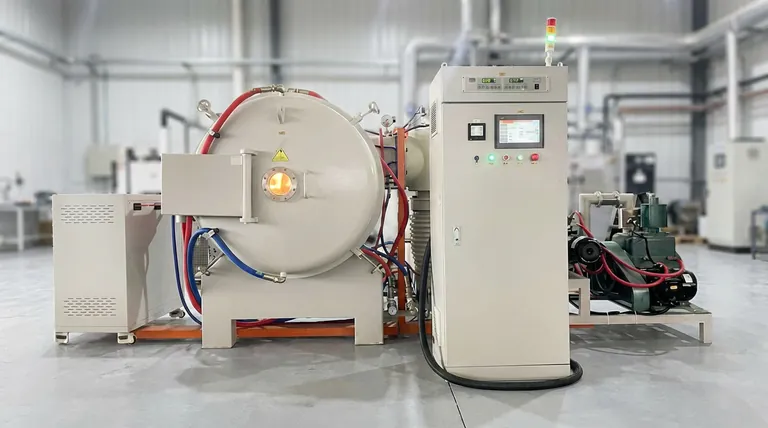
Blog Heating by Light: The Physics of Precision in a Vacuum Furnace
Heating by Light: The Physics of Precision in a Vacuum Furnace

Heating by Light: The Physics of Precision in a Vacuum Furnace

4 hours ago

The Intuition We Must Unlearn

Think about the heat from a bonfire. You feel it on your face as waves of warmth, but you also see the chaotic dance of hot air rising. Our daily experience teaches us that heat travels through the air around us.

This intuition is the first thing we must discard when we enter the world of a vacuum furnace.

Inside that pristine, controlled chamber, the rules are different. By removing the air, we remove the medium for heat transfer we are most familiar with. We are left with a more fundamental, elegant, and powerful force: thermal radiation.

Heating a part in a vacuum isn't like baking in a conventional oven; it's like positioning a planet to receive light from its sun.

The Dominant Principle: Heat as Light

The sun warms the Earth across 93 million miles of empty space. It does so through thermal radiation—a stream of electromagnetic energy. A vacuum furnace operates on the exact same principle, just on a much smaller scale.

Radiation in the Void

Everything with a temperature above absolute zero emits thermal energy. The hotter an object gets, the more energy it radiates.

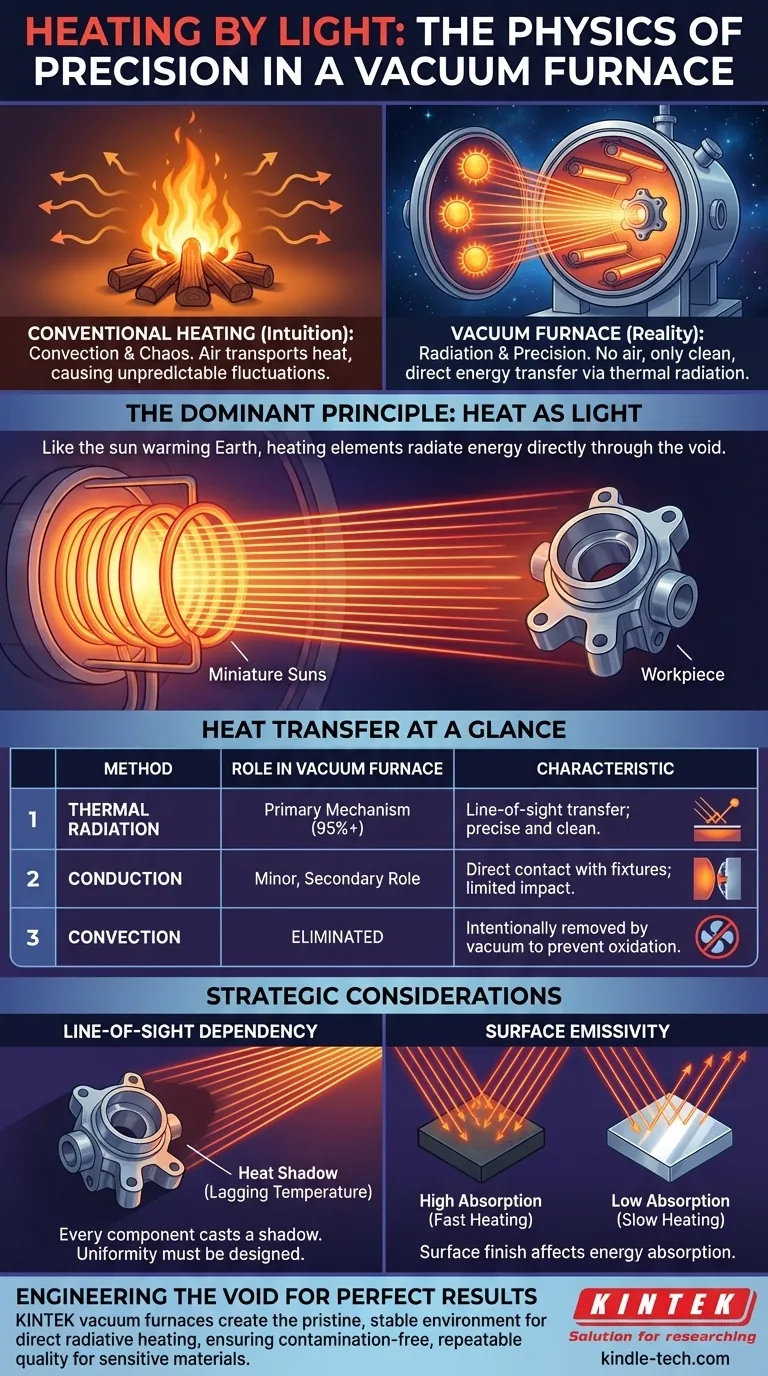
Inside a vacuum furnace, heating elements made of graphite or molybdenum act as miniature suns. When energized, they reach extreme temperatures and flood the chamber with infrared energy. This energy travels in straight lines through the vacuum until it strikes the workpiece, where it's absorbed and converted into heat.

There are no hot spots from swirling air currents, no unpredictable fluctuations. There is only the clean, direct transfer of energy from the source to the target.

The Psychology of "Line-of-Sight"

This "line-of-sight" dependency changes how we must think about the process. The challenge is no longer about circulating heat but about managing light.

You have to think like a lighting designer, not just an engineer. Every component loaded into the furnace casts a "heat shadow." Any surface hidden from the heating elements will lag in temperature, just as the side of a building opposite the sun remains cool.

This requires a deliberate and strategic approach to loading parts, ensuring every critical surface has a direct view of the energy source. Uniformity is not a given; it is engineered.

The Supporting Role and the Deliberate Absence

While radiation dominates, it isn't the only actor. Conduction plays a small part, while convection is intentionally banished.

Conduction: The Point of Contact

The workpiece rests on a fixture or hearth. At these direct points of contact, heat conducts from the hot fixture into the part.

However, the surface area involved in conduction is typically minuscule compared to the total surface area being bathed in radiation. It's an anchor point for heat, but it's not the main event.

Why Convection is the Enemy

In a standard furnace, fans circulate hot air (convection) to distribute heat. In a vacuum furnace, removing the air is the entire point.

Air contains oxygen and other reactive gases. At high temperatures, these gases are aggressive agents of contamination, causing oxidation and discoloration that can compromise the integrity of sensitive materials.

By creating a vacuum, we eliminate the medium for convection. This act achieves two critical goals:

  1. It protects the part, ensuring a perfectly clean, bright finish.
  2. It stabilizes the process, creating a predictable environment free from the chaos of turbulent air.

The Strategic Trade-Offs of a Radiation-First World

This reliance on radiation creates a unique set of operational considerations. Mastering them is the key to unlocking the technology's full potential.

  • Heating Uniformity is Designed: You cannot simply place parts in the furnace and expect even heating. Uniformity is achieved through careful arrangement and intelligent fixturing, ensuring all surfaces get their share of radiant energy.

  • The Surface is the Interface: A material's ability to absorb radiant energy is called emissivity. A dull, dark surface absorbs heat eagerly, while a shiny, reflective surface deflects it. This means two identical parts with different surface finishes will behave differently, a factor that must be accounted for in any precision process.

  • A Different Temperature Curve: At lower temperatures, radiation is less efficient than convection, sometimes leading to longer initial ramp-up times. But as temperatures soar, radiation becomes an exponentially more powerful and rapid method of heat transfer.

Heat Transfer at a Glance

Heat Transfer Method Role in Vacuum Furnace Key Characteristic
Thermal Radiation Primary Mechanism (95%+) Line-of-sight transfer via electromagnetic waves; precise and clean.
Conduction Minor, Secondary Role Heat transfer through direct contact with fixtures; limited impact.
Convection Eliminated Intentionally removed by the vacuum to prevent oxidation and contamination.

Engineering the Void for Perfect Results

Understanding these physics is the first step; having the right equipment is the second. The principles of radiative heat transfer demand an environment of extreme stability and control.

KINTEK's vacuum furnaces are engineered to provide exactly that. They create the pristine, stable void necessary to leverage the power of direct radiative heating, delivering the contamination-free results and process repeatability essential for advanced laboratory and industrial applications. By mastering the flow of heat as light, we enable you to achieve unparalleled quality in your most sensitive materials.

To harness the power of this precise and clean heating method for your most critical applications, Contact Our Experts.

Visual Guide
Heating by Light: The Physics of Precision in a Vacuum Furnace Visual Guide

Related Products

Related Articles

Related Products

Molybdenum Vacuum Heat Treat Furnace

Molybdenum Vacuum Heat Treat Furnace

Discover the benefits of a high-configuration molybdenum vacuum furnace with heat shield insulation. Ideal for high-purity, vacuum environments like sapphire crystal growth and heat treatment.

Vacuum Heat Treat Furnace with Ceramic Fiber Liner

Vacuum Heat Treat Furnace with Ceramic Fiber Liner

Vacuum furnace with polycrystalline ceramic fiber insulation liner for excellent heat insulation and uniform temperature field. Choose from 1200℃ or 1700℃ max. working temperature with high vacuum performance and precise temperature control.

2200 ℃ Graphite Vacuum Heat Treat Furnace

2200 ℃ Graphite Vacuum Heat Treat Furnace

Discover the power of the KT-VG Graphite Vacuum Furnace - with a maximum working temperature of 2200℃, it's perfect for vacuum sintering of various materials. Learn more now.

2200 ℃ Tungsten Vacuum Heat Treat and Sintering Furnace

2200 ℃ Tungsten Vacuum Heat Treat and Sintering Furnace

Experience the ultimate refractory metal furnace with our Tungsten vacuum furnace. Capable of reaching 2200℃, perfect for sintering advanced ceramics and refractory metals. Order now for high-quality results.

Laboratory Muffle Oven Furnace Bottom Lifting Muffle Furnace

Laboratory Muffle Oven Furnace Bottom Lifting Muffle Furnace

Efficiently produce batches with excellent temperature uniformity using our Bottom Lifting Furnace. Features two electric lifting stages and advanced temperature control up to 1600℃.

1200℃ Split Tube Furnace with Quartz Tube Laboratory Tubular Furnace

1200℃ Split Tube Furnace with Quartz Tube Laboratory Tubular Furnace

KT-TF12 split tube furnace: high-purity insulation, embedded heating wire coils, and max. 1200C. Widely used for new materials and chemical vapour deposition.

1800℃ Muffle Oven Furnace for Laboratory

1800℃ Muffle Oven Furnace for Laboratory

KT-18 muffle furnace with Japan Al2O3 polycrystalline fibe and Silicon Molybdenum heating element, up to 1900℃, PID temperature control and 7" smart touch screen. Compact design, low heat loss, and high energy efficiency. Safety interlock system and versatile functions.

1700℃ Controlled Atmosphere Furnace Nitrogen Inert Atmosphere Furnace

1700℃ Controlled Atmosphere Furnace Nitrogen Inert Atmosphere Furnace

KT-17A Controlled atmosphere furnace: 1700℃ heating, vacuum sealing technology, PID temperature control, and versatile TFT smart touch screen controller for laboratory and industrial use.

Laboratory High Pressure Vacuum Tube Furnace

Laboratory High Pressure Vacuum Tube Furnace

KT-PTF High Pressure Tube Furnace: Compact split tube furnace with strong positive pressure resistance. Working temp up to 1100°C and pressure up to 15Mpa. Also works under controller atmosphere or high vacuum.

High Temperature Muffle Oven Furnace for Laboratory Debinding and Pre Sintering

High Temperature Muffle Oven Furnace for Laboratory Debinding and Pre Sintering

KT-MD High temperature debinding and pre-sintering furnace for ceramic materials with various molding processes. Ideal for electronic components such as MLCC and NFC.

Ultra-High Temperature Graphite Vacuum Graphitization Furnace

Ultra-High Temperature Graphite Vacuum Graphitization Furnace

The ultra-high temperature graphitization furnace utilizes medium frequency induction heating in a vacuum or inert gas environment. The induction coil generates an alternating magnetic field, inducing eddy currents in the graphite crucible, which heats up and radiates heat to the workpiece, bringing it to the desired temperature. This furnace is primarily used for graphitization and sintering of carbon materials, carbon fiber materials, and other composite materials.

Vacuum Heat Treat and Molybdenum Wire Sintering Furnace for Vacuum Sintering

Vacuum Heat Treat and Molybdenum Wire Sintering Furnace for Vacuum Sintering

A vacuum molybdenum wire sintering furnace is a vertical or bedroom structure, which is suitable for withdrawal, brazing, sintering and degassing of metal materials under high vacuum and high temperature conditions. It is also suitable for dehydroxylation treatment of quartz materials.

1400℃ Muffle Oven Furnace for Laboratory

1400℃ Muffle Oven Furnace for Laboratory

Get precise high-temperature control up to 1500℃ with KT-14M Muffle furnace. Equipped with a smart touch screen controller and advanced insulation materials.

1400℃ Controlled Atmosphere Furnace with Nitrogen and Inert Atmosphere

1400℃ Controlled Atmosphere Furnace with Nitrogen and Inert Atmosphere

Achieve precise heat treatment with KT-14A controlled atmosphere furnace. Vacuum sealed with a smart controller, it's ideal for lab and industrial use up to 1400℃.

Graphite Vacuum Furnace High Thermal Conductivity Film Graphitization Furnace

Graphite Vacuum Furnace High Thermal Conductivity Film Graphitization Furnace

The high thermal conductivity film graphitization furnace has uniform temperature, low energy consumption and can operate continuously.

600T Vacuum Induction Hot Press Furnace for Heat Treat and Sintering

600T Vacuum Induction Hot Press Furnace for Heat Treat and Sintering

Discover the 600T Vacuum Induction Hot Press Furnace, designed for high-temperature sintering experiments in vacuum or protected atmospheres. Its precise temperature and pressure control, adjustable working pressure, and advanced safety features make it ideal for nonmetal materials, carbon composites, ceramics, and metal powders.

Vertical Laboratory Tube Furnace

Vertical Laboratory Tube Furnace

Elevate your experiments with our Vertical Tube Furnace. Versatile design allows for operation under various environments and heat treatment applications. Order now for precise results!

Graphite Vacuum Furnace IGBT Experimental Graphitization Furnace

Graphite Vacuum Furnace IGBT Experimental Graphitization Furnace

IGBT experimental graphitization furnace, a tailored solution for universities and research institutions, with high heating efficiency, user-friendliness, and precise temperature control.

Vertical High Temperature Graphite Vacuum Graphitization Furnace

Vertical High Temperature Graphite Vacuum Graphitization Furnace

Vertical high temperature graphitization furnace for carbonization and graphitization of carbon materials up to 3100℃.Suitable for shaped graphitization of carbon fiber filaments and other materials sintered in a carbon environment.Applications in metallurgy, electronics, and aerospace for producing high-quality graphite products like electrodes and crucibles.

Vacuum Dental Porcelain Sintering Furnace

Vacuum Dental Porcelain Sintering Furnace

Get precise and reliable results with KinTek's Vacuum Porcelain Furnace. Suitable for all porcelain powders, it features hyperbolic ceramic furnace function, voice prompt, and automatic temperature calibration.


Leave Your Message



















