The Anxiety of the Black Box
Imagine a materials scientist developing a new carbon fiber composite. The goal is a panel that is perfectly flat, impossibly strong, and utterly free of internal voids. The resin and fiber are laid up with surgical precision. The material is placed into a machine. The door closes.
And then comes the wait.
This waiting period is a source of quiet anxiety for many engineers and researchers. The process happening inside the machine can feel like a black box. Did the resin flow correctly? Was the pressure truly uniform? Will the final part meet spec, or will a hidden flaw render hours of work useless?
The goal of modern manufacturing isn't just to make things; it's to eliminate this uncertainty. It's to replace hope with predictability. This is the domain of the hot press—a machine designed not just to apply force, but to impose order on a molecular level.
A Duet of Heat and Pressure
At its heart, hot press molding is a simple concept: it combines thermal energy and mechanical pressure. But its effectiveness lies in the sophisticated control of this duet. The two forces must work in perfect harmony.
Pressure as a Tool for Intimacy
A hot press uses a hydraulic system to generate immense force. But this force isn't about brute strength. It’s about creating intimacy.
The pressure forces layers of material into perfect, uniform contact. It squeezes out trapped air and volatile compounds, closing the microscopic gaps where delamination and failure begin. A rigid, four-column machine frame isn't just a structural element; it's the guardian of this uniformity, resisting deflection to ensure the pressure at the center of the part is identical to the pressure at its edge.
Heat as the Catalyst for Change
Heat provides the energy for transformation. For a thermoset resin, it triggers the cross-linking reaction that solidifies the liquid into a durable polymer matrix. For a thermoplastic, it brings the material to a state of plastic flow, allowing it to consolidate.
But like pressure, heat must be uniform. Modern hot presses use thick, solid steel platens with internal channels for circulating heated oil. This ensures that every square centimeter of the material experiences the same temperature profile. An unevenly heated platen creates internal stresses—a hidden weakness that may only reveal itself under load.
The Anatomy of Predictability
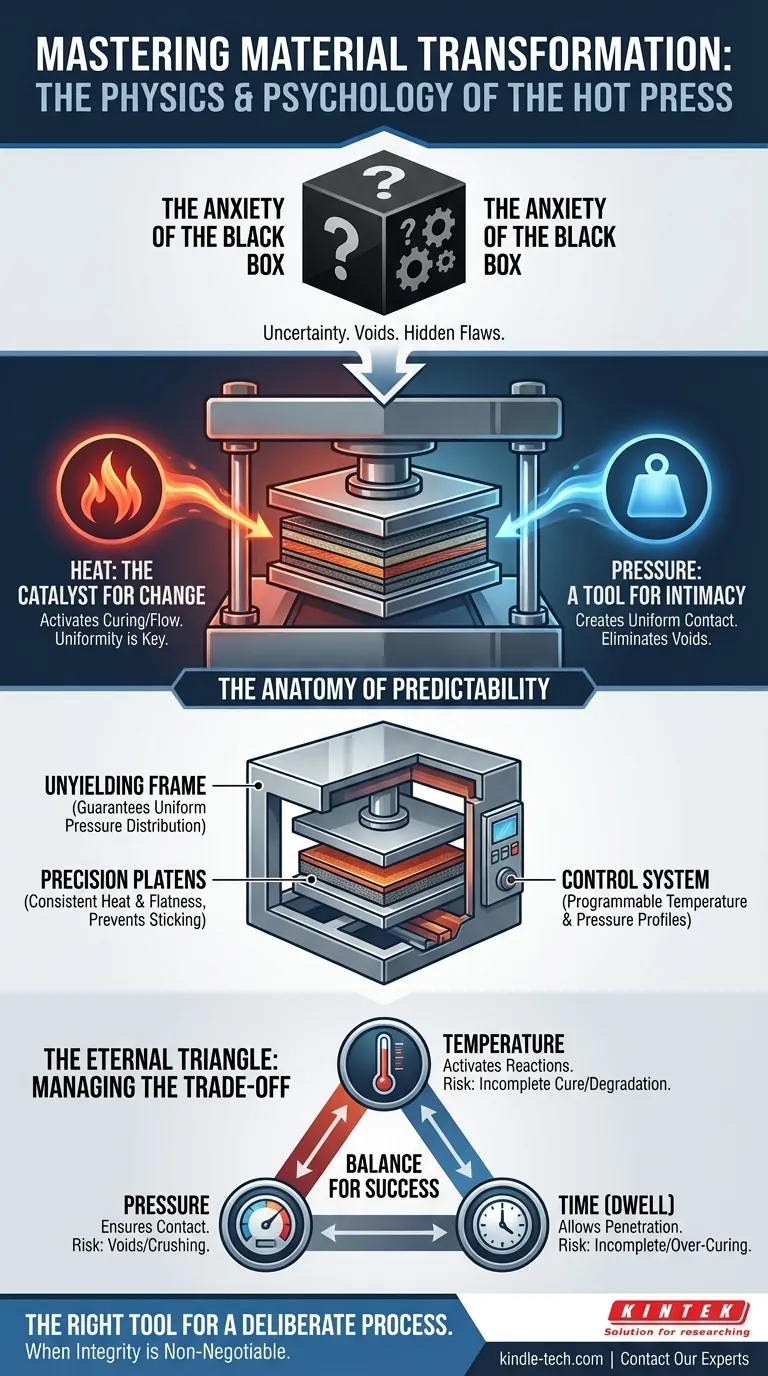
A modern hot press is an instrument of control. Every component is engineered to remove variables and deliver a repeatable outcome. This design philosophy is a direct answer to the anxiety of the black box.
-
The Unyielding Frame: The robust structure ensures the platens remain perfectly parallel under tons of force. It is the physical guarantee of uniform pressure distribution.
-
The Platens: These are the heart of the press. Machined to be perfectly flat and often plated with hard chromium, they deliver consistent heat and prevent materials from sticking. Their thickness is a defense against warping, ensuring they remain a reliable surface for thousands of cycles.
-
The Control System: This is where human intent becomes physical reality. An operator can program precise, multi-stage profiles for temperature and pressure. The process is no longer a simple "on/off" cycle but a carefully choreographed sequence, ensuring the material is cured or bonded under ideal conditions.
The Eternal Triangle: Temperature, Pressure, and Time
Success in hot press molding is about managing a critical trade-off between three key parameters. Optimizing for one often requires a compromise on another. Understanding this balance is key to mastering the process.
| Parameter | Function | The Risk of "Wrong" |
|---|---|---|
| Temperature | Activates chemical reactions (curing) or flow. | Too Low: Incomplete cure, weak bonds. Too High: Material degradation, burning. |
| Pressure | Ensures uniform contact, eliminates voids. | Too Low: Voids, delamination. Too High: Crushing the core, excessive resin bleed-out. |
| Time (Dwell) | Allows heat to penetrate and reactions to complete. | Too Short: Incomplete cure. Too Long: Reduced throughput, potential over-curing. |
The Right Tool for a Deliberate Process
Hot press molding is not always the fastest or cheapest method. Its value is not in speed, but in control.
It is the chosen process when the integrity of a bond is non-negotiable, when a composite panel must be flawless, and when consistency from the first part to the thousandth is paramount.
For research labs and development teams creating the materials of tomorrow, this level of precision isn't a luxury; it's a necessity. Guesswork is the enemy of innovation. That’s why a reliable, high-precision hot press is a cornerstone of any advanced materials laboratory. KINTEK provides robust hot press solutions engineered to deliver the uniform heat and exacting pressure control essential for your most demanding applications.
When your results depend on eliminating variables and achieving perfect consolidation, you need a partner in precision. Contact Our Experts
Visual Guide
Related Products
- Automatic Heated Hydraulic Press Machine with Heated Plates for Laboratory Hot Press 25T 30T 50T
- Manual High Temperature Heated Hydraulic Press Machine with Heated Plates for Lab
- Touchscreen Automatic Vacuum Heat Press
- 30T 40T Split Automatic Heated Hydraulic Press Machine with Heated Plates for Laboratory Hot Press
- Vacuum Hot Press Furnace Machine Heated Vacuum Press
Related Articles
- Why Your Composite and Polymer Parts Keep Failing: The Secret Is Simultaneous Heat and Pressure
- The Physics of Flawless Materials: Deconstructing the Hydraulic Hot Press
- Precision Under Pressure: The Physics and Psychology of the Hydraulic Hot Press
- Hydraulic Hot Press: Principles, Components, Features, Advantages, and Applications
- Comprehensive Guide to Hydraulic Hot Press: Function, Features and Applications