Blog Mastering the Void: How Removing Air Unlocks Material Perfection
Mastering the Void: How Removing Air Unlocks Material Perfection

Mastering the Void: How Removing Air Unlocks Material Perfection

2 hours ago

The Unseen Variable in Every Workshop

Imagine a master chef trying to create a delicate sauce in a kitchen filled with unpredictable drafts and dust. No matter how precise the recipe or skilled the chef, the final product is at the mercy of an environment they can't control.

This is the hidden challenge of traditional heat treatment.

We often think of it as simply applying heat to metal. But we're not just adding energy; we're doing it within an active, reactive atmosphere. The air we breathe, essential for life, becomes a powerful and often destructive variable at high temperatures. It introduces chaos at a microscopic level, leading to imperfections that can compromise the most critical components.

A vacuum furnace changes the rules of the game. It isn't about creating emptiness; it's about engineering a perfect, controlled environment. By removing the unpredictable variable of air, it transforms heat treatment from a craft into a precise science.

The Tyranny of the Atmosphere

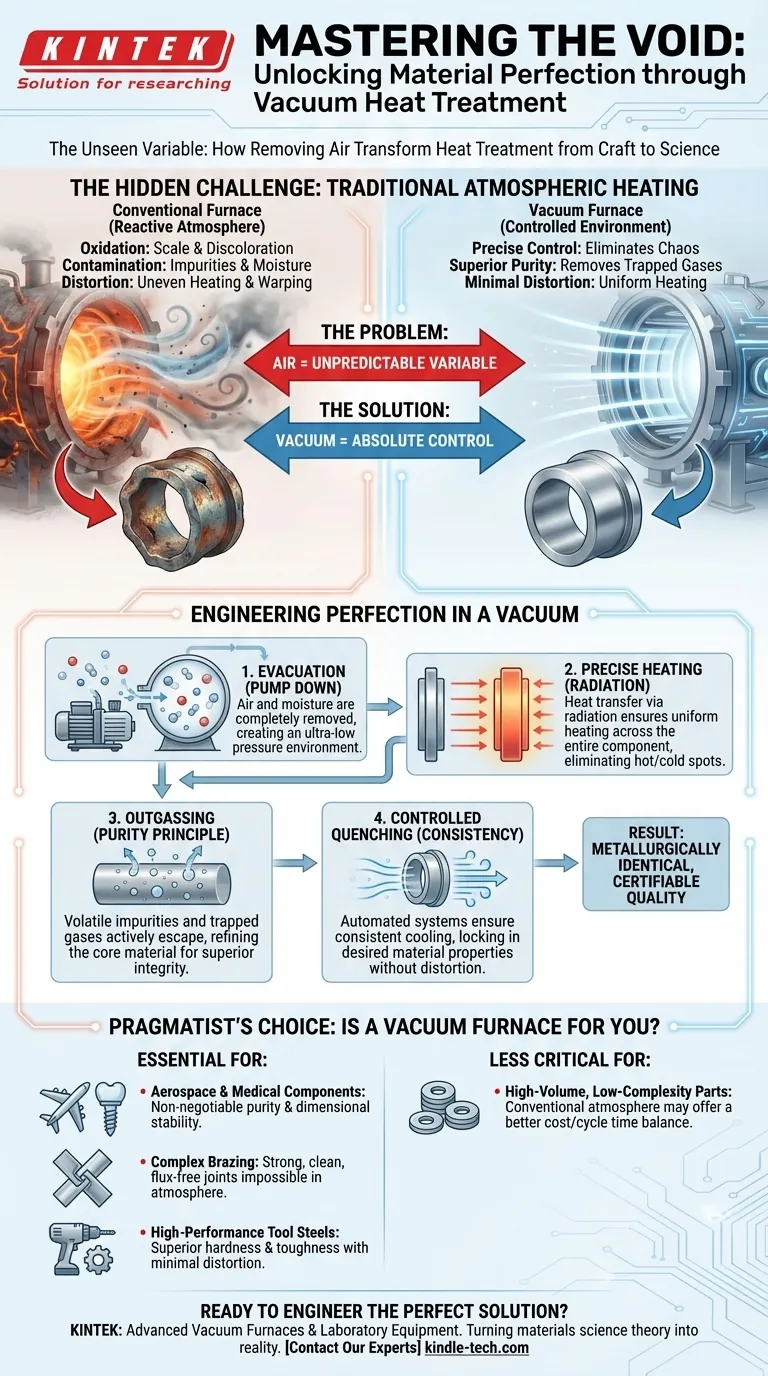
The air in a conventional furnace is an active participant, and rarely for the better. Its presence introduces three fundamental risks to material integrity.

Oxidation: The Obvious Flaw

At high temperatures, oxygen aggressively reacts with a metal's surface. This creates the familiar scale and discoloration, an oxide layer that must often be machined or chemically removed. This isn't just a cosmetic issue; it alters surface properties and can ruin precise dimensions.

Contamination: The Subtle Betrayal

Beyond oxygen, the atmosphere contains moisture, nitrogen, and other trace elements that can infiltrate the material's structure. Worse, the material itself contains trapped impurities. In a normal furnace, these are locked in. A vacuum actively pulls these volatile substances out—a process called outgassing—leading to a fundamentally purer, stronger final product.

Distortion: The Physical Consequence

Atmospheric heating is often uneven. Convection currents create hot and cold spots, imposing thermal stresses across a component. This microscopic battle leads to a macroscopic failure: warping and distortion. For precision parts in aerospace or medical devices, where tolerances are measured in microns, this is unacceptable.

Engineering Perfection in a Vacuum

By removing the air, we don't just prevent problems; we gain an unprecedented level of control over the material's final state. The focus shifts from mitigating chaos to designing a perfect outcome.

From Chaos to Absolute Control

The primary heat transfer mechanism in a vacuum is radiation. This is a far more uniform and predictable method than convection, ensuring the entire component reaches the target temperature at the same rate. This eliminates the thermal stresses that cause distortion and ensures consistent properties throughout the material.

Repeatability by Design

Modern vacuum furnaces, like those offered by KINTEK, are automated systems. The entire cycle—from pump-down and heating to soaking and quenching—is managed by a computer. This removes human error and environmental variance, delivering metallurgically identical results from batch to batch. This isn't just consistency; it's certifiable quality.

The Purity Principle

A vacuum doesn't just protect the surface; it refines the core material. By creating an environment with extremely low pressure, the furnace encourages trapped gases and volatile impurities to escape. The result is a material with superior structural integrity, enhanced electrical properties, and a longer fatigue life.

The Pragmatist’s Choice: Is a Vacuum Furnace for You?

This level of control comes with practical considerations. Vacuum technology represents a higher initial investment and can involve longer cycle times due to the need to pump down the chamber. The high-performance systems also demand diligent, specialized maintenance.

The decision hinges on the demands of your application.

Application Focus Why a Vacuum Furnace is Essential
Aerospace & Medical Components Unmatched purity and dimensional stability are non-negotiable for safety and performance.
Complex Brazing Creates strong, clean, flux-free joints that are impossible to achieve in an atmosphere.
High-Performance Tool Steels Precise heating and rapid quenching deliver superior hardness and toughness with minimal distortion.
High-Volume, Low-Complexity Parts A conventional atmosphere furnace may offer a more economical balance of cost and cycle time.

Ultimately, choosing a vacuum furnace is a statement about quality. It's a commitment to removing uncertainty and engineering materials to their absolute highest potential. For applications where failure is not an option, the controlled environment of a vacuum is the only true path to perfection.

At KINTEK, we provide the advanced vacuum furnaces and laboratory equipment that turn materials science theory into reality. We understand that true innovation lies in the details of process control. If you are ready to eliminate the unseen variables and achieve unparalleled results in your heat treatment processes, our team is here to help you engineer the perfect solution. Contact Our Experts.

Visual Guide
Mastering the Void: How Removing Air Unlocks Material Perfection Visual Guide

Related Products

Related Articles

Related Products

Vacuum Hot Press Furnace Heated Vacuum Press Machine Tube Furnace

Vacuum Hot Press Furnace Heated Vacuum Press Machine Tube Furnace

Reduce forming pressure & shorten sintering time with Vacuum Tube Hot Press Furnace for high-density, fine-grain materials. Ideal for refractory metals.

600T Vacuum Induction Hot Press Furnace for Heat Treat and Sintering

600T Vacuum Induction Hot Press Furnace for Heat Treat and Sintering

Discover the 600T Vacuum Induction Hot Press Furnace, designed for high-temperature sintering experiments in vacuum or protected atmospheres. Its precise temperature and pressure control, adjustable working pressure, and advanced safety features make it ideal for nonmetal materials, carbon composites, ceramics, and metal powders.

Vacuum Heat Treat Furnace with Ceramic Fiber Liner

Vacuum Heat Treat Furnace with Ceramic Fiber Liner

Vacuum furnace with polycrystalline ceramic fiber insulation liner for excellent heat insulation and uniform temperature field. Choose from 1200℃ or 1700℃ max. working temperature with high vacuum performance and precise temperature control.

Vacuum Heat Treat and Pressure Sintering Furnace for High Temperature Applications

Vacuum Heat Treat and Pressure Sintering Furnace for High Temperature Applications

Vacuum pressure sintering furnaces are designed for high temperature hot pressing applications in metal and ceramic sintering. Its advanced features ensure precise temperature control, reliable pressure maintenance, and a robust design for seamless operation.

Vacuum Heat Treat Furnace and Levitation Induction Melting Furnace

Vacuum Heat Treat Furnace and Levitation Induction Melting Furnace

Experience precise melting with our Vacuum Levitation Melting Furnace. Ideal for high melting point metals or alloys, with advanced technology for effective smelting. Order now for high-quality results.

Vacuum Hot Press Furnace Machine Heated Vacuum Press

Vacuum Hot Press Furnace Machine Heated Vacuum Press

Discover the advantages of Vacuum Hot Press Furnace! Manufacture dense refractory metals & compounds, ceramics, and composites under high temp and pressure.

Molybdenum Vacuum Heat Treat Furnace

Molybdenum Vacuum Heat Treat Furnace

Discover the benefits of a high-configuration molybdenum vacuum furnace with heat shield insulation. Ideal for high-purity, vacuum environments like sapphire crystal growth and heat treatment.

2200 ℃ Tungsten Vacuum Heat Treat and Sintering Furnace

2200 ℃ Tungsten Vacuum Heat Treat and Sintering Furnace

Experience the ultimate refractory metal furnace with our Tungsten vacuum furnace. Capable of reaching 2200℃, perfect for sintering advanced ceramics and refractory metals. Order now for high-quality results.

Lab-Scale Vacuum Induction Melting Furnace

Lab-Scale Vacuum Induction Melting Furnace

Get precise alloy composition with our Vacuum Induction Melting Furnace. Ideal for aerospace, nuclear energy, and electronic industries. Order now for effective smelting and casting of metals and alloys.

Graphite Vacuum Furnace IGBT Experimental Graphitization Furnace

Graphite Vacuum Furnace IGBT Experimental Graphitization Furnace

IGBT experimental graphitization furnace, a tailored solution for universities and research institutions, with high heating efficiency, user-friendliness, and precise temperature control.

Vacuum Heat Treat Sintering Brazing Furnace

Vacuum Heat Treat Sintering Brazing Furnace

A vacuum brazing furnace is a type of industrial furnace used for brazing, a metalworking process that joins two pieces of metal using a filler metal that melts at a lower temperature than the base metals. Vacuum brazing furnaces are typically used for high-quality applications where a strong, clean joint is required.

2200 ℃ Graphite Vacuum Heat Treat Furnace

2200 ℃ Graphite Vacuum Heat Treat Furnace

Discover the power of the KT-VG Graphite Vacuum Furnace - with a maximum working temperature of 2200℃, it's perfect for vacuum sintering of various materials. Learn more now.

Vacuum Sealed Continuous Working Rotary Tube Furnace Rotating Tube Furnace

Vacuum Sealed Continuous Working Rotary Tube Furnace Rotating Tube Furnace

Experience efficient material processing with our vacuum-sealed rotary tube furnace. Perfect for experiments or industrial production, equipped with optional features for controlled feeding and optimized results. Order now.

Small Vacuum Heat Treat and Tungsten Wire Sintering Furnace

Small Vacuum Heat Treat and Tungsten Wire Sintering Furnace

The small vacuum tungsten wire sintering furnace is a compact experimental vacuum furnace specially designed for universities and scientific research institutes. The furnace features a CNC welded shell and vacuum piping to ensure leak-free operation. Quick-connect electrical connections facilitate relocation and debugging, and the standard electrical control cabinet is safe and convenient to operate.

Ultra-High Temperature Graphite Vacuum Graphitization Furnace

Ultra-High Temperature Graphite Vacuum Graphitization Furnace

The ultra-high temperature graphitization furnace utilizes medium frequency induction heating in a vacuum or inert gas environment. The induction coil generates an alternating magnetic field, inducing eddy currents in the graphite crucible, which heats up and radiates heat to the workpiece, bringing it to the desired temperature. This furnace is primarily used for graphitization and sintering of carbon materials, carbon fiber materials, and other composite materials.

Vacuum Heat Treat and Molybdenum Wire Sintering Furnace for Vacuum Sintering

Vacuum Heat Treat and Molybdenum Wire Sintering Furnace for Vacuum Sintering

A vacuum molybdenum wire sintering furnace is a vertical or bedroom structure, which is suitable for withdrawal, brazing, sintering and degassing of metal materials under high vacuum and high temperature conditions. It is also suitable for dehydroxylation treatment of quartz materials.

Vacuum Arc Induction Melting Furnace

Vacuum Arc Induction Melting Furnace

Discover the power of Vacuum Arc Furnace for melting active & refractory metals. High-speed, remarkable degassing effect, and free of contamination. Learn more now!

Non Consumable Vacuum Arc Induction Melting Furnace

Non Consumable Vacuum Arc Induction Melting Furnace

Explore the benefits of Non-Consumable Vacuum Arc Furnace with high melting point electrodes. Small, easy to operate & eco-friendly. Ideal for laboratory research on refractory metals & carbides.

Horizontal High Temperature Graphite Vacuum Graphitization Furnace

Horizontal High Temperature Graphite Vacuum Graphitization Furnace

Horizontal Graphitization Furnace: This type of furnace is designed with the heating elements placed horizontally, allowing for uniform heating of the sample. It's well-suited for graphitizing large or bulky samples that require precise temperature control and uniformity.

Vertical High Temperature Graphite Vacuum Graphitization Furnace

Vertical High Temperature Graphite Vacuum Graphitization Furnace

Vertical high temperature graphitization furnace for carbonization and graphitization of carbon materials up to 3100℃.Suitable for shaped graphitization of carbon fiber filaments and other materials sintered in a carbon environment.Applications in metallurgy, electronics, and aerospace for producing high-quality graphite products like electrodes and crucibles.


Leave Your Message