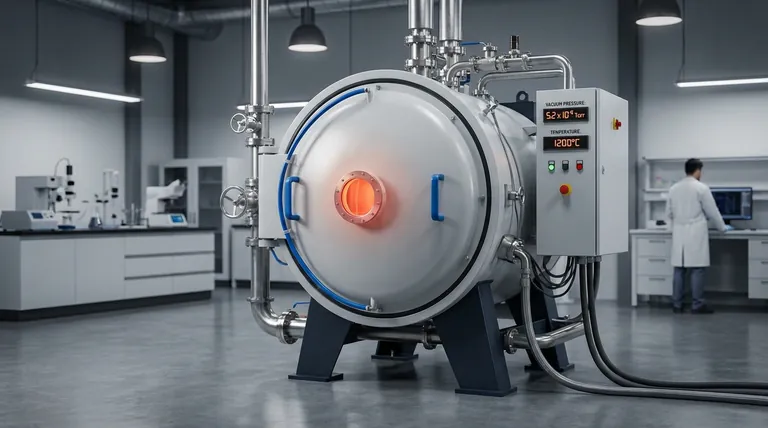
The Invisible Enemy in the Room
Imagine a team of engineers crafting a turbine blade for a new jet engine. The alloy is revolutionary, designed to withstand temperatures that would melt steel. The final step is a heat treatment cycle in a vacuum furnace.
Weeks later, during testing, the blade fails catastrophically. The cause? A microscopic oxide inclusion, an impurity invisible to the naked eye. It formed because a few stray molecules of oxygen—the same gas we need to live—became a corrosive poison at 2000°C.
This isn't a failure of metallurgy. It's a failure of atmosphere.
The Psychology of Emptiness
A vacuum furnace's primary role is not just to get hot. Its real job is to create an environment of absolute control. At high temperatures, the familiar world becomes hostile. The nitrogen, oxygen, and water vapor in the air become hyper-reactive agents of contamination.
Creating a vacuum is an act of removing variables. It's a systematic effort to eliminate the invisible chaos of atmospheric gases, ensuring that the only thing a material interacts with is heat, and itself.
This pursuit of emptiness is driven by a deep-seated need to prevent failure. In aerospace, medicine, and electronics, where the stakes are incredibly high, you cannot afford to let a random oxygen molecule dictate the integrity of a critical component. A vacuum is the ultimate form of risk mitigation.
A Spectrum of Control, Not a Single Number
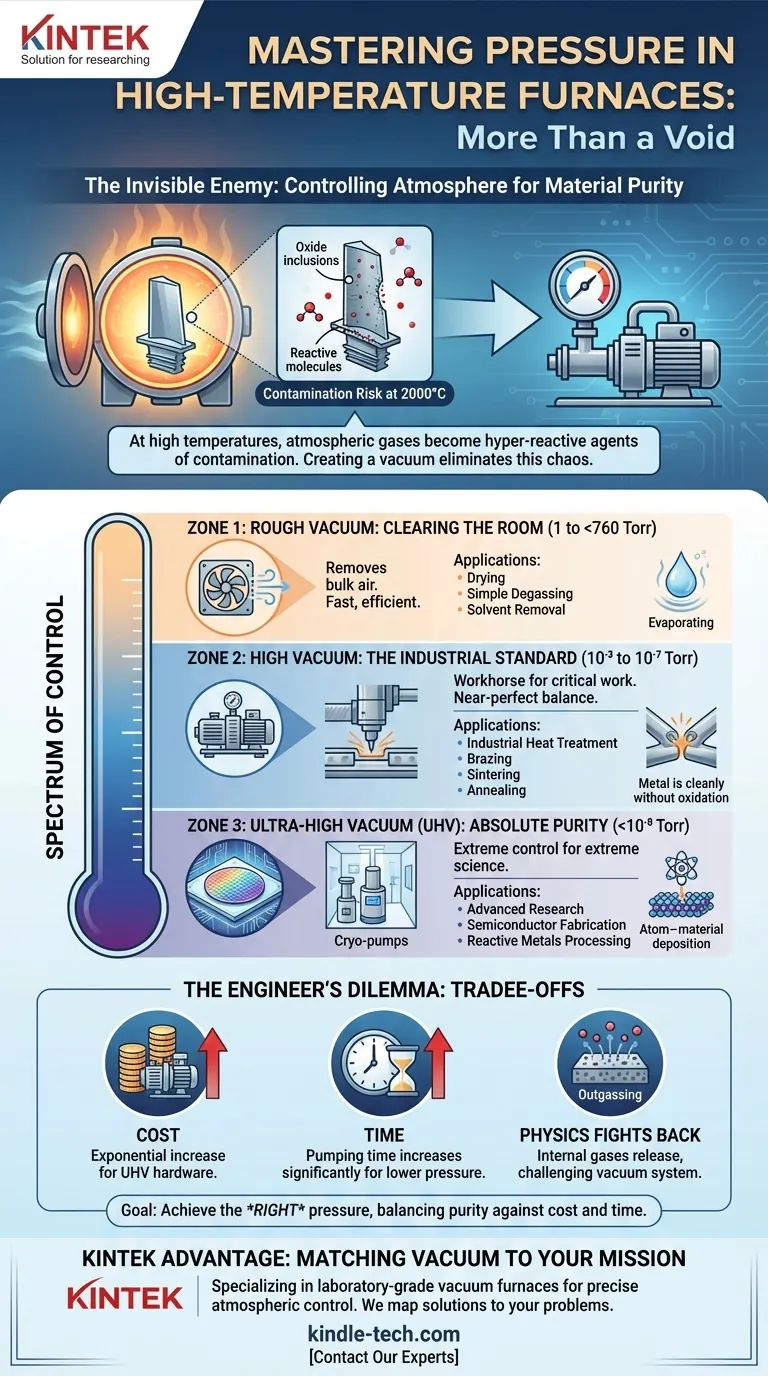
The term "vacuum" is misleadingly simple. It's not a single state but a vast spectrum of engineered emptiness, measured in Torr (where 760 Torr is standard sea-level atmospheric pressure).
Choosing the right level is a strategic decision, not a race to the bottom.
Rough Vacuum: Clearing the Room
(1 to <760 Torr)
This is the first stage, like opening the doors to clear a crowded room. It removes the bulk of the air. It's fast, efficient, and perfect for processes like drying or removing solvents, where the goal is simply to get rid of the majority of moisture and atmospheric gases.
High Vacuum: The Industrial Standard
(10⁻³ to 10⁻⁷ Torr)
This is the realm where most critical work happens. It's an environment pure enough for brazing complex assemblies, sintering powdered metals into solid parts, and heat-treating sensitive alloys without oxidation. This level provides a near-perfect balance of purity, speed, and cost, making it the workhorse for industrial and advanced laboratory applications.
Ultra-High Vacuum (UHV): The Pursuit of Absolute Purity
(<10⁻⁸ Torr)
Reaching UHV is like hunting for the last speck of dust in a football stadium. This level of emptiness is required only for the most sensitive tasks: advanced materials research, semiconductor fabrication, and processes involving metals so reactive they will bond with almost any stray molecule. It's a world of extreme control for extreme science.
The Engineer's Dilemma: The Cost of Nothing
There's a powerful cognitive bias that "more is better." We instinctively assume a deeper vacuum (lower pressure) is always superior. But in engineering, the optimal path is rarely the most extreme one.
The push for lower pressure comes with steep trade-offs.
- Cost: The hardware required for UHV—turbomolecular pumps, cryo-pumps, complex seals—is exponentially more expensive than the mechanical pumps needed for a rough vacuum.
- Time: Pumping a chamber down to a high vacuum might take an hour. Reaching UHV can take many hours, or even days. In a production environment, time is a critical resource.
- Physics Fights Back: As you heat a material, it releases trapped internal gases—a process called outgassing. Your vacuum system must be powerful enough to overcome this constant internal "leak," maintaining purity even as the material itself tries to contaminate the environment.
The goal is not to achieve the lowest possible pressure. The goal is to achieve the right pressure for the job, balancing purity against the practical constraints of time and budget.
Matching the Vacuum to Your Mission
The key is to define your objective first, then select the tool. The furnace's vacuum capability must align perfectly with your material's needs.
| Vacuum Level | Pressure Range (Torr) | Common Applications |
|---|---|---|
| Rough Vacuum | 1 to <760 Torr | Drying, simple degassing, solvent removal |
| High Vacuum | 10⁻³ to 10⁻⁷ Torr | Industrial heat treatment, brazing, sintering, annealing |
| Ultra-High Vacuum (UHV) | <10⁻⁸ Torr | Advanced research, semiconductor manufacturing, reactive metals |
This table doesn't just list numbers; it maps solutions to problems. Your process dictates the vacuum, not the other way around. Whether you are simply drying a sample or developing next-generation alloys, achieving flawless results depends on precise atmospheric control.
At KINTEK, we specialize in providing the laboratory-grade vacuum furnaces that give you this control. We understand that success lies in mastering the invisible environment where your materials are forged. Our systems are designed to deliver the specific, stable, and pure atmosphere your work demands.
To ensure your materials achieve their full potential, you need a partner who understands the nuanced physics of high-temperature processing. Contact Our Experts
Visual Guide
Related Products
- Vacuum Hot Press Furnace Heated Vacuum Press Machine Tube Furnace
- 600T Vacuum Induction Hot Press Furnace for Heat Treat and Sintering
- Vacuum Hot Press Furnace Machine Heated Vacuum Press
- Vacuum Heat Treat Furnace and Levitation Induction Melting Furnace
- 2200 ℃ Tungsten Vacuum Heat Treat and Sintering Furnace
Related Articles
- The Purity Paradox: Choosing the Heart of Your Vacuum Hot Press Furnace
- Comprehensive Guide to Vacuum Hot Press Furnace Application
- Vacuum Hot Press Furnace: A Comprehensive Guide
- Forging Perfection in a Void: The Physics of Ultra-Dense Materials
- Defeating the Void: The Quiet Power of Vacuum Hot Pressing



















