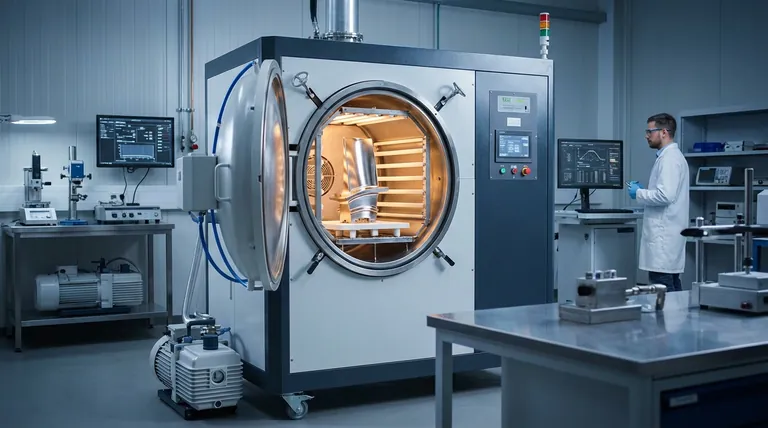
The Invisible Contaminant
Imagine an aerospace engineer inspecting a turbine blade, a marvel of metallurgy designed to withstand incredible stress. A hairline fracture is found, not from a design flaw, but from a microscopic imperfection born during its creation. The culprit wasn't a foreign substance or a faulty alloy.
It was the air itself.
At the high temperatures required for manufacturing advanced components, the oxygen and other gases in our atmosphere become aggressive contaminants. This is the fundamental paradox of traditional heat treatment: the very process designed to strengthen a material can introduce the seeds of its failure.
This forces a psychological shift. We instinctively think of manufacturing as an additive process—we add heat, we add pressure. The vacuum furnace operates on a more profound, almost philosophical principle: true perfection is often achieved not by adding more, but by taking something away.
The Power of Nothing
The defining feature of a vacuum furnace isn't the heat; it's the profound emptiness. By removing the atmosphere, we don't just create an empty space. We create an environment of absolute control.
Winning the War Against Oxidation
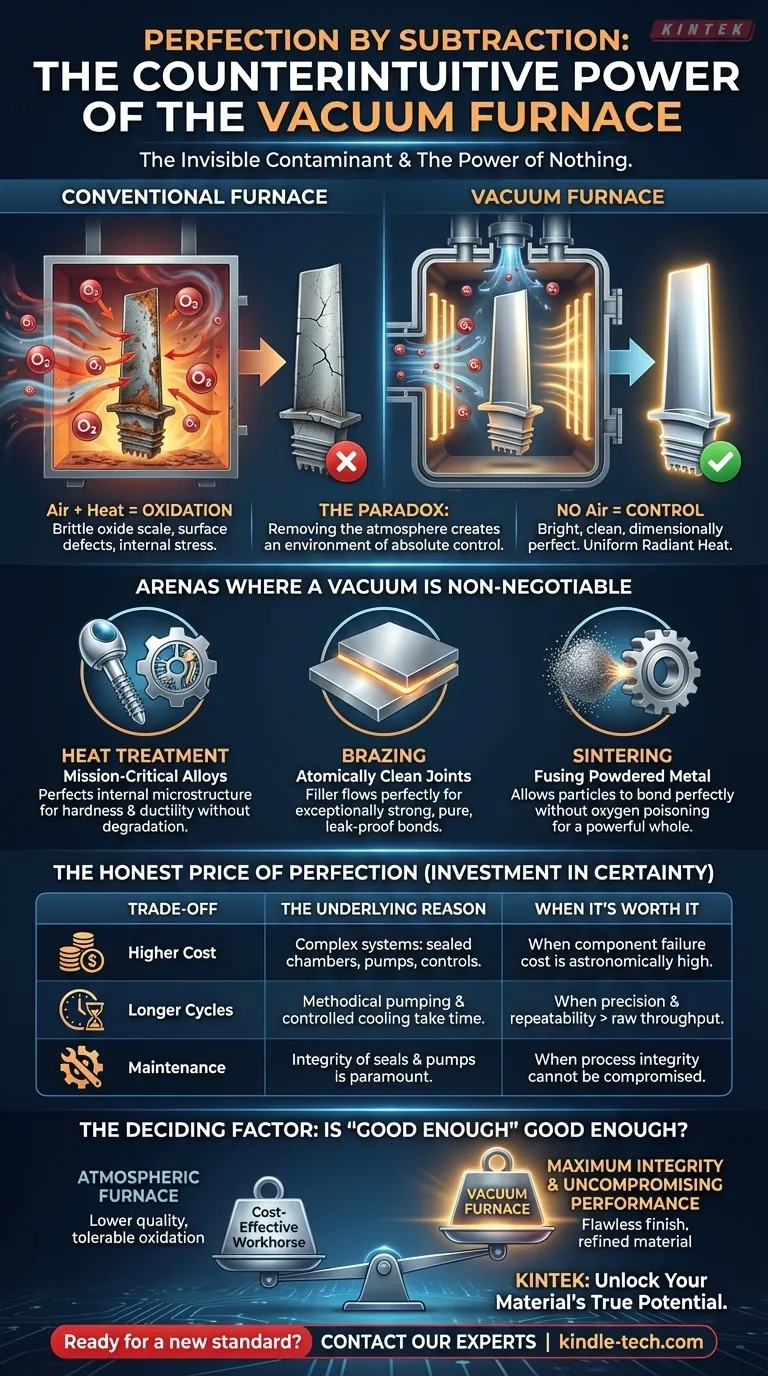
At high temperatures, metal's reaction with oxygen is like rust on fast-forward. It forms a brittle, flaky layer of oxide scale that compromises surface finish, alters precise dimensions, and creates weak points.
A vacuum furnace uses powerful pumps to remove the atmospheric reactant. In its place is a void. This subtractive process results in a component that emerges from the heat bright, clean, and dimensionally perfect, eliminating the need for corrosive and costly post-process cleaning.
The Certainty of Radiant Heat
In a conventional furnace, heat is transferred chaotically by air currents (convection). Some parts of a component get hotter, faster. This unevenness creates internal stresses.
In a vacuum, heat transfer occurs primarily through radiation. The heating elements emit thermal energy that travels unimpeded, striking all surfaces of the workpiece with incredible uniformity. Every part of the component receives the same thermal instructions at the same time, ensuring predictable, homogenous results.
Arenas Where a Vacuum is Non-Negotiable
This level of control isn't a luxury; for many advanced applications, it is a strict necessity. The process dictates the performance, and in these fields, performance is everything.
-
Heat Treatment: For mission-critical alloys in aerospace or medical implants, a vacuum ensures the material's internal microstructure is perfected to achieve specific hardness or ductility without any surface degradation. The material reaches its full theoretical potential.
-
Brazing: This process joins metals with a filler material. In a vacuum, the joint is atomically clean. The filler metal flows perfectly into the gap, creating a bond that is exceptionally strong, pure, and leak-proof. It’s the difference between a simple joint and a seamless, monolithic structure.
-
Sintering: Fusing powdered metal into a solid, dense part is a delicate dance. Each tiny grain must bond perfectly with its neighbors. The presence of oxygen would poison this process, preventing proper fusion. A vacuum is the only environment that allows these particles to form a clean, powerful whole.
The Honest Price of Perfection
Such a powerful tool is not a universal solution. Its advantages are balanced by deliberate trade-offs, which are less about drawbacks and more about the focus of the process itself.
| Trade-Off | The Underlying Reason | When It's Worth It |
|---|---|---|
| Higher Cost | Complex systems: sealed chambers, powerful pumps, sophisticated controls. | When the cost of component failure is astronomically high. |
| Longer Cycles | The methodical process of pumping down a vacuum and controlled cooling takes time. | When precision and repeatability are more critical than raw throughput. |
| Maintenance | The integrity of the vacuum system (seals, pumps) is paramount and requires expertise. | When process integrity cannot be compromised by even the smallest leak. |
Choosing a vacuum furnace is an investment in certainty. You are paying to eliminate an entire category of variables that can lead to failure.
The Deciding Factor: Is "Good Enough" Good Enough?
The choice between an atmospheric furnace and a vacuum furnace boils down to a single question: what is your standard for quality?
If your parts can tolerate a degree of surface oxidation and the application is not mission-critical, a conventional furnace is a cost-effective workhorse.
But if your goal is maximum material integrity, a flawless surface finish, and uncompromising performance, you aren't just heating a part; you are refining it in a controlled universe. You are choosing to work in a vacuum.
For laboratories and R&D teams operating at the frontier where material purity defines success, controlling this unseen variable is everything. KINTEK provides high-quality vacuum furnaces and lab equipment engineered to deliver that precise, contaminant-free environment. We empower you to unlock the true potential of your materials.
Ready to achieve a new standard of material perfection? Contact Our Experts
Visual Guide
Related Products
- Vacuum Hot Press Furnace Heated Vacuum Press Machine Tube Furnace
- 600T Vacuum Induction Hot Press Furnace for Heat Treat and Sintering
- Vacuum Hot Press Furnace Machine Heated Vacuum Press
- Vacuum Heat Treat Furnace and Levitation Induction Melting Furnace
- 2200 ℃ Tungsten Vacuum Heat Treat and Sintering Furnace
Related Articles
- The Purity Paradox: Choosing the Heart of Your Vacuum Hot Press Furnace
- Comprehensive Guide to Vacuum Hot Press Furnace Application
- Vacuum Hot Press Furnace: A Comprehensive Guide
- Forging Perfection in a Void: The Physics of Ultra-Dense Materials
- Defeating the Void: The Quiet Power of Vacuum Hot Pressing



















