The Tyranny of the Void
An engineer is designing a ceramic component for a satellite's optical system. It cannot warp, it cannot fracture, and it must be dimensionally perfect. A tiny, microscopic void—an empty space smaller than a grain of sand—could concentrate stress under launch vibrations and lead to catastrophic failure.
This isn't just a manufacturing problem; it's a philosophical one. How close to perfection must a material be? And what is the price of eliminating that last 1% of imperfection?
This is the core dilemma engineers face when choosing between two fundamental methods of powder metallurgy: hot pressing and the more conventional cold pressing followed by sintering. The choice reveals a deep tension between the pursuit of absolute material integrity and the pragmatic demands of cost and scale.
Two Philosophies of Creation
At their heart, these two processes represent different beliefs about how to turn loose powder into a solid, dependable part.
The Path of Integration: Hot Pressing
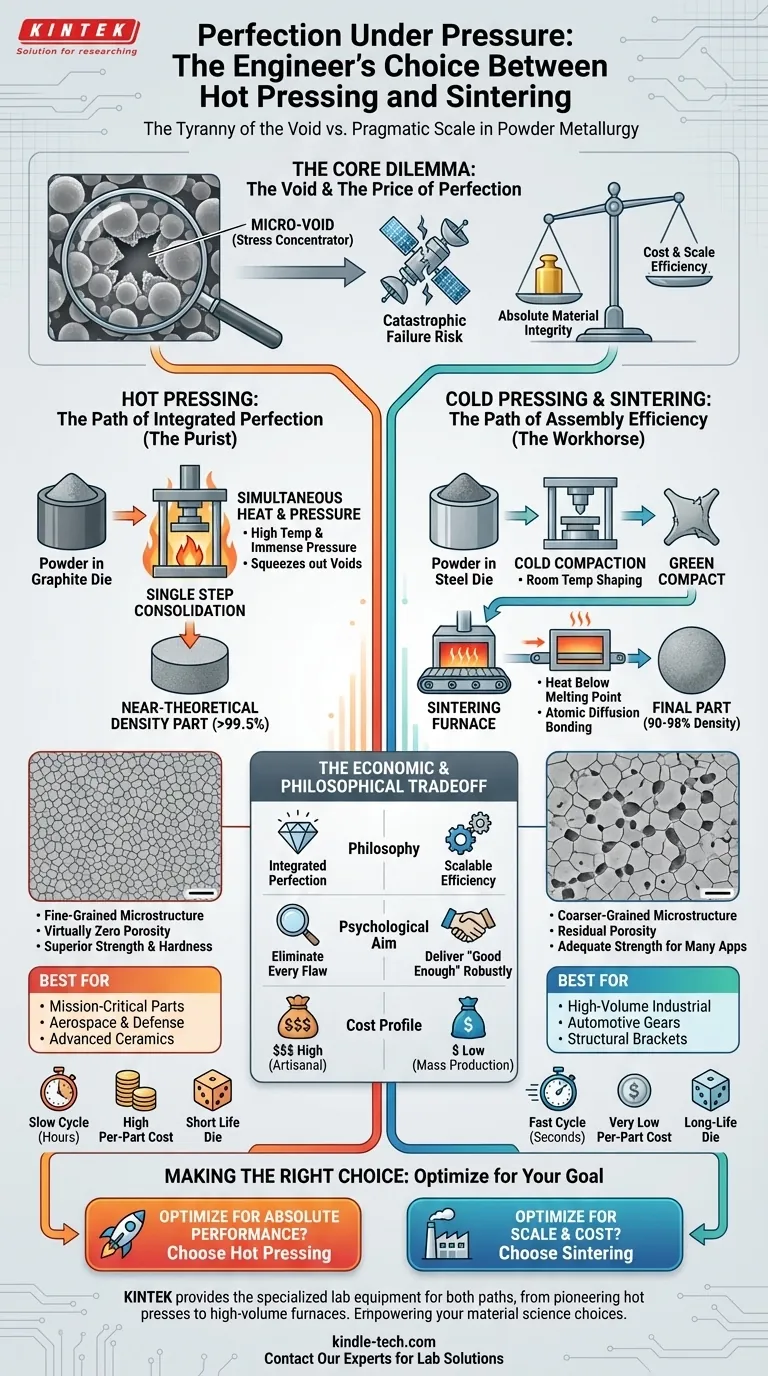
Hot pressing is the method of the purist. It combines compaction and thermal bonding into a single, elegant step.
Powder is loaded into a die, typically made of graphite, which is then heated to extreme temperatures while immense pressure is applied simultaneously. The heat softens the particles, and the pressure actively squeezes out the voids, forcing the material into a state of near-theoretical density.
It's a process built on control, aiming to eliminate flaws at the moment of creation.
The Path of Assembly: Cold Pressing & Sintering
This is the workhorse of modern industry, a two-step method built on efficiency.
First, the powder is compacted into a "green compact" at room temperature. This part is solid enough to be handled but is mechanically weak. Then, this compact is moved to a furnace and sintered—heated to just below its melting point—where the particles slowly bond and fuse together.
This is manufacturing as an assembly line: one distinct process for shaping, another for strengthening. It’s a philosophy built on scalability and speed.
The Anatomy of a Flaw
The decision between these two paths often comes down to a single factor: porosity. In materials science, a pore isn't just empty space; it's a potential point of failure.
The Pursuit of 99.9%
Hot pressing excels at hunting down and eliminating these voids. By applying pressure during the heating cycle, it closes off the escape routes for pores and accelerates densification.
The result is a final part with density often exceeding 99.5% of the theoretical maximum. This lack of porosity translates directly into superior mechanical properties—higher strength, greater hardness, and enhanced fracture toughness. The material is as close to a perfect solid as one can get.
The Virtue of "Good Enough"
Cold pressing and sintering, by contrast, almost always leaves some residual porosity, with densities typically in the 90-98% range. The sintering process relies on atomic diffusion, which can struggle to close the final, stubborn voids.
But for countless applications, from automotive gears to structural brackets, this level of density is not just good enough; it's optimal. The marginal gains in strength from eliminating that last 5% of porosity often don't justify the exponential increase in cost and time.
The Microstructure's Silent Story
Beyond density, the processes tell different stories at the microscopic level.
Sintering requires long times at high temperatures. This long "bake" encourages grains within the material to grow larger. While this helps bonding, larger grains can sometimes compromise a material's strength, in the same way a wall made of a few large boulders is weaker than one made of many well-interlocked bricks.
Hot pressing achieves full density much faster and often at lower temperatures. This short, intense cycle effectively freezes the microstructure in a fine-grained state, preserving its intrinsic strength and hardness. It’s the metallurgical equivalent of a flash-freeze, locking in peak performance.
The Unavoidable Logic of Economics
While an engineer's heart may desire the perfection of hot pressing, the balance sheet often demands the pragmatism of sintering.
| Feature | Hot Pressing | Cold Pressing & Sintering |
|---|---|---|
| Philosophy | Integrated Perfection | Scalable Efficiency |
| Cycle Time | Slow (hours per batch) | Fast (seconds per part) |
| Cost Profile | High per-part cost (expensive, short-life dies) | Very low per-part cost (at high volume) |
| Best For | Mission-critical parts, advanced ceramics | High-volume industrial components |
| Psychological Aim | Eliminate every potential flaw | Deliver robust performance cost-effectively |
Hot pressing is an artisanal, low-volume process. Its graphite or ceramic dies are expensive and wear out quickly under the harsh conditions.
Cold pressing is built for mass production. Its steel dies can stamp out millions of parts, driving the per-unit cost down to cents. It is the engine of the modern parts industry.
Making the Right Choice
Ultimately, the choice is not about which process is "better," but which is right for the job. It requires asking the right question:
- Are you optimizing for absolute performance? For applications where failure is not an option—aerospace, defense, advanced R&D—hot pressing is the clear choice. It is the only way to reliably produce materials like non-oxide ceramics or complex composites with near-zero porosity.
- Are you optimizing for scale and cost? For producing millions of reliable gears, bearings, or connectors, cold pressing and sintering is the undisputed champion. It is the engine of industrial manufacturing.
Navigating this decision requires not just theoretical knowledge, but the right tools to test, validate, and produce. From laboratory-scale hot presses for pioneering new materials to the furnaces required for high-volume sintering, the equipment defines the boundary of what is possible.
At KINTEK, we provide the specialized lab equipment and consumables that empower researchers and engineers to turn these complex material science choices into tangible results. Whether you are chasing perfection or engineering for scale, understanding your tools is the first step. If you're weighing these critical trade-offs for your next project, our team is ready to help you find the right equipment for the task. Contact Our Experts
Visual Guide
Related Products
- Heated Hydraulic Press Machine with Heated Plates Split Manual Laboratory Hot Press
- Automatic Heated Hydraulic Press Machine with Heated Plates for Laboratory Hot Press 25T 30T 50T
- Automatic Heated Hydraulic Press Machine with Heated Plates for Laboratory Hot Press
- Heated Hydraulic Press Machine with Heated Plates for Vacuum Box Laboratory Hot Press
- Manual High Temperature Heated Hydraulic Press Machine with Heated Plates for Lab
Related Articles
- How to choose a laboratory hot press
- Why Your Composite and Polymer Parts Keep Failing: The Secret Is Simultaneous Heat and Pressure
- Choosing the Right Press for Your Laboratory Needs
- More Than a Squeeze: The Physics and Psychology of the Hydraulic Hot Press
- Comprehensive Guide to Hydraulic Hot Press: Function, Features and Applications