The Struggle Against Entropy
In metallurgy, nature is an adversary. If you heat a metal in the open air, nature responds with oxidation. It seeks to revert refined materials back to their chaotic, ore-like states.
We build vacuum furnaces not just to get things hot, but to create a sanctuary.
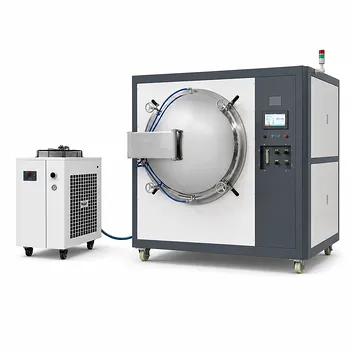
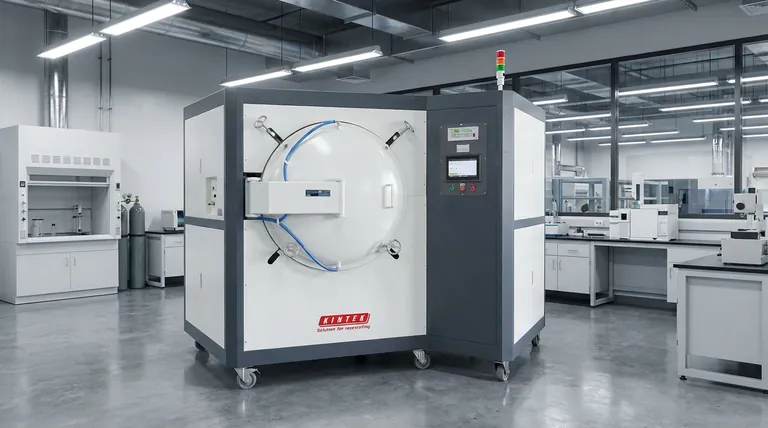
A vacuum furnace is a highly controlled environment designed to pause the laws of nature. It creates a space where heat can do its work without the interference of air. But this "box of nothing" is actually a complex, interconnected organism.
It relies on five critical systems working in absolute concert. When one fails, the physics collapse. Here is the anatomy of that machine.
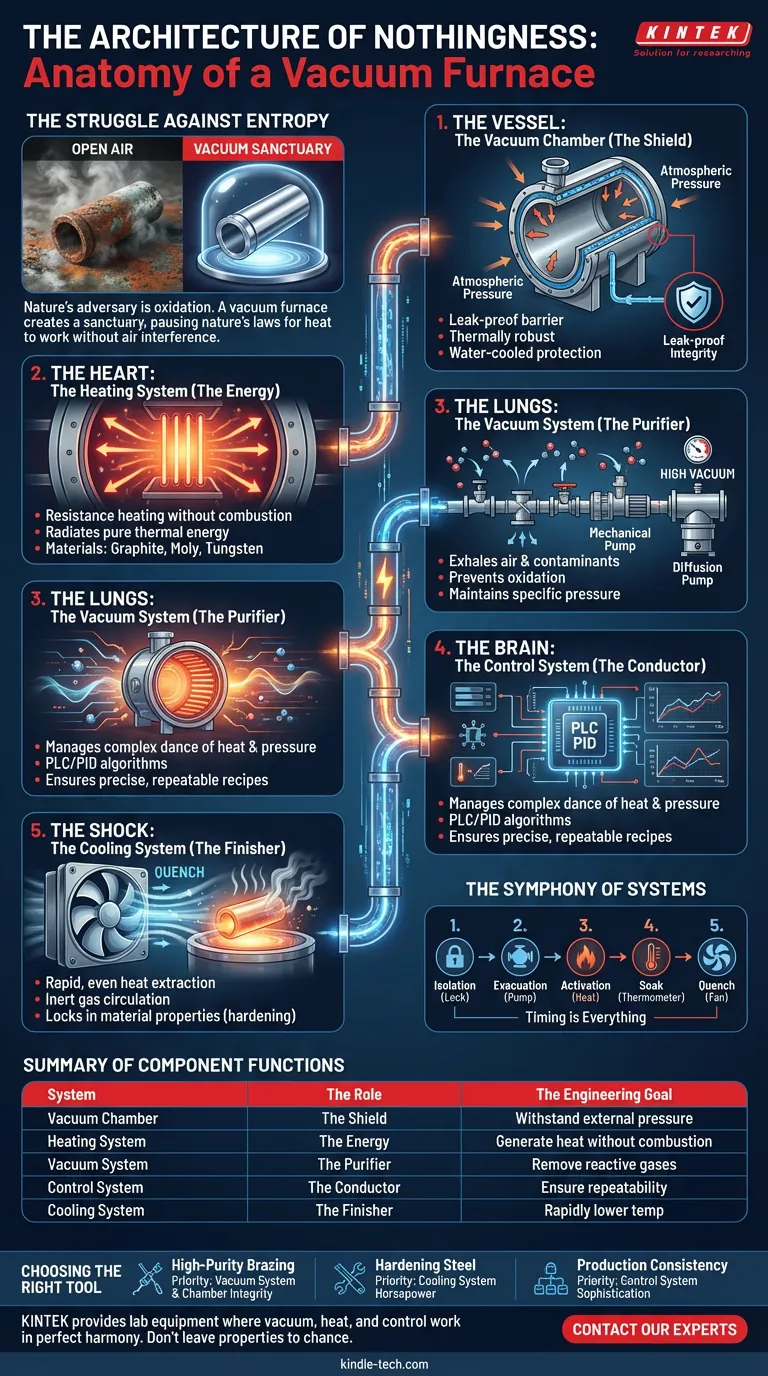
1. The Vessel: The Vacuum Chamber
The first requirement of control is isolation.
The vacuum chamber, or furnace shell, is the physical barrier between your process and the atmosphere. It is a submarine in reverse; instead of keeping the ocean out, it must withstand the immense crushing pressure of the atmosphere trying to rush back into the void.
To maintain integrity, this shell must be:
- Leak-proof: Even microscopic gaps compromise the process.
- Thermally Robust: Able to contain internal infernos while remaining stable.
- Water-Cooled: Often double-walled to protect the operator and the shell itself.
2. The Heart: The Heating System
Once you have isolated the space, you must energize it. The heating system typically resides inside the chamber.
In a standard oven, heat is simple. In a vacuum, heat is a challenge. You cannot use standard burners because there is no oxygen to support combustion.
Instead, we rely on resistance. The heating elements act as the heart of the furnace, radiating pure thermal energy. Because they operate in a vacuum, these elements can be made of materials that would otherwise burn up instantly in air:
- Graphite: Excellent for high-temperature stability.
- Molybdenum or Tungsten: Specialized metals for specific purity requirements.
3. The Lungs: The Vacuum System
This is the defining feature of the machine. The vacuum system is responsible for the "exhale"—removing air, gases, and vaporized contaminants.
It is not enough to just pump the air out once. The system often employs a series of pumps and gauges to maintain a specific pressure level throughout the cycle. By removing the atmosphere, we remove the oxygen.
Without oxygen, there is no oxidation. The metal emerges brighter and stronger than when it went in.
4. The Brain: The Control System
Complexity requires management.
A vacuum furnace is a dangerous dance of high voltage, extreme heat, and pressure differentials. The Control System is the brain that keeps this dance from becoming a disaster.
Using sophisticated PLC (Programmable Logic Controller) or PID loops, the system reads data from sensors (thermocouples) and adjusts the power millisecond by millisecond. It ensures the material follows a precise "thermal recipe," guaranteeing that the result is repeatable.
5. The Shock: The Cooling System
Heating changes the structure of the material; cooling locks it in place.
Once the heating cycle finishes, the material is often too soft. To achieve hardness, it must be cooled rapidly but evenly. Since there is no air to carry the heat away, the Cooling System takes over.
It typically backfills the vacuum chamber with an inert gas (like Argon or Nitrogen) and circulates it furiously over the parts using high-velocity fans. This rapid heat extraction—quenching—is what gives steel its edge.
The Symphony of Systems
The magic of a vacuum furnace lies in the sequence. It is a relay race where timing is everything.
- Isolation: The chamber seals.
- Evacuation: The vacuum system purges the atmosphere.
- Activation: The control system ramps up the heating elements.
- Soak: The material sits at peak temperature, transforming.
- Quench: The cooling system freezes that transformation in time.
Summary of Component Functions
| System | The Role | The Engineering Goal |
|---|---|---|
| Vacuum Chamber | The Shield | Withstand external atmospheric pressure. |
| Heating System | The Energy | Generate heat without combustion (Graphite/Moly). |
| Vacuum System | The Purifier | Remove reactive gases and oxygen. |
| Control System | The Conductor | Ensure repeatability via PLC/PID algorithms. |
| Cooling System | The Finisher | Rapidly lower temp to lock in material properties. |
Choosing the Right Tool
Understanding these components changes how you buy and use these machines.
If you are doing high-purity brazing, your priority is the quality of the Vacuum System and the leak integrity of the Chamber.
If you are hardening steel, your priority is the horsepower of the Cooling System to ensure a fast enough quench.
If you need production-line consistency, your priority is the sophistication of the Control System.
At KINTEK, we understand that a furnace is more than the sum of its parts. It is an instrument of precision. Whether you need high-purity annealing or aggressive quenching, we provide lab equipment designed where the vacuum, heat, and control systems work in perfect harmony.
Don't leave your material properties to chance.
Contact Our Experts to discuss your specific thermal processing needs and find the KINTEK solution that fits your laboratory.
Visual Guide
Related Products
- Vacuum Hot Press Furnace Heated Vacuum Press Machine Tube Furnace
- 600T Vacuum Induction Hot Press Furnace for Heat Treat and Sintering
- Vacuum Hot Press Furnace Machine Heated Vacuum Press
- Vacuum Heat Treat Furnace and Levitation Induction Melting Furnace
- 2200 ℃ Tungsten Vacuum Heat Treat and Sintering Furnace
Related Articles
- The Purity Paradox: Choosing the Heart of Your Vacuum Hot Press Furnace
- Comprehensive Guide to Vacuum Hot Press Furnace Application
- Vacuum Hot Press Furnace: A Comprehensive Guide
- Forging Perfection in a Void: The Physics of Ultra-Dense Materials
- Defeating the Void: The Quiet Power of Vacuum Hot Pressing