In the world of material science, we are often obsessed with addition.
We add carbon to iron to make steel. We add chromium to prevent rust. We coat, we plate, and we alloy, believing that the path to a superior product is always found in more.
But in the most critical applications—aerospace turbines, medical implants, and semiconductors—the biggest threat isn't a lack of ingredients. It is the environment itself.
At high temperatures, the air we breathe becomes a corrosive enemy. Oxygen transforms from a life-giver into a contaminant, reacting with metals to create brittle oxide layers that act like microscopic fault lines.
This is where the vacuum furnace enters the narrative. It is a machine built on a counter-intuitive premise: sometimes, to make something stronger, you must take everything else away.
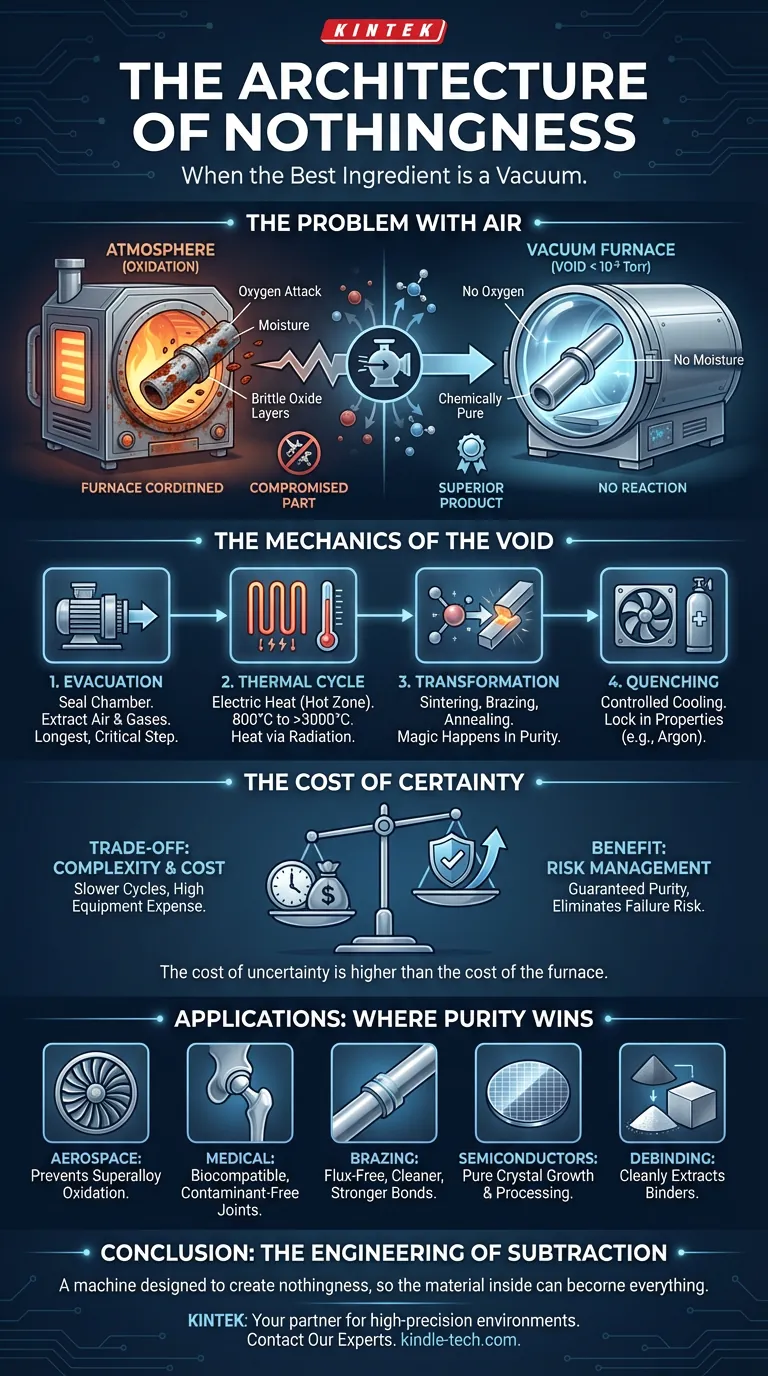
The Problem with Air
Imagine trying to weld two pieces of aerospace-grade alloy. In a standard furnace, even a microscopic amount of oxygen triggers rapid oxidation. The metal "rusts" instantly at 1000°C.
The result is a part that looks strong but hides a chemically compromised surface. In high-stakes engineering, this uncertainty is unacceptable.
A vacuum furnace solves this by mechanically removing the atmosphere. It pulls the pressure down to levels often less than 10⁻³ Torr.
In this void, chemical reactions stop.
- No Oxygen: Oxidation is physically impossible.
- No Moisture: Hydrogen embrittlement is prevented.
- No Contaminants: The material remains chemically pure.
The vacuum doesn't just heat the material; it protects it.
The Mechanics of the Void
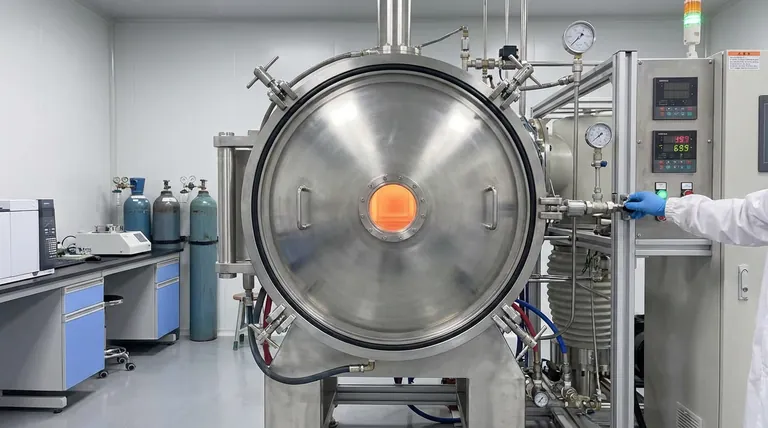
A vacuum furnace is not simply an oven; it is a pressure vessel wrapped in a thermal management system. The operation follows a logic of strict isolation.
1. Evacuation
Before a single degree of heat is added, the chamber is sealed. Powerful pumping systems extract air and gases. This is the longest and most critical step. If you rush the vacuum, you ruin the purity.
2. The Thermal Cycle
Once the environment is "empty," electric heating elements (the hot zone) activate. Temperatures can soar from 800°C to over 3000°C. Because there is no air to transfer heat via convection, the furnace relies on radiation. It is a pure, direct transfer of energy.
3. Transformation
This is where the magic happens.
- Sintering: Powders fuse into solid mass without impurities.
- Brazing: Filler metals flow into joints without the need for messy flux.
- Annealing: Stresses in the metal relax, softening the structure for further working.
4. Quenching
The process often ends with controlled cooling. Some furnaces introduce inert gases (like Argon) to cool the parts rapidly, locking in specific metallurgical properties.
The Cost of Certainty
If vacuum furnaces are so superior, why isn't every toaster a vacuum chamber?
The trade-off is complexity.
Running a vacuum furnace is slower than running an atmospheric one. You cannot simply open the door, toss in a part, and pull it out. The cycle of pumping down, heating, and cooling requires time.
Furthermore, the equipment is expensive. You are paying for heavy-duty seals, precision pumps, and the electricity to run them.
But you have to view this through the lens of risk management.
In industries like medical manufacturing, the cost of a failed batch due to contamination is astronomical. The cost of a vacuum furnace is high, but the cost of uncertainty is higher. You pay a premium for the guarantee that the environment will not attack your product.
Applications: Where Purity Wins
Vacuum technology is the standard wherever "good enough" is not an option.
| Application | The Role of Vacuum |
|---|---|
| Aerospace Components | Prevents oxidation on superalloys used in jet engines. |
| Medical Implants | Ensures titanium joints are biocompatible and contaminant-free. |
| Brazing (Joining) | Allows flux-free joining, creating cleaner, stronger bonds. |
| Semiconductors | Essential for growing pure crystals and processing wafers. |
| Debinding | Cleanly extracts binder materials from sintered powders. |
Conclusion: The Engineering of Subtraction
There is a certain romance to the vacuum furnace. It is a machine designed to create nothingness, so that the material inside can become everything it was meant to be.
It removes the noise, the chaos, and the chemistry of the atmosphere, leaving only the heat and the metal.
At KINTEK, we understand that for high-precision laboratories, the environment is just as important as the equipment. Whether you are sintering advanced ceramics or annealing delicate alloys, the quality of your vacuum determines the quality of your results.
Don't let the atmosphere compromise your research.
Visual Guide
Related Products
- Vacuum Hot Press Furnace Heated Vacuum Press Machine Tube Furnace
- 600T Vacuum Induction Hot Press Furnace for Heat Treat and Sintering
- Vacuum Hot Press Furnace Machine Heated Vacuum Press
- Vacuum Heat Treat Furnace and Levitation Induction Melting Furnace
- 2200 ℃ Tungsten Vacuum Heat Treat and Sintering Furnace
Related Articles
- The Purity Paradox: Choosing the Heart of Your Vacuum Hot Press Furnace
- Comprehensive Guide to Vacuum Hot Press Furnace Application
- Vacuum Hot Press Furnace: A Comprehensive Guide
- Forging Perfection in a Void: The Physics of Ultra-Dense Materials
- Defeating the Void: The Quiet Power of Vacuum Hot Pressing