Blog The Art of Nothingness: Vacuum, Inert Gas, and the Pursuit of Purity
The Art of Nothingness: Vacuum, Inert Gas, and the Pursuit of Purity

The Art of Nothingness: Vacuum, Inert Gas, and the Pursuit of Purity

7 hours ago

The Violence of Heat

When you heat a metal, you are not just changing its temperature. You are changing its personality.

At room temperature, steel and titanium are stable. But add extreme thermal energy, and they become chemically desperate. They yearn to bond with oxygen. They seek out carbon.

In a standard room, the air is filled with reactive elements waiting to attack the surface of your material. The result is oxidation (scaling) or decarburization. The metal comes out weaker and uglier than it went in.

This is the central problem of heat treatment: How do you protect a material at its most vulnerable moment?

There are two primary schools of thought. One is to crowd out the enemy. The other is to remove the battlefield entirely.

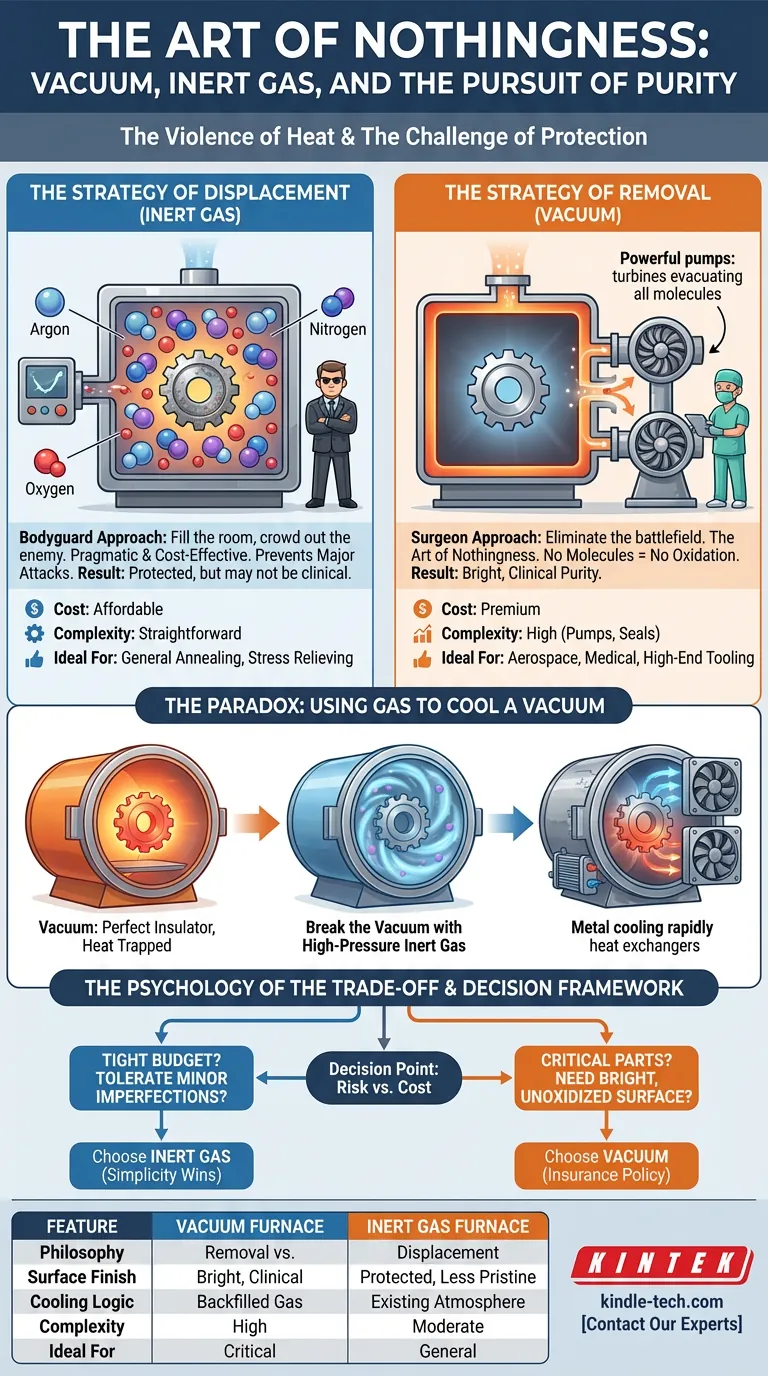
The Strategy of Displacement (Inert Gas)

The first strategy is the Inert Gas Furnace.

Think of this as a bodyguard approach. You cannot empty the room of air, so you fill it with something else—something that refuses to fight.

You pump the furnace chamber full of Argon or Nitrogen. These non-reactive gases displace the oxygen, blanketing your workpiece in a protective fog.

It is effective. It prevents the major chemical attacks.

It is also pragmatic.

  • Cost: It is generally affordable.
  • Complexity: The machinery is straightforward.
  • Result: It prevents scaling, though it may not achieve clinical perfection.

For general annealing or stress relieving where "good enough" is acceptable, displacement is the logical economic choice.

The Strategy of Removal (Vacuum)

The second strategy is the Vacuum Furnace.

This is the approach of the surgeon. You don't just cover up the contaminants; you eliminate them.

Using powerful pumps, a vacuum furnace evacuates the chamber, physically removing air molecules until the pressure drops to near-space levels.

The result is "The Art of Nothingness."

Because there are no molecules to react with, there is no oxidation. None. The part emerges from the furnace with a "bright" surface finish—often cleaner than when it went in.

This purity is non-negotiable for high-stakes industries:

  • Aerospace components.
  • Medical implants.
  • High-end tool steels.

If the cost of failure is high, you pay the premium for the vacuum.

The Paradox: Using Gas to Cool a Vacuum

Here is where the engineering gets romantic, and where most confusion arises.

A vacuum is a perfect insulator. A thermos flask works on this principle. If there is no air, heat cannot travel by convection. It stays trapped in the metal.

This is great for efficiency during heating. It is a disaster for cooling.

In metallurgy, how you cool (quench) is often more important than how you heat. To harden steel, you need to cool it violently fast to freeze the microstructure in place.

So, how do you cool something rapidly in a vacuum that acts like a thermos?

You break the vacuum.

In modern vacuum furnaces, once the heating cycle is done, the system rapidly backfills the chamber with high-pressure inert gas. Powerful fans circulate this gas through heat exchangers, stripping the heat away from the metal.

This gives you the best of both worlds:

  1. Heating: The absolute purity of a vacuum.
  2. Cooling: The speed and control of gas quenching.

The Psychology of the Trade-off

Choosing between a standard inert gas furnace and a vacuum furnace is rarely a technical impossibility. It is usually a psychological calculation of risk versus cost.

A vacuum furnace is a complex beast. It requires robust chambers, high-performance seals, and sophisticated pumping systems. It is expensive to buy and slower to cycle (pumping down takes time).

An inert gas furnace is simpler, faster, and cheaper.

How do you choose?

The Decision Framework

  • Choose Vacuum if: You need a bright, unoxidized surface without post-processing. If you are working with reactive alloys (Titanium) or critical medical/aerospace parts, the premium is an insurance policy you must buy.
  • Choose Inert Gas if: You are doing general oxidation protection. If your budget is tight and you can tolerate minor surface imperfections, simplicity wins.
  • Choose Active Atmosphere if: You actually want a reaction (like carburizing or nitriding). Neither vacuum nor inert gas will help you there; you need reactive gases to change the surface chemistry.

Summary: The Engineering Trade-offs

Feature Vacuum Furnace Inert Gas Furnace
Philosophy Removal: Eliminate the atmosphere entirely. Displacement: Replace air with non-reactive gas.
Surface Finish Bright, clean, clinical purity. Protected, but less pristine than vacuum.
Cooling Logic Uses backfilled gas to break the insulating vacuum. Uses the existing atmosphere to cool.
Complexity High (Pumps, seals, pressure vessels). Moderate (Gas flow controls).
Ideal For Aerospace, Medical, Critical Tooling. General Heat Treatment, Budget-Conscious Labs.

Precision is a Choice

There is no "better" furnace, only the right tool for the specific metallurgical goal.

Whether you need the clinical silence of a vacuum or the pragmatic protection of an argon blanket, the goal is always control. Control over the heat, and control over the reaction.

At KINTEK, we specialize in the equipment that gives you that control. From high-vacuum systems to robust inert gas solutions, we help laboratories navigate the trade-offs to find the perfect thermal processing solution.

Contact Our Experts

Visual Guide

The Art of Nothingness: Vacuum, Inert Gas, and the Pursuit of Purity Visual Guide

Related Products

Related Articles

Related Products

Vacuum Heat Treat Furnace with Ceramic Fiber Liner

Vacuum Heat Treat Furnace with Ceramic Fiber Liner

Vacuum furnace with polycrystalline ceramic fiber insulation liner for excellent heat insulation and uniform temperature field. Choose from 1200℃ or 1700℃ max. working temperature with high vacuum performance and precise temperature control.

Vacuum Heat Treat Sintering Brazing Furnace

Vacuum Heat Treat Sintering Brazing Furnace

A vacuum brazing furnace is a type of industrial furnace used for brazing, a metalworking process that joins two pieces of metal using a filler metal that melts at a lower temperature than the base metals. Vacuum brazing furnaces are typically used for high-quality applications where a strong, clean joint is required.

Vacuum Heat Treat and Molybdenum Wire Sintering Furnace for Vacuum Sintering

Vacuum Heat Treat and Molybdenum Wire Sintering Furnace for Vacuum Sintering

A vacuum molybdenum wire sintering furnace is a vertical or bedroom structure, which is suitable for withdrawal, brazing, sintering and degassing of metal materials under high vacuum and high temperature conditions. It is also suitable for dehydroxylation treatment of quartz materials.

2200 ℃ Tungsten Vacuum Heat Treat and Sintering Furnace

2200 ℃ Tungsten Vacuum Heat Treat and Sintering Furnace

Experience the ultimate refractory metal furnace with our Tungsten vacuum furnace. Capable of reaching 2200℃, perfect for sintering advanced ceramics and refractory metals. Order now for high-quality results.

Vacuum Heat Treat and Sintering Furnace with 9MPa Air Pressure

Vacuum Heat Treat and Sintering Furnace with 9MPa Air Pressure

The air pressure sintering furnace is a high-tech equipment commonly used for the sintering of advanced ceramic materials. It combines vacuum sintering and pressure sintering techniques to achieve high-density and high-strength ceramics.

Vacuum Hot Press Furnace Heated Vacuum Press Machine Tube Furnace

Vacuum Hot Press Furnace Heated Vacuum Press Machine Tube Furnace

Reduce forming pressure & shorten sintering time with Vacuum Tube Hot Press Furnace for high-density, fine-grain materials. Ideal for refractory metals.

2200 ℃ Graphite Vacuum Heat Treat Furnace

2200 ℃ Graphite Vacuum Heat Treat Furnace

Discover the power of the KT-VG Graphite Vacuum Furnace - with a maximum working temperature of 2200℃, it's perfect for vacuum sintering of various materials. Learn more now.

Laboratory Quartz Tube Furnace Tubular RTP Heating Furnace

Laboratory Quartz Tube Furnace Tubular RTP Heating Furnace

Get lightning-fast heating with our RTP Rapid Heating Tube Furnace. Designed for precise, high-speed heating and cooling with convenient sliding rail and TFT touch screen controller. Order now for ideal thermal processing!

1700℃ Laboratory Quartz Tube Furnace with Alumina Tube Tubular Furnace

1700℃ Laboratory Quartz Tube Furnace with Alumina Tube Tubular Furnace

Looking for a high-temperature tube furnace? Check out our 1700℃ Tube Furnace with Alumina Tube. Perfect for research and industrial applications up to 1700C.

600T Vacuum Induction Hot Press Furnace for Heat Treat and Sintering

600T Vacuum Induction Hot Press Furnace for Heat Treat and Sintering

Discover the 600T Vacuum Induction Hot Press Furnace, designed for high-temperature sintering experiments in vacuum or protected atmospheres. Its precise temperature and pressure control, adjustable working pressure, and advanced safety features make it ideal for nonmetal materials, carbon composites, ceramics, and metal powders.

Graphite Vacuum Furnace IGBT Experimental Graphitization Furnace

Graphite Vacuum Furnace IGBT Experimental Graphitization Furnace

IGBT experimental graphitization furnace, a tailored solution for universities and research institutions, with high heating efficiency, user-friendliness, and precise temperature control.

1700℃ Muffle Oven Furnace for Laboratory

1700℃ Muffle Oven Furnace for Laboratory

Get superior heat control with our 1700℃ Muffle Furnace. Equipped with intelligent temperature microprocessor, TFT touch screen controller & advanced insulation materials for precise heating up to 1700C. Order now!

1200℃ Split Tube Furnace with Quartz Tube Laboratory Tubular Furnace

1200℃ Split Tube Furnace with Quartz Tube Laboratory Tubular Furnace

KT-TF12 split tube furnace: high-purity insulation, embedded heating wire coils, and max. 1200C. Widely used for new materials and chemical vapour deposition.

1800℃ Muffle Oven Furnace for Laboratory

1800℃ Muffle Oven Furnace for Laboratory

KT-18 muffle furnace with Japan Al2O3 polycrystalline fibe and Silicon Molybdenum heating element, up to 1900℃, PID temperature control and 7" smart touch screen. Compact design, low heat loss, and high energy efficiency. Safety interlock system and versatile functions.

Ultra-High Temperature Graphite Vacuum Graphitization Furnace

Ultra-High Temperature Graphite Vacuum Graphitization Furnace

The ultra-high temperature graphitization furnace utilizes medium frequency induction heating in a vacuum or inert gas environment. The induction coil generates an alternating magnetic field, inducing eddy currents in the graphite crucible, which heats up and radiates heat to the workpiece, bringing it to the desired temperature. This furnace is primarily used for graphitization and sintering of carbon materials, carbon fiber materials, and other composite materials.

Vacuum Hot Press Furnace Machine Heated Vacuum Press

Vacuum Hot Press Furnace Machine Heated Vacuum Press

Discover the advantages of Vacuum Hot Press Furnace! Manufacture dense refractory metals & compounds, ceramics, and composites under high temp and pressure.

Horizontal High Temperature Graphite Vacuum Graphitization Furnace

Horizontal High Temperature Graphite Vacuum Graphitization Furnace

Horizontal Graphitization Furnace: This type of furnace is designed with the heating elements placed horizontally, allowing for uniform heating of the sample. It's well-suited for graphitizing large or bulky samples that require precise temperature control and uniformity.

1400℃ Muffle Oven Furnace for Laboratory

1400℃ Muffle Oven Furnace for Laboratory

Get precise high-temperature control up to 1500℃ with KT-14M Muffle furnace. Equipped with a smart touch screen controller and advanced insulation materials.

Graphite Vacuum Furnace High Thermal Conductivity Film Graphitization Furnace

Graphite Vacuum Furnace High Thermal Conductivity Film Graphitization Furnace

The high thermal conductivity film graphitization furnace has uniform temperature, low energy consumption and can operate continuously.

Vacuum Dental Porcelain Sintering Furnace

Vacuum Dental Porcelain Sintering Furnace

Get precise and reliable results with KinTek's Vacuum Porcelain Furnace. Suitable for all porcelain powders, it features hyperbolic ceramic furnace function, voice prompt, and automatic temperature calibration.


Leave Your Message