Oxygen is a paradox. Biologically, it is essential for life. Metallurgically, it is a thief.
At room temperature, oxidation is a slow decay—rust on an old gate. But raise the temperature to 1,000°C, and oxygen becomes ravenous. It attacks metal surfaces instantly. It creates scale. It compromises structural integrity.
In advanced manufacturing, you cannot afford this reaction. The difference between a functional aerospace component and a catastrophic failure often comes down to the microscopic purity of the material.
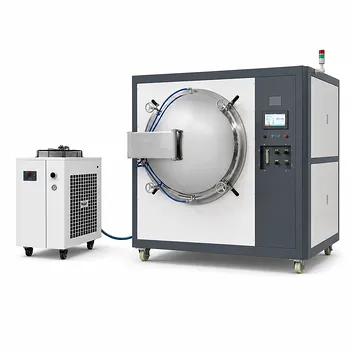
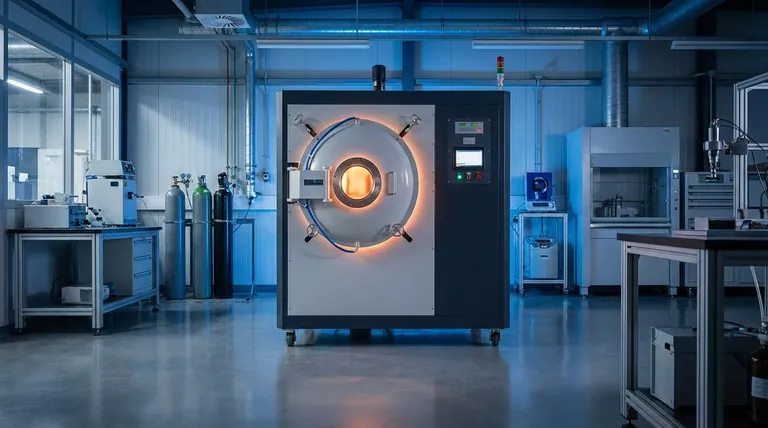
This is where the vacuum furnace enters the narrative. It is not merely an oven; it is a time capsule that pauses chemical reactions, allowing engineers to manipulate matter without the interference of nature.
The Physics of "Nothingness"
A standard furnace is chaotic. It heats materials in the presence of air, which is roughly 21% oxygen.
A vacuum furnace operates on a different philosophy: Subtraction before addition.
Before the heating elements ever glow, the system pumps out the atmosphere. It removes the variables. By creating a vacuum, we fundamentally change how physics acts upon the material.
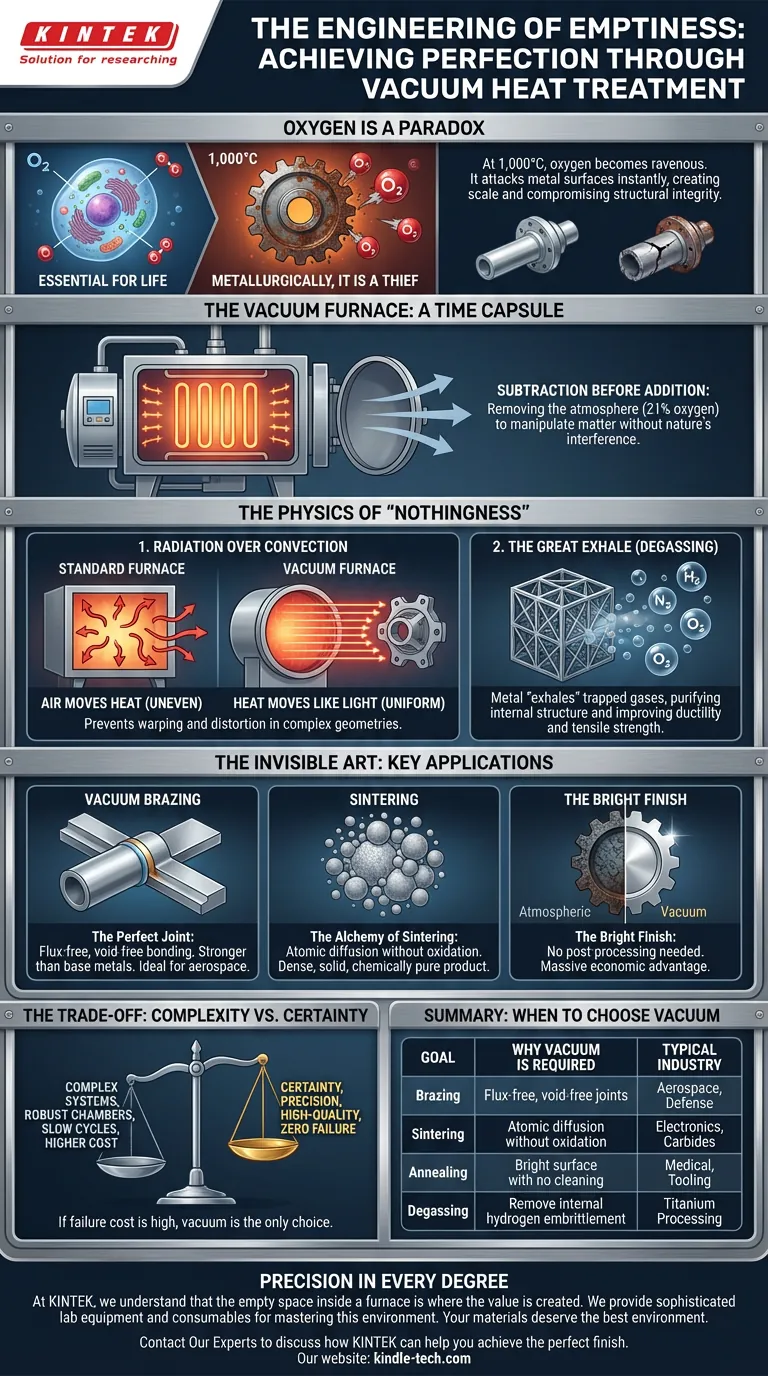
1. Radiation Over Convection
In a standard oven, air moves heat around (convection). It is often uneven.
In a vacuum, there is no air to move heat. Thermal energy must travel via radiation. This is heat moving like light. It strikes the component directly and uniformly. This uniformity prevents the warping and distortion that plague complex geometries in atmospheric furnaces.
2. The Great Exhale (Degassing)
Materials are like sponges; they trap gases during their initial formation.
When you heat a metal in a vacuum, you lower the vapor pressure. The material effectively "exhales." It releases trapped hydrogen, nitrogen, and oxygen. This process, called degassing, doesn't just clean the surface—it purifies the internal structure of the metal, dramatically improving ductility and tensile strength.
The Invisible Art: Key Applications
Why go to the trouble of creating a void? Because certain results are impossible in the presence of air.
The Perfect Joint: Vacuum Brazing
Brazing is the art of joining two metals using a filler alloy.
In air, you need flux—a chemical cleaning agent—to stop oxidation. It is messy and often leaves residue.
In a vacuum, the absence of oxygen acts as the ultimate cleaning agent. The brazing alloy flows into the joints by capillary action, unhindered by oxide layers. The result is a bond that is often stronger than the base metals themselves. This is standard procedure for medical implants and jet engine turbines.
The Alchemy of Sintering
Sintering turns powder into solid mass.
When fusing powdered metals or ceramics, any oxide on the particle surface acts as a barrier. It prevents true bonding. A vacuum removes that barrier. It allows atoms to diffuse across particle boundaries, creating a dense, solid, and chemically pure final product.
The Bright Finish
Consider the aesthetic and functional surface of a part.
- Atmospheric Heat Treat: The part emerges dark, scaled, and requires sandblasting or acid cleaning.
- Vacuum Heat Treat: The part emerges as bright and shiny as it went in.
For precision industries, eliminating post-processing steps is not just a luxury; it is a massive economic advantage.
The Trade-off: Complexity vs. Certainty
Engineering is the management of trade-offs. The vacuum furnace is no exception.
These systems are heavy, complex beasts. They require robust chambers to withstand atmospheric pressure crushing inward. They need sophisticated pumping systems and longer cycle times to achieve the necessary vacuum levels before heating begins.
They are not cheap. They are not fast.
But they are certain.
If your goal is speed and low cost for non-critical parts, a conveyor belt atmospheric furnace is fine. But if the cost of failure is high—if a micro-crack means a grounded plane or a failed surgical tool—the vacuum furnace is the only logical choice.
Summary: When to Choose Vacuum
The decision usually comes down to the requirements of the final product.
| Goal | Why Vacuum is Required | Typical Industry |
|---|---|---|
| Brazing | Requires flux-free, void-free joints | Aerospace, Defense |
| Sintering | Needs atomic diffusion without oxidation | Electronics, Carbides |
| Annealing | Demands a bright surface with no cleaning | Medical, Tooling |
| Degassing | Must remove internal hydrogen embrittlement | Titanium Processing |
Precision in Every Degree
In the world of thermal processing, "good enough" is rarely good enough. The shift from standard heating to vacuum processing is a shift from hoping for quality to engineering it.
At KINTEK, we understand that the empty space inside a furnace is where the value is created. We provide the sophisticated lab equipment and consumables necessary to master this environment. whether you are sintering advanced ceramics or brazing critical alloys, our solutions ensure that oxygen never compromises your work.
Your materials deserve the best environment.
Contact Our Experts to discuss how KINTEK can help you achieve the perfect finish.
Visual Guide
Related Products
- Vacuum Hot Press Furnace Heated Vacuum Press Machine Tube Furnace
- 600T Vacuum Induction Hot Press Furnace for Heat Treat and Sintering
- Vacuum Hot Press Furnace Machine Heated Vacuum Press
- Vacuum Heat Treat Furnace and Levitation Induction Melting Furnace
- 2200 ℃ Tungsten Vacuum Heat Treat and Sintering Furnace
Related Articles
- The Purity Paradox: Choosing the Heart of Your Vacuum Hot Press Furnace
- Comprehensive Guide to Vacuum Hot Press Furnace Application
- Vacuum Hot Press Furnace: A Comprehensive Guide
- Forging Perfection in a Void: The Physics of Ultra-Dense Materials
- Defeating the Void: The Quiet Power of Vacuum Hot Pressing