Blog The Invisible Anvil: Mastering Gas Quenching in Vacuum Furnaces
The Invisible Anvil: Mastering Gas Quenching in Vacuum Furnaces

The Invisible Anvil: Mastering Gas Quenching in Vacuum Furnaces

2 hours ago

Heat treatment is often romanticized as a process of fire and intensity. We imagine the glowing red metal, the extreme temperatures, and the energy consumed.

But in material science, the heating phase is merely the setup. The cooling phase is the execution.

It is during the cooling—specifically gas quenching in vacuum furnaces—that the metallurgical destiny of a component is sealed. It is a race against time, fighting to "freeze" a specific microstructure before the laws of thermodynamics allow the atoms to drift back into a relaxed, softer state.

This is not just about blowing air on a hot part. It is a precise orchestration of pressure, velocity, and chemistry.

The Tale of Two Cooling Systems

To understand vacuum furnaces, you must first embrace a contradiction: the machine is trying to freeze itself while burning its contents.

There is often confusion between the two cooling systems operating simultaneously. They serve opposing masters.

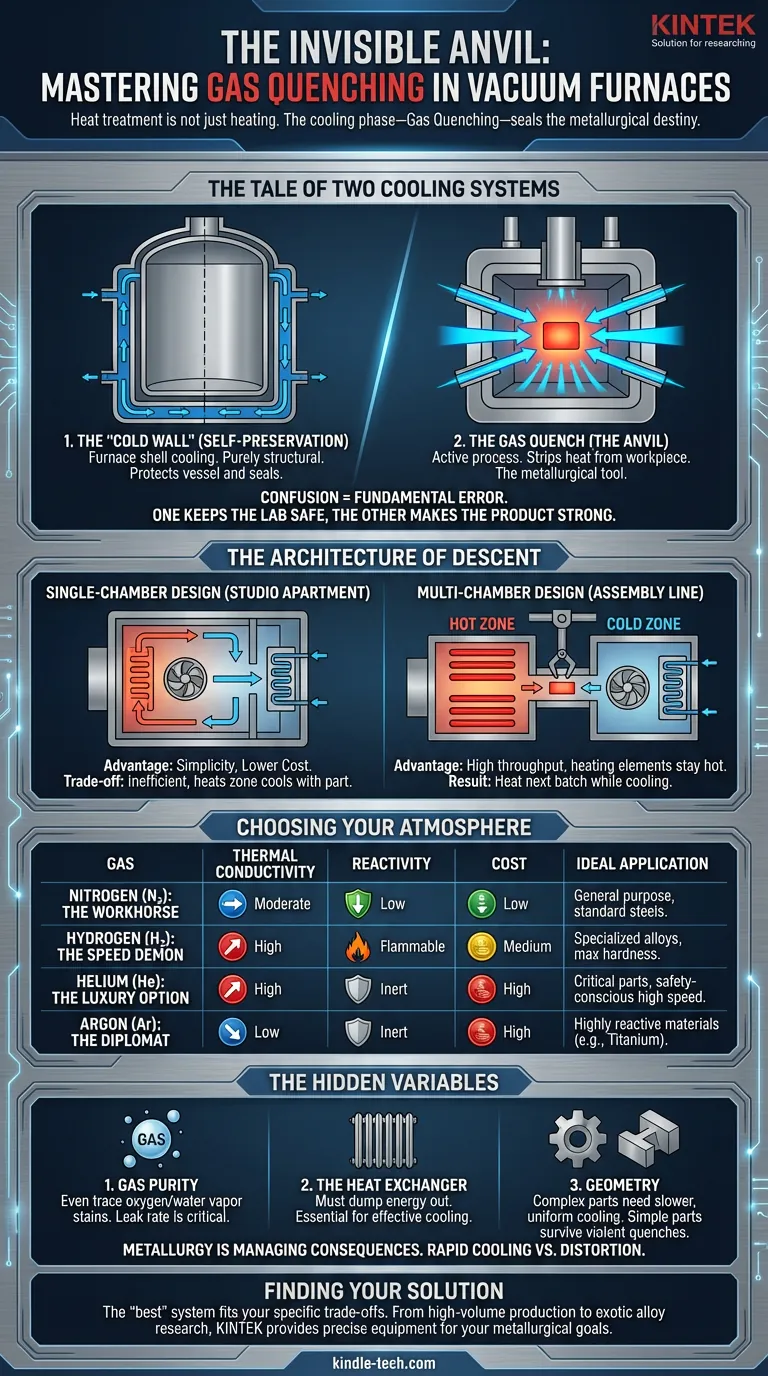
1. The "Cold Wall" (Self-Preservation) The furnace shell is double-skinned and continuously circulated with water. This system never sleeps. Its job is purely structural—to keep the outer steel from warping and to ensure the vacuum seals don’t melt. It protects the vessel.

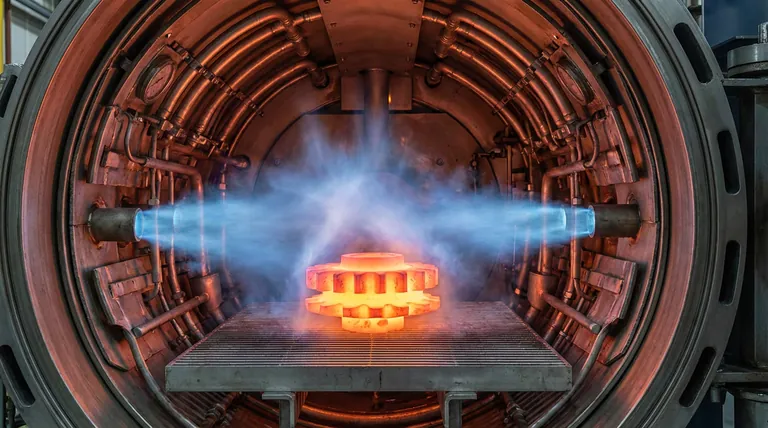
2. The Gas Quench (The Anvil) This is the active process. Once the heating cycle concludes, high-purity gas is blasted into the chamber. It strips heat away from the workpiece to harden it. This is the metallurgical tool.

Confusing the two is a fundamental error. One keeps the lab safe; the other makes the product strong.

The Architecture of Descent

How you arrange the quenching process defines your laboratory's workflow. The design of the furnace dictates the rhythm of production.

Single-Chamber Design

Think of this as a studio apartment. You live, sleep, and eat in one room.

In a single-chamber design, the heating elements turn off, and the gas floods the same space. A high-power fan forces the gas through the workload and over an internal heat exchanger.

  • The Advantage: Simplicity and lower capital cost.
  • The Trade-off: The heating zone itself must be cooled down with the part, which is energy-inefficient for rapid cycling.

Multi-Chamber Design

This is the assembly line approach. The workpiece is mechanically moved from a hot zone to a dedicated cold zone.

  • The Advantage: The heating elements stay hot, protected from the thermal shock of the cold gas.
  • The Result: You can heat the next batch while the previous one cools. High throughput, high efficiency.

Choosing Your Atmosphere

If the furnace design is the hardware, the gas is the software.

The gas you choose determines how violently you strip heat away from the metal. It is a trade-off between thermal aggression and chemical safety.

Nitrogen (N₂): The Workhorse

Nitrogen is the industry standard. It is cheap, abundant, and offers decent thermal conductivity. For 80% of general heat-treating applications, high-purity nitrogen (>99.999%) is the logical choice.

Hydrogen (H₂): The Speed Demon

When you need speed, hydrogen is king. It has the highest thermal conductivity of the common gases. It strips heat faster than anything else.

  • The Catch: It is explosive. Using hydrogen requires rigorous safety protocols and specialized furnace construction. It is high risk, high reward.

Helium (He): The Luxury Option

Helium offers near-hydrogen performance without the explosion risk. It flows easily and cools rapidly. However, its cost makes it prohibitive for anything but the most critical aerospace or medical applications.

Argon (Ar): The Diplomat

Argon is heavy, slow, and completely inert. It doesn’t cool very fast. You use Argon only when the material is so reactive that even Nitrogen would cause a reaction. It is the choice for ultimate surface purity, not speed.

The Hidden Variables

Metallurgy is the art of managing consequences. We want hardness, which requires rapid cooling. But rapid cooling introduces distortion.

If you cool the outside of a thick steel block instantly while the core remains hot, the differential stress will tear the metal apart. You will get a hard part, but it might be cracked or warped.

The engineering challenge lies in three areas:

  1. Gas Purity: Even trace amounts of oxygen (above 2 ppm) or water vapor can stain the bright finish. A vacuum furnace is only as good as its leak rate.
  2. The Heat Exchanger: You can circulate gas as fast as you want, but if the heat exchanger can't dump that energy out of the system, you are just blowing hot air on hot metal.
  3. Geometry: Complex parts require slower, more uniform cooling. Simple parts can survive a violent quench.

Summary of Cooling Mediums

Gas Thermal Conductivity Reactivity Cost Ideal Application
Nitrogen Moderate Low Low General purpose, standard steels
Hydrogen High Flammable Medium Specialized alloys requiring max hardness
Helium High Inert High Critical parts, safety-conscious high speed
Argon Low Inert High Highly reactive materials (Titanium, etc.)

Finding Your Solution

The "best" system does not exist. There is only the system that fits your specific trade-offs.

If you are running a high-volume production line, a multi-chamber nitrogen system is your engine. If you are researching exotic alloys in a small lab, a single-chamber argon setup might be your sanctuary.

At KINTEK, we understand that lab equipment isn't just machinery; it is the variable that controls your experiment's success. Whether you need the brute force of hydrogen cooling or the delicate touch of argon, we provide the precise equipment to match your metallurgical goals.

Contact Our Experts

Visual Guide

The Invisible Anvil: Mastering Gas Quenching in Vacuum Furnaces Visual Guide

Related Products

Related Articles

Related Products

Vacuum Heat Treat Furnace with Ceramic Fiber Liner

Vacuum Heat Treat Furnace with Ceramic Fiber Liner

Vacuum furnace with polycrystalline ceramic fiber insulation liner for excellent heat insulation and uniform temperature field. Choose from 1200℃ or 1700℃ max. working temperature with high vacuum performance and precise temperature control.

Vacuum Heat Treat Sintering Brazing Furnace

Vacuum Heat Treat Sintering Brazing Furnace

A vacuum brazing furnace is a type of industrial furnace used for brazing, a metalworking process that joins two pieces of metal using a filler metal that melts at a lower temperature than the base metals. Vacuum brazing furnaces are typically used for high-quality applications where a strong, clean joint is required.

Vacuum Heat Treat and Sintering Furnace with 9MPa Air Pressure

Vacuum Heat Treat and Sintering Furnace with 9MPa Air Pressure

The air pressure sintering furnace is a high-tech equipment commonly used for the sintering of advanced ceramic materials. It combines vacuum sintering and pressure sintering techniques to achieve high-density and high-strength ceramics.

1200℃ Controlled Atmosphere Furnace Nitrogen Inert Atmosphere Furnace

1200℃ Controlled Atmosphere Furnace Nitrogen Inert Atmosphere Furnace

Discover our KT-12A Pro Controlled atmosphere furnace - high precision, heavy duty vacuum chamber, versatile smart touch screen controller, and excellent temperature uniformity up to 1200C. Ideal for both laboratory and industrial application.

Molybdenum Vacuum Heat Treat Furnace

Molybdenum Vacuum Heat Treat Furnace

Discover the benefits of a high-configuration molybdenum vacuum furnace with heat shield insulation. Ideal for high-purity, vacuum environments like sapphire crystal growth and heat treatment.

Small Vacuum Heat Treat and Tungsten Wire Sintering Furnace

Small Vacuum Heat Treat and Tungsten Wire Sintering Furnace

The small vacuum tungsten wire sintering furnace is a compact experimental vacuum furnace specially designed for universities and scientific research institutes. The furnace features a CNC welded shell and vacuum piping to ensure leak-free operation. Quick-connect electrical connections facilitate relocation and debugging, and the standard electrical control cabinet is safe and convenient to operate.

2200 ℃ Tungsten Vacuum Heat Treat and Sintering Furnace

2200 ℃ Tungsten Vacuum Heat Treat and Sintering Furnace

Experience the ultimate refractory metal furnace with our Tungsten vacuum furnace. Capable of reaching 2200℃, perfect for sintering advanced ceramics and refractory metals. Order now for high-quality results.

2200 ℃ Graphite Vacuum Heat Treat Furnace

2200 ℃ Graphite Vacuum Heat Treat Furnace

Discover the power of the KT-VG Graphite Vacuum Furnace - with a maximum working temperature of 2200℃, it's perfect for vacuum sintering of various materials. Learn more now.

Laboratory Vacuum Tilt Rotary Tube Furnace Rotating Tube Furnace

Laboratory Vacuum Tilt Rotary Tube Furnace Rotating Tube Furnace

Discover the versatility of Laboratory Rotary Furnace: Ideal for calcination, drying, sintering, and high-temperature reactions. Adjustable rotating and tilting functions for optimal heating. Suitable for vacuum and controlled atmosphere environments. Learn more now!

Graphite Vacuum Furnace Bottom Discharge Graphitization Furnace for Carbon Materials

Graphite Vacuum Furnace Bottom Discharge Graphitization Furnace for Carbon Materials

Bottom-out graphitization furnace for carbon materials, ultra-high temperature furnace up to 3100°C, suitable for graphitization and sintering of carbon rods and carbon blocks. Vertical design, bottom discharging, convenient feeding and discharging, high temperature uniformity, low energy consumption, good stability, hydraulic lifting system, convenient loading and unloading.

Horizontal High Temperature Graphite Vacuum Graphitization Furnace

Horizontal High Temperature Graphite Vacuum Graphitization Furnace

Horizontal Graphitization Furnace: This type of furnace is designed with the heating elements placed horizontally, allowing for uniform heating of the sample. It's well-suited for graphitizing large or bulky samples that require precise temperature control and uniformity.

Graphite Vacuum Furnace High Thermal Conductivity Film Graphitization Furnace

Graphite Vacuum Furnace High Thermal Conductivity Film Graphitization Furnace

The high thermal conductivity film graphitization furnace has uniform temperature, low energy consumption and can operate continuously.

Vacuum Dental Porcelain Sintering Furnace

Vacuum Dental Porcelain Sintering Furnace

Get precise and reliable results with KinTek's Vacuum Porcelain Furnace. Suitable for all porcelain powders, it features hyperbolic ceramic furnace function, voice prompt, and automatic temperature calibration.

Large Vertical Graphite Vacuum Graphitization Furnace

Large Vertical Graphite Vacuum Graphitization Furnace

A large vertical high-temperature graphitization furnace is a type of industrial furnace used for the graphitization of carbon materials, such as carbon fiber and carbon black. It is a high-temperature furnace that can reach temperatures of up to 3100°C.

Ultra-High Temperature Graphite Vacuum Graphitization Furnace

Ultra-High Temperature Graphite Vacuum Graphitization Furnace

The ultra-high temperature graphitization furnace utilizes medium frequency induction heating in a vacuum or inert gas environment. The induction coil generates an alternating magnetic field, inducing eddy currents in the graphite crucible, which heats up and radiates heat to the workpiece, bringing it to the desired temperature. This furnace is primarily used for graphitization and sintering of carbon materials, carbon fiber materials, and other composite materials.

Vacuum Heat Treat Furnace and Levitation Induction Melting Furnace

Vacuum Heat Treat Furnace and Levitation Induction Melting Furnace

Experience precise melting with our Vacuum Levitation Melting Furnace. Ideal for high melting point metals or alloys, with advanced technology for effective smelting. Order now for high-quality results.

Graphite Vacuum Furnace IGBT Experimental Graphitization Furnace

Graphite Vacuum Furnace IGBT Experimental Graphitization Furnace

IGBT experimental graphitization furnace, a tailored solution for universities and research institutions, with high heating efficiency, user-friendliness, and precise temperature control.

Laboratory Rapid Thermal Processing (RTP) Quartz Tube Furnace

Laboratory Rapid Thermal Processing (RTP) Quartz Tube Furnace

Get lightning-fast heating with our RTP Rapid Heating Tube Furnace. Designed for precise, high-speed heating and cooling with convenient sliding rail and TFT touch screen controller. Order now for ideal thermal processing!

Vacuum Hot Press Furnace Machine for Lamination and Heating

Vacuum Hot Press Furnace Machine for Lamination and Heating

Experience clean and precise lamination with Vacuum Lamination Press. Perfect for wafer bonding, thin-film transformations, and LCP lamination. Order now!

Heated Hydraulic Press Machine with Heated Plates for Vacuum Box Laboratory Hot Press

Heated Hydraulic Press Machine with Heated Plates for Vacuum Box Laboratory Hot Press

Enhance your lab's precision with our lab press for vacuum box. Press pills and powders with ease and precision in a vacuum environment, reducing oxidation and improving consistency. Compact and easy to use with a digital pressure gauge.


Leave Your Message