The Paradox of an Empty Space
A vacuum furnace is an instrument of pristine control. Its purpose is to create a void, an environment stripped of atmospheric interference, to forge materials with absolute precision. Yet, the greatest threat to this controlled world isn't a catastrophic failure, but a silent, invisible saboteur: contamination.
The challenge is psychological. We are wired to react to immediate, visible problems. A microscopic film of oil or a fine layer of dust doesn't set off alarms. It's a quiet degradation, a gradual decline in performance that's easy to dismiss until a batch is ruined or a heating element fails unexpectedly. Mastering a vacuum furnace is mastering the discipline of fighting an enemy you cannot always see.
The High Cost of a Dirty Secret
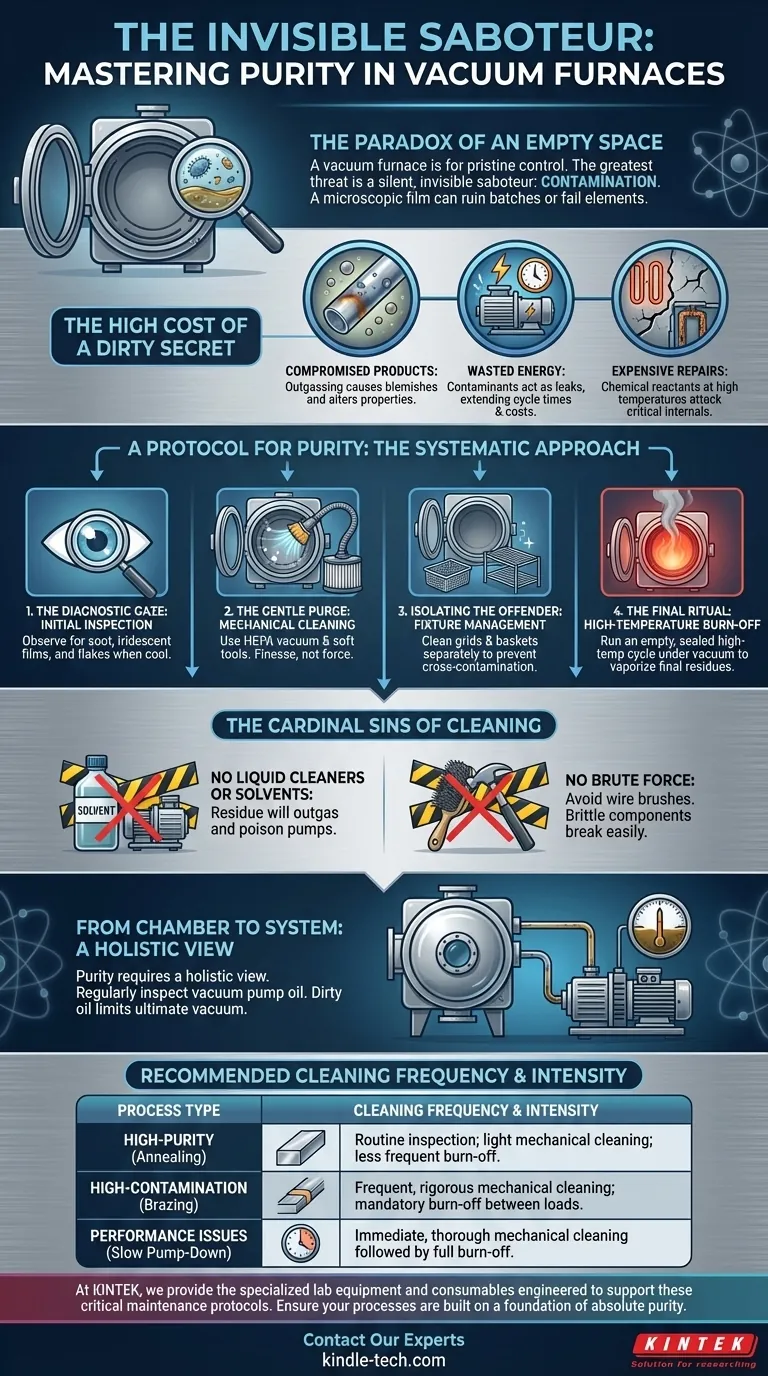
Neglecting furnace hygiene isn't a shortcut; it's an accumulation of technical debt. This debt is paid through compromised products, wasted energy, and expensive repairs.
The Betrayal of the Workpiece
At high temperatures and low pressures, every forgotten fingerprint and microscopic particle of dust begins to "outgas," vaporizing into the vacuum. These phantom gases can redeposit onto your workpiece, causing discoloration, blemishes, or, worse, altering its fundamental metallurgical properties. The very process designed to purify and strengthen becomes a source of flaws.
The Sisyphean Struggle for Vacuum
Contaminants on the chamber walls add to the gas load, forcing the vacuum pumps to work harder and longer to reach the target pressure. This is a battle you are destined to lose. The constant outgassing acts as a leak that isn't a leak, extending cycle times, driving up energy costs, and potentially preventing the furnace from ever reaching the deep vacuum required for sensitive processes.
The Slow Corrosion of Capital
Some contaminants are not merely passive films; they are chemical reactants waiting for thermal activation. At high temperatures, these residues can aggressively attack the furnace’s most critical and expensive internals—the delicate graphite insulation, ceramic fixtures, and metallic heating elements. This slow-motion chemical assault leads to brittleness, premature failure, and costly downtime.
A Protocol for Purity: The Systematic Approach
Effective cleaning is not an act of brute force but a methodical ritual. It's a systematic process designed to remove contaminants without inflicting damage on the furnace's sensitive ecosystem.
1. The Diagnostic Gaze: Initial Inspection
Before any action, observe. Once the furnace is cool and vented, conduct a thorough visual inspection. Look for the tell-tale signs: soot from dirty parts, iridescent films from oils, or fine flakes of oxide from previous loads. This initial survey informs the intensity of your cleaning strategy.
2. The Gentle Purge: Mechanical Cleaning
The primary weapon is a high-efficiency particulate air (HEPA) filter vacuum. Work methodically from top to bottom, removing all loose debris. For adhered films, use soft, non-metallic brushes or abrasive pads. The goal is finesse, not force, especially around heating element supports and gas quench nozzles.
3. Isolating the Offender: Fixture Management
Workpiece grids, baskets, and racks are contamination hotspots. They should be removed and cleaned separately. This critical step isolates the heaviest sources of contamination, preventing you from inadvertently spreading them throughout the chamber during cleaning.
4. The Final Ritual: The High-Temperature Burn-Off
After mechanical cleaning, the burn-off cycle is the ultimate purification. An empty furnace is sealed and run to a high temperature under vacuum. This process vaporizes any remaining microscopic oils and adsorbed water molecules, which are then efficiently swept away by the vacuum system. It is the final, definitive step that resets the chamber to a state of pristine readiness.
The Cardinal Sins of Cleaning
How you clean is as important as that you clean. A few common mistakes can cause more harm than the contamination itself.
- The Siren's Call of Solvents: Never use liquid cleaners or volatile solvents inside the chamber. Any residue will become a massive outgassing source in the next cycle, poisoning your vacuum pumps and contaminating your product.
- The Brute Force Fallacy: Be gentle. Graphite insulation is brittle. Molybdenum heating elements can be fragile. Using wire brushes or excessive force is a recipe for expensive mechanical damage.
From Chamber to System: A Holistic View
A pristine chamber is necessary, but not sufficient. Contamination can hide in the system's arteries. Regularly inspect your vacuum pump oil. Dirty, vaporous oil will limit the ultimate vacuum your furnace can achieve, no matter how immaculate the chamber is. True purity requires a holistic view of the entire vacuum system.
The discipline of furnace maintenance is the foundation of reliable, high-quality thermal processing. By understanding the nature of contamination and adhering to a systematic cleaning protocol, you transform the furnace from a simple piece of equipment into a predictable and precise scientific instrument. This level of control is achievable with the right knowledge and the right tools.
| Process Type | Recommended Cleaning Frequency & Intensity |
|---|---|
| High-Purity Processes (Annealing) | Routine inspection; light mechanical cleaning; less frequent burn-off cycles. |
| High-Contamination Processes (Brazing) | Frequent, rigorous mechanical cleaning; mandatory burn-off between sensitive loads. |
| Performance Issues (Slow Pump-Down) | Immediate, thorough mechanical cleaning followed by a full burn-off cycle. |
At KINTEK, we provide the specialized lab equipment and consumables engineered to support these critical maintenance protocols. We understand that success is built on the details. Contact Our Experts to ensure your processes are built on a foundation of absolute purity.
Visual Guide
Related Products
- Vacuum Hot Press Furnace Heated Vacuum Press Machine Tube Furnace
- 600T Vacuum Induction Hot Press Furnace for Heat Treat and Sintering
- Vacuum Hot Press Furnace Machine Heated Vacuum Press
- Vacuum Heat Treat Furnace and Levitation Induction Melting Furnace
- Vacuum Heat Treat and Pressure Sintering Furnace for High Temperature Applications
Related Articles
- The Purity Paradox: Choosing the Heart of Your Vacuum Hot Press Furnace
- Comprehensive Guide to Vacuum Hot Press Furnace Application
- Vacuum Hot Press Furnace: A Comprehensive Guide
- Forging Perfection in a Void: The Physics of Ultra-Dense Materials
- Defeating the Void: The Quiet Power of Vacuum Hot Pressing