Blog The Science of Nothing: Why High-Performance Materials Demand a Vacuum
The Science of Nothing: Why High-Performance Materials Demand a Vacuum

The Science of Nothing: Why High-Performance Materials Demand a Vacuum

2 hours ago

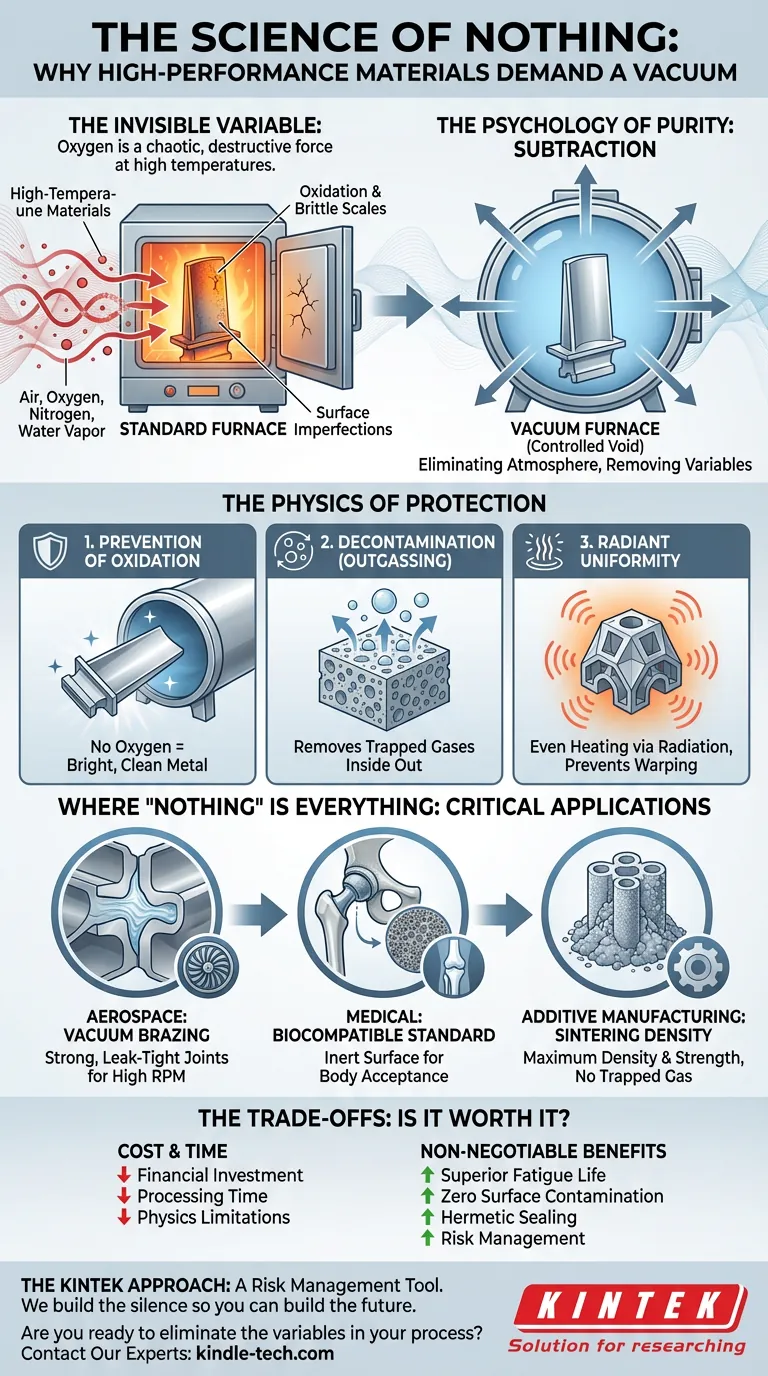
The Invisible Variable

In the world of high-stakes engineering—whether building the turbine blades of a jet engine or the replacement hip joint for a patient—the greatest threat often isn't mechanical stress or thermal shock.

It is air.

Specifically, it is oxygen. To us, oxygen is life. To a piece of titanium or superalloy heated to 1,000°C, oxygen is a chaotic, destructive force. It seeks to bond, to corrode, and to weaken.

A standard furnace is like an open wound; it invites infection from the atmosphere. At high temperatures, oxidation creates brittle scales and surface imperfections. In critical applications, a microscopic imperfection isn't just a defect; it is a potential catastrophe.

This is where the vacuum furnace enters the narrative. It is a machine designed to produce "nothing"—a controlled void that removes the chaos of the atmosphere to protect the integrity of the material.

The Psychology of Purity

We often think of manufacturing as adding things: adding heat, adding pressure, adding layers.

The vacuum furnace operates on a different psychological principle: subtraction.

By removing the atmosphere, we remove the variables. We eliminate the nitrogen, oxygen, and water vapor that create uncertainty.

The Physics of Protection

When you strip away the air, you achieve three specific outcomes that are impossible in an open environment:

  1. Prevention of Oxidation: Without oxygen, metals cannot oxidize. They emerge from the furnace as bright and clean as they went in.
  2. Decontamination (Outgassing): The vacuum actively pulls trapped gases out of the metal or ceramic powder. It cleans the material from the inside out.
  3. Radiant Uniformity: In a vacuum, heat doesn't travel by convection (air currents). It travels by radiation. This ensures that a complex geometric part is heated evenly, preventing internal stresses that lead to warping.

Where "Nothing" is Everything

The decision to use a vacuum furnace is usually binary. You use it because you have no other choice. If the cost of failure is high, the investment in a vacuum is mandatory.

Here is where the technology is non-negotiable:

1. Aerospace: The Art of Brazing

Turbine blades require complex cooling channels. These parts are often joined using vacuum brazing.

Because the vacuum removes air pockets, the filler metal flows like water, wetting the surface perfectly. The result is a leak-tight joint that is often stronger than the base metal itself. In an engine screaming at 30,000 RPM, you cannot afford a void in the brazing joint.

2. Medical: The Biocompatible Standard

Medical implants must be chemically inert. A vacuum environment is essential for sintering porous coatings on titanium implants.

The vacuum ensures that no foreign contaminants react with the surface, guaranteeing the body accepts the part without rejection.

3. Additive Manufacturing: Sintering Density

In powder metallurgy and 3D printing, the goal is to turn dust into a solid rock.

If you sinter in air, you trap gas bubbles inside the part. These bubbles become crack initiation points. Vacuum sintering pulls that gas out, pulling the particles tighter together for maximum density and strength.

The Trade-Offs: Is It Worth It?

Engineering is the study of trade-offs. The "perfect" environment of a vacuum comes at a cost.

  • Financial Cost: These are sophisticated pressure vessels with complex pumping systems. They cost significantly more than standard ovens.
  • Time: Creating a vacuum takes time. You cannot just open the door; you must pump down, process, and backfill.
  • Physics Limitations: You cannot process materials with high vapor pressures (like Zinc or Cadmium). In a vacuum, these metals will boil off and contaminate the entire chamber.

However, the calculation is simple. If your product requires superior fatigue life, zero surface contamination, or hermetic sealing, the cost of the furnace is negligible compared to the cost of a failed part.

Summary of Applications

Process Goal Critical Industry
Annealing Softening metal to relieve stress without surface damage. Automotive / Tooling
Vacuum Brazing Joining complex geometries with void-free bonds. Aerospace / Energy
Sintering Fusing powder into high-density solids. Medical / Defense
Degassing Removing dissolved gases for high-purity needs. Electronics / X-Ray

The KINTEK Approach

At KINTEK, we understand that a vacuum furnace is not just a hot box. It is a risk management tool.

Our equipment is designed for the engineer who sleeps better knowing the variables have been controlled. Whether you are sintering advanced ceramics or brazing critical sensors, our systems provide the precise temperature uniformity and deep vacuum levels required to ensure material success.

We build the silence so you can build the future.

Are you ready to eliminate the variables in your process?

Contact Our Experts

Visual Guide

The Science of Nothing: Why High-Performance Materials Demand a Vacuum Visual Guide

Related Products

Related Articles

Related Products

Vacuum Heat Treat Sintering Brazing Furnace

Vacuum Heat Treat Sintering Brazing Furnace

A vacuum brazing furnace is a type of industrial furnace used for brazing, a metalworking process that joins two pieces of metal using a filler metal that melts at a lower temperature than the base metals. Vacuum brazing furnaces are typically used for high-quality applications where a strong, clean joint is required.

Molybdenum Vacuum Heat Treat Furnace

Molybdenum Vacuum Heat Treat Furnace

Discover the benefits of a high-configuration molybdenum vacuum furnace with heat shield insulation. Ideal for high-purity, vacuum environments like sapphire crystal growth and heat treatment.

Vacuum Heat Treat Furnace with Ceramic Fiber Liner

Vacuum Heat Treat Furnace with Ceramic Fiber Liner

Vacuum furnace with polycrystalline ceramic fiber insulation liner for excellent heat insulation and uniform temperature field. Choose from 1200℃ or 1700℃ max. working temperature with high vacuum performance and precise temperature control.

2200 ℃ Tungsten Vacuum Heat Treat and Sintering Furnace

2200 ℃ Tungsten Vacuum Heat Treat and Sintering Furnace

Experience the ultimate refractory metal furnace with our Tungsten vacuum furnace. Capable of reaching 2200℃, perfect for sintering advanced ceramics and refractory metals. Order now for high-quality results.

2200 ℃ Graphite Vacuum Heat Treat Furnace

2200 ℃ Graphite Vacuum Heat Treat Furnace

Discover the power of the KT-VG Graphite Vacuum Furnace - with a maximum working temperature of 2200℃, it's perfect for vacuum sintering of various materials. Learn more now.

Vacuum Heat Treat and Molybdenum Wire Sintering Furnace for Vacuum Sintering

Vacuum Heat Treat and Molybdenum Wire Sintering Furnace for Vacuum Sintering

A vacuum molybdenum wire sintering furnace is a vertical or bedroom structure, which is suitable for withdrawal, brazing, sintering and degassing of metal materials under high vacuum and high temperature conditions. It is also suitable for dehydroxylation treatment of quartz materials.

Vacuum Heat Treat and Sintering Furnace with 9MPa Air Pressure

Vacuum Heat Treat and Sintering Furnace with 9MPa Air Pressure

The air pressure sintering furnace is a high-tech equipment commonly used for the sintering of advanced ceramic materials. It combines vacuum sintering and pressure sintering techniques to achieve high-density and high-strength ceramics.

1400℃ Controlled Atmosphere Furnace with Nitrogen and Inert Atmosphere

1400℃ Controlled Atmosphere Furnace with Nitrogen and Inert Atmosphere

Achieve precise heat treatment with KT-14A controlled atmosphere furnace. Vacuum sealed with a smart controller, it's ideal for lab and industrial use up to 1400℃.

Graphite Vacuum Furnace Bottom Discharge Graphitization Furnace for Carbon Materials

Graphite Vacuum Furnace Bottom Discharge Graphitization Furnace for Carbon Materials

Bottom-out graphitization furnace for carbon materials, ultra-high temperature furnace up to 3100°C, suitable for graphitization and sintering of carbon rods and carbon blocks. Vertical design, bottom discharging, convenient feeding and discharging, high temperature uniformity, low energy consumption, good stability, hydraulic lifting system, convenient loading and unloading.

Vacuum Hot Press Furnace Heated Vacuum Press Machine Tube Furnace

Vacuum Hot Press Furnace Heated Vacuum Press Machine Tube Furnace

Reduce forming pressure & shorten sintering time with Vacuum Tube Hot Press Furnace for high-density, fine-grain materials. Ideal for refractory metals.

Horizontal High Temperature Graphite Vacuum Graphitization Furnace

Horizontal High Temperature Graphite Vacuum Graphitization Furnace

Horizontal Graphitization Furnace: This type of furnace is designed with the heating elements placed horizontally, allowing for uniform heating of the sample. It's well-suited for graphitizing large or bulky samples that require precise temperature control and uniformity.

1200℃ Controlled Atmosphere Furnace Nitrogen Inert Atmosphere Furnace

1200℃ Controlled Atmosphere Furnace Nitrogen Inert Atmosphere Furnace

Discover our KT-12A Pro Controlled atmosphere furnace - high precision, heavy duty vacuum chamber, versatile smart touch screen controller, and excellent temperature uniformity up to 1200C. Ideal for both laboratory and industrial application.

Vacuum Hot Press Furnace Machine Heated Vacuum Press

Vacuum Hot Press Furnace Machine Heated Vacuum Press

Discover the advantages of Vacuum Hot Press Furnace! Manufacture dense refractory metals & compounds, ceramics, and composites under high temp and pressure.

Graphite Vacuum Furnace High Thermal Conductivity Film Graphitization Furnace

Graphite Vacuum Furnace High Thermal Conductivity Film Graphitization Furnace

The high thermal conductivity film graphitization furnace has uniform temperature, low energy consumption and can operate continuously.

Vertical High Temperature Graphite Vacuum Graphitization Furnace

Vertical High Temperature Graphite Vacuum Graphitization Furnace

Vertical high temperature graphitization furnace for carbonization and graphitization of carbon materials up to 3100℃.Suitable for shaped graphitization of carbon fiber filaments and other materials sintered in a carbon environment.Applications in metallurgy, electronics, and aerospace for producing high-quality graphite products like electrodes and crucibles.

600T Vacuum Induction Hot Press Furnace for Heat Treat and Sintering

600T Vacuum Induction Hot Press Furnace for Heat Treat and Sintering

Discover the 600T Vacuum Induction Hot Press Furnace, designed for high-temperature sintering experiments in vacuum or protected atmospheres. Its precise temperature and pressure control, adjustable working pressure, and advanced safety features make it ideal for nonmetal materials, carbon composites, ceramics, and metal powders.

Small Vacuum Heat Treat and Tungsten Wire Sintering Furnace

Small Vacuum Heat Treat and Tungsten Wire Sintering Furnace

The small vacuum tungsten wire sintering furnace is a compact experimental vacuum furnace specially designed for universities and scientific research institutes. The furnace features a CNC welded shell and vacuum piping to ensure leak-free operation. Quick-connect electrical connections facilitate relocation and debugging, and the standard electrical control cabinet is safe and convenient to operate.

Vacuum Dental Porcelain Sintering Furnace

Vacuum Dental Porcelain Sintering Furnace

Get precise and reliable results with KinTek's Vacuum Porcelain Furnace. Suitable for all porcelain powders, it features hyperbolic ceramic furnace function, voice prompt, and automatic temperature calibration.

Ultra-High Temperature Graphite Vacuum Graphitization Furnace

Ultra-High Temperature Graphite Vacuum Graphitization Furnace

The ultra-high temperature graphitization furnace utilizes medium frequency induction heating in a vacuum or inert gas environment. The induction coil generates an alternating magnetic field, inducing eddy currents in the graphite crucible, which heats up and radiates heat to the workpiece, bringing it to the desired temperature. This furnace is primarily used for graphitization and sintering of carbon materials, carbon fiber materials, and other composite materials.

Vacuum Heat Treat Furnace and Levitation Induction Melting Furnace

Vacuum Heat Treat Furnace and Levitation Induction Melting Furnace

Experience precise melting with our Vacuum Levitation Melting Furnace. Ideal for high melting point metals or alloys, with advanced technology for effective smelting. Order now for high-quality results.


Leave Your Message