Blog The Silent Engine: Engineering the Perfect Thermal Environment
The Silent Engine: Engineering the Perfect Thermal Environment

The Silent Engine: Engineering the Perfect Thermal Environment

2 weeks ago

The Architecture of Heat

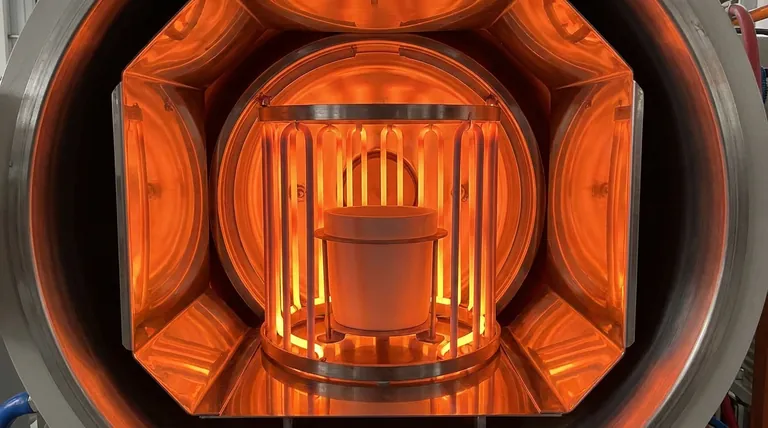
A vacuum furnace is a contradiction. It is a vessel designed to contain nothing—a void—yet it is responsible for forging the strongest materials on earth.

Inside this void, the environment is violent. Temperatures soar to levels where ordinary matter disintegrates. The pressure drops to mimic deep space.

At the center of this chaos sits the heating element.

It is the heart of the machine. If the vacuum pump is the lungs, the heating element is the pulse. It dictates what is possible. It determines whether a medical implant remains sterile or an aerospace component fails under stress.

Choosing this component is not a shopping task. It is a critical engineering decision that balances three opposing forces: thermal capability, chemical purity, and economic reality.

The Two Philosophies: Metal vs. Carbon

When engineers design a "hot zone," they generally choose between two distinct material philosophies. Each has its own personality, strengths, and fatal flaws.

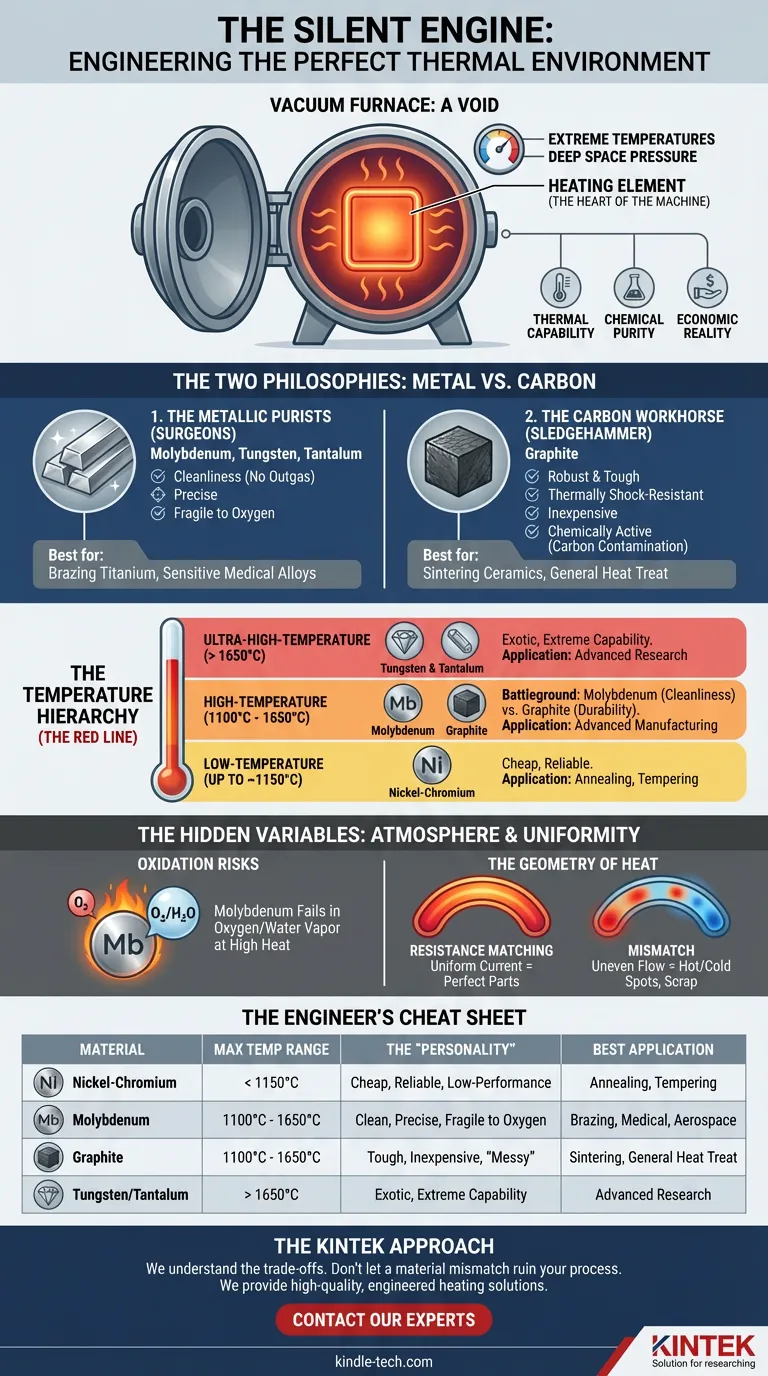
1. The Metallic Purists (Molybdenum, Tungsten, Tantalum)

These are the surgeons of the thermal world.

Metallic elements are prized for their cleanliness. They do not outgas. They do not shed particles. If you are brazing titanium or processing sensitive medical alloys, metal is often the only choice.

  • Molybdenum: The industry standard for high-purity work (1100°C to 1650°C). It is stable and clean.
  • Tungsten & Tantalum: The heavy lifters. When temperatures exceed 1650°C—approaching the melting point of common ceramics—these refractory metals are required. They are expensive, brittle, and brilliant.
  • Nickel-Chromium: The accessible option. Useful only for lower temperatures (up to ~1150°C), typically for annealing or tempering.

2. The Carbon Workhorse (Graphite)

Graphite is the sledgehammer. It is robust, thermally shock-resistant, and significantly cheaper than refractory metals.

However, graphite is chemically active. In high temperatures, it creates a carbon-rich environment. For sintering ceramics, this is often fine. For processing certain steel alloys, it is a disaster. The carbon will migrate into the metal, altering its metallurgy and ruining the batch.

The Temperature Hierarchy

In engineering, temperature is not just a number on a dial. It is a threshold of material failure.

The selection of a heating element is dictated primarily by the "red line"—the point of no return.

Low-Temperature (Up to ~1150°C)

Here, the stakes are lower. Nickel-Chromium alloys dominate. They are cost-effective and reliable. But like a budget car engine, if you redline them consistently, they will degrade rapidly.

High-Temperature (1100°C to 1650°C)

This is the standard operating range for most advanced manufacturing. The battle here is between Molybdenum and Graphite.

  • Choose Molybdenum for cleanliness (aerospace, medical).
  • Choose Graphite for durability and cost savings (sintering, general heat treat).

Ultra-High-Temperature (Above 1650°C)

This is rarefied air. Only Tungsten and Tantalum survive here. These materials are difficult to fabricate and expensive to procure, but for research and advanced material science, they are irreplaceable.

The Hidden Variables: Atmosphere and Uniformity

A heating element does not exist in a vacuum—metaphorically speaking. It interacts with everything around it.

Oxidation Risks: A Molybdenum element is a marvel of engineering, but it has an Achilles' heel. A trace amount of oxygen or water vapor at high heat will cause it to oxidize and fail catastrophically. Graphite, conversely, is immune to this specific failure mode but carries the risk of carbon contamination.

The Geometry of Heat: It is not enough to generate heat; you must control it.

For large hot zones, particularly those using graphite, resistance matching is vital. If the curved elements do not have identical electrical resistance, the current will flow unevenly. This creates hot spots and cold spots.

The result? A batch of parts where half are perfect and half are scrap.

Summary: The Engineer's Cheat Sheet

Material Max Temp Range The "Personality" Best Application
Nickel-Chromium < 1150°C Cheap, reliable, low-performance Annealing, Tempering
Molybdenum 1100°C - 1650°C Clean, precise, fragile to oxygen Brazing, Medical, Aerospace
Graphite 1100°C - 1650°C Tough, inexpensive, "messy" Sintering, General Heat Treat
Tungsten/Tantalum > 1650°C Exotic, extreme capability Advanced Research

The KINTEK Approach

There is a difference between buying a spare part and investing in process reliability.

At KINTEK, we understand that a heating element is not just a wire or a rod. It is the defining variable of your laboratory's success. Whether you need the surgical purity of Molybdenum or the rugged durability of Graphite, the choice involves trade-offs that affect your budget and your data.

We help you navigate those trade-offs. We provide high-quality, engineered heating solutions designed to withstand the violent environment of the vacuum chamber, ensuring your science remains sound.

Don't let a material mismatch ruin your process. Contact Our Experts

Visual Guide
The Silent Engine: Engineering the Perfect Thermal Environment Visual Guide

Related Products

Related Articles

Related Products

Molybdenum Vacuum Heat Treat Furnace

Molybdenum Vacuum Heat Treat Furnace

Discover the benefits of a high-configuration molybdenum vacuum furnace with heat shield insulation. Ideal for high-purity, vacuum environments like sapphire crystal growth and heat treatment.

2200 ℃ Tungsten Vacuum Heat Treat and Sintering Furnace

2200 ℃ Tungsten Vacuum Heat Treat and Sintering Furnace

Experience the ultimate refractory metal furnace with our Tungsten vacuum furnace. Capable of reaching 2200℃, perfect for sintering advanced ceramics and refractory metals. Order now for high-quality results.

Molybdenum Disilicide (MoSi2) Thermal Elements Electric Furnace Heating Element

Molybdenum Disilicide (MoSi2) Thermal Elements Electric Furnace Heating Element

Discover the power of Molybdenum Disilicide (MoSi2) Heating Element for high-temperature resistance. Unique oxidation resistance with stable resistance value. Learn more about its benefits now!

Vacuum Heat Treat Furnace with Ceramic Fiber Liner

Vacuum Heat Treat Furnace with Ceramic Fiber Liner

Vacuum furnace with polycrystalline ceramic fiber insulation liner for excellent heat insulation and uniform temperature field. Choose from 1200℃ or 1700℃ max. working temperature with high vacuum performance and precise temperature control.

Small Vacuum Heat Treat and Tungsten Wire Sintering Furnace

Small Vacuum Heat Treat and Tungsten Wire Sintering Furnace

The small vacuum tungsten wire sintering furnace is a compact experimental vacuum furnace specially designed for universities and scientific research institutes. The furnace features a CNC welded shell and vacuum piping to ensure leak-free operation. Quick-connect electrical connections facilitate relocation and debugging, and the standard electrical control cabinet is safe and convenient to operate.

Vacuum Heat Treat Sintering Brazing Furnace

Vacuum Heat Treat Sintering Brazing Furnace

A vacuum brazing furnace is a type of industrial furnace used for brazing, a metalworking process that joins two pieces of metal using a filler metal that melts at a lower temperature than the base metals. Vacuum brazing furnaces are typically used for high-quality applications where a strong, clean joint is required.

Graphite Vacuum Furnace High Thermal Conductivity Film Graphitization Furnace

Graphite Vacuum Furnace High Thermal Conductivity Film Graphitization Furnace

The high thermal conductivity film graphitization furnace has uniform temperature, low energy consumption and can operate continuously.

Horizontal High Temperature Graphite Vacuum Graphitization Furnace

Horizontal High Temperature Graphite Vacuum Graphitization Furnace

Horizontal Graphitization Furnace: This type of furnace is designed with the heating elements placed horizontally, allowing for uniform heating of the sample. It's well-suited for graphitizing large or bulky samples that require precise temperature control and uniformity.

Graphite Vacuum Furnace Bottom Discharge Graphitization Furnace for Carbon Materials

Graphite Vacuum Furnace Bottom Discharge Graphitization Furnace for Carbon Materials

Bottom-out graphitization furnace for carbon materials, ultra-high temperature furnace up to 3100°C, suitable for graphitization and sintering of carbon rods and carbon blocks. Vertical design, bottom discharging, convenient feeding and discharging, high temperature uniformity, low energy consumption, good stability, hydraulic lifting system, convenient loading and unloading.

Graphite Vacuum Furnace IGBT Experimental Graphitization Furnace

Graphite Vacuum Furnace IGBT Experimental Graphitization Furnace

IGBT experimental graphitization furnace, a tailored solution for universities and research institutions, with high heating efficiency, user-friendliness, and precise temperature control.

Ultra-High Temperature Graphite Vacuum Graphitization Furnace

Ultra-High Temperature Graphite Vacuum Graphitization Furnace

The ultra-high temperature graphitization furnace utilizes medium frequency induction heating in a vacuum or inert gas environment. The induction coil generates an alternating magnetic field, inducing eddy currents in the graphite crucible, which heats up and radiates heat to the workpiece, bringing it to the desired temperature. This furnace is primarily used for graphitization and sintering of carbon materials, carbon fiber materials, and other composite materials.

Laboratory Vacuum Tilt Rotary Tube Furnace Rotating Tube Furnace

Laboratory Vacuum Tilt Rotary Tube Furnace Rotating Tube Furnace

Discover the versatility of Laboratory Rotary Furnace: Ideal for calcination, drying, sintering, and high-temperature reactions. Adjustable rotating and tilting functions for optimal heating. Suitable for vacuum and controlled atmosphere environments. Learn more now!

Graphite Vacuum Continuous Graphitization Furnace

Graphite Vacuum Continuous Graphitization Furnace

High-temperature graphitization furnace is a professional equipment for graphitization treatment of carbon materials. It is a key equipment for the production of high-quality graphite products. It has high temperature, high efficiency and uniform heating. It is suitable for various high-temperature treatments and graphitization treatments. It is widely used in metallurgy, electronics, aerospace, etc. industry.

Laboratory High Pressure Vacuum Tube Furnace

Laboratory High Pressure Vacuum Tube Furnace

KT-PTF High Pressure Tube Furnace: Compact split tube furnace with strong positive pressure resistance. Working temp up to 1100°C and pressure up to 15Mpa. Also works under controller atmosphere or high vacuum.

Graphite Vacuum Furnace Negative Material Graphitization Furnace

Graphite Vacuum Furnace Negative Material Graphitization Furnace

Graphitization furnace for battery production has uniform temperature and low energy consumption. Graphitization furnace for negative electrode materials: an efficient graphitization solution for battery production and advanced functions to enhance battery performance.

1200℃ Controlled Atmosphere Furnace Nitrogen Inert Atmosphere Furnace

1200℃ Controlled Atmosphere Furnace Nitrogen Inert Atmosphere Furnace

Discover our KT-12A Pro Controlled atmosphere furnace - high precision, heavy duty vacuum chamber, versatile smart touch screen controller, and excellent temperature uniformity up to 1200C. Ideal for both laboratory and industrial application.

Dental Porcelain Zirconia Sintering Ceramic Vacuum Press Furnace

Dental Porcelain Zirconia Sintering Ceramic Vacuum Press Furnace

Get precise dental results with Dental Vacuum Press Furnace. Automatic temperature calibration, low noise tray, and touch screen operation. Order now!

1400℃ Laboratory High Temperature Tube Furnace with Alumina Tube

1400℃ Laboratory High Temperature Tube Furnace with Alumina Tube

Looking for a tube furnace for high-temperature applications? Our 1400℃ Tube Furnace with Alumina Tube is perfect for research and industrial use.

Laboratory Rapid Thermal Processing (RTP) Quartz Tube Furnace

Laboratory Rapid Thermal Processing (RTP) Quartz Tube Furnace

Get lightning-fast heating with our RTP Rapid Heating Tube Furnace. Designed for precise, high-speed heating and cooling with convenient sliding rail and TFT touch screen controller. Order now for ideal thermal processing!

1400℃ Muffle Oven Furnace for Laboratory

1400℃ Muffle Oven Furnace for Laboratory

Get precise high-temperature control up to 1500℃ with KT-14M Muffle furnace. Equipped with a smart touch screen controller and advanced insulation materials.


Leave Your Message