Blog The Invisible Variable: Selecting the Heart of Your Vacuum Furnace
The Invisible Variable: Selecting the Heart of Your Vacuum Furnace

The Invisible Variable: Selecting the Heart of Your Vacuum Furnace

5 days ago

The Hidden Architecture of Heat

In engineering, what you cannot see is often more critical than what you can.

A vacuum furnace appears to be a static steel vessel from the outside. But inside, during a cycle, it is a dynamic, violent environment where temperature and chemistry collide.

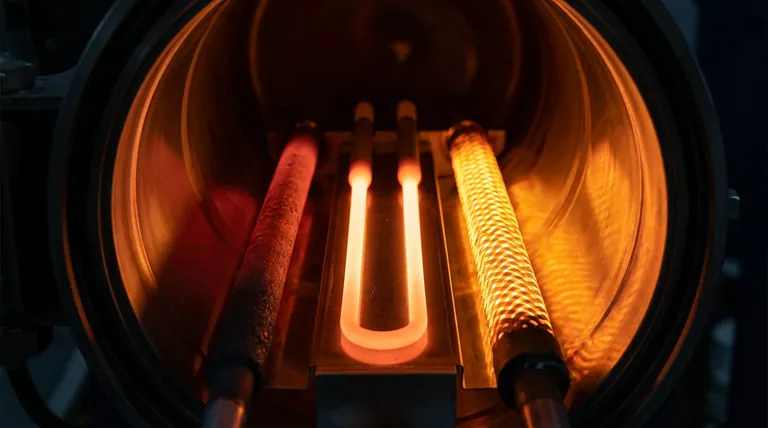
At the center of this storm is the heating element.

It is easy to think of the heating element as a simple utility—a glorified lightbulb filament that just needs to get hot. This is a mistake. The material you choose for your heating element is not just a component; it is the atmosphere of your process.

It dictates the purity you can achieve. It defines the speed at which you can work. It determines whether your medical alloy is life-saving or scrap metal.

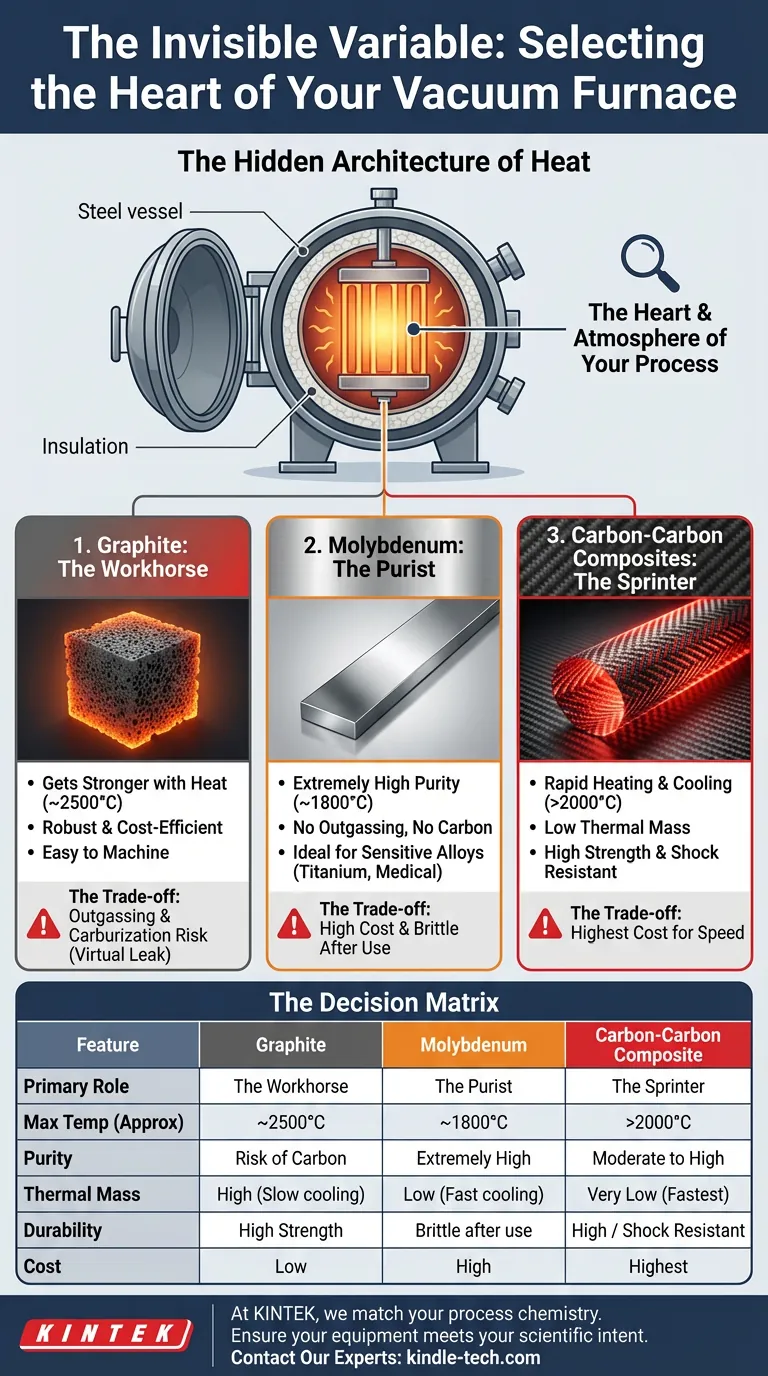
When designing or selecting a vacuum furnace, you are essentially choosing between three distinct philosophies: the rugged utility of Graphite, the clinical purity of Molybdenum, or the high-speed performance of Carbon-Carbon Composites.

Here is how to navigate the trade-offs.

The Physics of the Void

Vacuum furnaces operate in an oxygen-free environment. This is the only reason we can use the materials we do. In open air, graphite would burn away, and molybdenum would oxidize instantly.

The vacuum protects the element. But the element must also protect the workload.

The interaction between these two defines your success.

1. Graphite: The Paradox of Strength

Graphite is the standard for a reason. It is the workhorse of the heat-treating industry.

It possesses a rare, almost romantic engineering quality: it gets stronger as it gets hotter. Up to about 2500°C (4532°F), graphite defies the usual rules of material degradation. It is robust, relatively inexpensive, and easy to machine into complex geometries.

But graphite breathes.

Because it is porous, graphite acts like a sponge. When the furnace is open to air, the element absorbs moisture and gases. When the cycle begins and the heat rises, the element releases these trapped molecules—a process known as outgassing.

The Trade-off: You get incredible durability and cost-efficiency. In exchange, you must manage the "virtual leak" of outgassing, which can extend your pump-down times.

Furthermore, graphite is carbon. If you are processing materials that are chemically hungry for carbon (like Titanium), a graphite element can cause "carburization," subtly altering the surface chemistry of your parts.

2. Molybdenum: The Clinical Approach

If graphite is the sledgehammer, Molybdenum (Moly) is the scalpel.

In industries like aerospace and medical device manufacturing, contamination is not an inconvenience; it is a failure. You cannot have stray carbon atoms migrating into a hip implant or a jet engine turbine blade.

For these applications, we turn to refractory metals.

Molybdenum provides an all-metal, exceptionally clean hot zone. It does not outgas like graphite. It does not shed carbon. It offers the purest possible vacuum environment.

The Trade-off: Purity comes at a price—literally and physically. Molybdenum is significantly more expensive than graphite.

It is also temperamental. After repeated cycles of extreme heat, Molybdenum recrystallizes and becomes brittle. It loses its ductility. A graphite rod can take a knock; a used Molybdenum strip can shatter like glass if mishandled during maintenance. It demands respect and a steady hand.

3. Carbon-Carbon Composites: Buying Time

Time is the most expensive variable in any lab or production floor.

Traditional graphite is heavy. It has high thermal mass, meaning it soaks up a tremendous amount of heat. Once you turn the power off, a heavy graphite hot zone acts like a heat battery, continuing to radiate warmth long after you want the furnace to cool down.

Enter Carbon-Carbon Composites (CFC).

By reinforcing a graphite matrix with carbon fibers, engineers created a material that is stronger than standard graphite but significantly thinner and lighter.

The Trade-off: CFC elements hold very little heat. They allow the furnace to heat up rapidly and, more importantly, cool down immediately. This slashes cycle times, increasing throughput.

The downside is the upfront investment. You are paying a premium for speed and mechanical resilience.

The Decision Matrix

There is no "best" material. There is only the material that aligns with your specific constraints.

Great engineering is about understanding the failure mode you are willing to accept to get the performance you need.

Summary of Characteristics

Feature Graphite Molybdenum Carbon-Carbon Composite
Primary Role The Workhorse The Purist The Sprinter
Max Temp (Approx) ~2500°C ~1800°C >2000°C
Purity Risk of Carbon dust/vapor Extremely High Moderate to High
Thermal Mass High (Slow cooling) Low (Fast cooling) Very Low (Fastest cooling)
Durability High Strength Brittle after use High / Shock Resistant
Cost Low High Highest

How to Choose

When you speak to a KINTEK expert, we start with the application, not the catalogue.

  1. Select Graphite if your process is general-purpose (hardening steels, brazing) and cost is a primary driver. It is reliable and forgiving.
  2. Select Molybdenum if your workload is chemically sensitive. If you are processing Titanium, Niobium, or Tantalum, you cannot risk carbon interaction. The element must be metal.
  3. Select Composites if your bottleneck is time. If you need to run multiple cycles per shift, the rapid cooling of CFC pays for itself in throughput.

The Human Element in Lab Equipment

A vacuum furnace is a system. If one variable is misaligned—if the element fights the workload—the system fails.

At KINTEK, we specialize in identifying these variables before they become problems. We understand that you aren't just buying a heating element; you are buying a controlled environment for your research or production.

Whether you need the ruggedness of graphite or the precision of molybdenum, our role is to ensure your equipment matches your scientific intent.

Do not leave your process chemistry to chance.

Contact Our Experts

Visual Guide

The Invisible Variable: Selecting the Heart of Your Vacuum Furnace Visual Guide

Related Products

Related Articles

Related Products

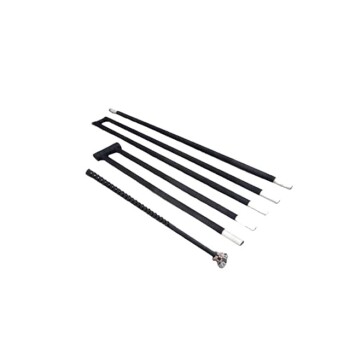
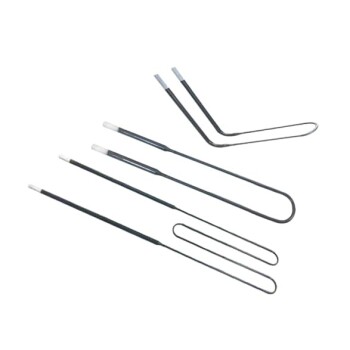
Molybdenum Disilicide (MoSi2) Thermal Elements Electric Furnace Heating Element

Molybdenum Disilicide (MoSi2) Thermal Elements Electric Furnace Heating Element

Discover the power of Molybdenum Disilicide (MoSi2) Heating Element for high-temperature resistance. Unique oxidation resistance with stable resistance value. Learn more about its benefits now!

Ultra-High Temperature Graphite Vacuum Graphitization Furnace

Ultra-High Temperature Graphite Vacuum Graphitization Furnace

The ultra-high temperature graphitization furnace utilizes medium frequency induction heating in a vacuum or inert gas environment. The induction coil generates an alternating magnetic field, inducing eddy currents in the graphite crucible, which heats up and radiates heat to the workpiece, bringing it to the desired temperature. This furnace is primarily used for graphitization and sintering of carbon materials, carbon fiber materials, and other composite materials.

Graphite Vacuum Furnace IGBT Experimental Graphitization Furnace

Graphite Vacuum Furnace IGBT Experimental Graphitization Furnace

IGBT experimental graphitization furnace, a tailored solution for universities and research institutions, with high heating efficiency, user-friendliness, and precise temperature control.

Graphite Vacuum Continuous Graphitization Furnace

Graphite Vacuum Continuous Graphitization Furnace

High-temperature graphitization furnace is a professional equipment for graphitization treatment of carbon materials. It is a key equipment for the production of high-quality graphite products. It has high temperature, high efficiency and uniform heating. It is suitable for various high-temperature treatments and graphitization treatments. It is widely used in metallurgy, electronics, aerospace, etc. industry.

Laboratory Vacuum Tilt Rotary Tube Furnace Rotating Tube Furnace

Laboratory Vacuum Tilt Rotary Tube Furnace Rotating Tube Furnace

Discover the versatility of Laboratory Rotary Furnace: Ideal for calcination, drying, sintering, and high-temperature reactions. Adjustable rotating and tilting functions for optimal heating. Suitable for vacuum and controlled atmosphere environments. Learn more now!

Graphite Vacuum Furnace Negative Material Graphitization Furnace

Graphite Vacuum Furnace Negative Material Graphitization Furnace

Graphitization furnace for battery production has uniform temperature and low energy consumption. Graphitization furnace for negative electrode materials: an efficient graphitization solution for battery production and advanced functions to enhance battery performance.

Small Vacuum Heat Treat and Tungsten Wire Sintering Furnace

Small Vacuum Heat Treat and Tungsten Wire Sintering Furnace

The small vacuum tungsten wire sintering furnace is a compact experimental vacuum furnace specially designed for universities and scientific research institutes. The furnace features a CNC welded shell and vacuum piping to ensure leak-free operation. Quick-connect electrical connections facilitate relocation and debugging, and the standard electrical control cabinet is safe and convenient to operate.

1400℃ Controlled Atmosphere Furnace with Nitrogen and Inert Atmosphere

1400℃ Controlled Atmosphere Furnace with Nitrogen and Inert Atmosphere

Achieve precise heat treatment with KT-14A controlled atmosphere furnace. Vacuum sealed with a smart controller, it's ideal for lab and industrial use up to 1400℃.

Laboratory Rapid Thermal Processing (RTP) Quartz Tube Furnace

Laboratory Rapid Thermal Processing (RTP) Quartz Tube Furnace

Get lightning-fast heating with our RTP Rapid Heating Tube Furnace. Designed for precise, high-speed heating and cooling with convenient sliding rail and TFT touch screen controller. Order now for ideal thermal processing!

Graphite Disc Rod and Sheet Electrode Electrochemical Graphite Electrode

Graphite Disc Rod and Sheet Electrode Electrochemical Graphite Electrode

High-quality graphite electrodes for electrochemical experiments. Complete models with acid and alkali resistance, safety, durability, and customization options.

1400℃ Laboratory High Temperature Tube Furnace with Alumina Tube

1400℃ Laboratory High Temperature Tube Furnace with Alumina Tube

Looking for a tube furnace for high-temperature applications? Our 1400℃ Tube Furnace with Alumina Tube is perfect for research and industrial use.

Multi-zone Laboratory Tube Furnace

Multi-zone Laboratory Tube Furnace

Experience precise, efficient thermal testing with our Multi Zone Tube Furnace. Independent heating zones and temperature sensors allow for controlled high-temperature gradient heating fields. Order now for advanced thermal analysis!

Carbon Graphite Boat -Laboratory Tube Furnace with Cover

Carbon Graphite Boat -Laboratory Tube Furnace with Cover

Covered Carbon Graphite Boat Laboratory Tube Furnaces are specialized vessels or vessels made of graphite material designed to withstand extreme high temperatures and chemically aggressive environments.

Infrared Heating Quantitative Flat Plate Press Mold

Infrared Heating Quantitative Flat Plate Press Mold

Discover advanced infrared heating solutions with high-density insulation and precise PID control for uniform thermal performance in various applications.

24T 30T 60T Heated Hydraulic Press Machine with Heated Plates for Laboratory Hot Press

24T 30T 60T Heated Hydraulic Press Machine with Heated Plates for Laboratory Hot Press

Looking for a reliable Hydraulic Heated Lab Press? Our 24T / 40T model is perfect for material research labs, pharmacy, ceramics, and more. With a small footprint and the ability to work inside a vacuum glove box, it's the efficient and versatile solution for your sample preparation needs.

Custom PTFE Teflon Parts Manufacturer for PTFE Buchner Funnel and Triangular Funnel

Custom PTFE Teflon Parts Manufacturer for PTFE Buchner Funnel and Triangular Funnel

The PTFE funnel is a piece of laboratory equipment used primarily for filtration processes, particularly in the separation of solid and liquid phases in a mixture. This setup allows for efficient and rapid filtration, making it indispensable in various chemical and biological applications.

Manual Lab Heat Press

Manual Lab Heat Press

Manual hydraulic presses are mainly used in laboratories for various applications such as forging, molding, stamping, riveting and other operations. It allows the creation of complex shapes while saving material.

Manual Heated Hydraulic Press Machine with Heated Plates for Laboratory Hot Press

Manual Heated Hydraulic Press Machine with Heated Plates for Laboratory Hot Press

The Manual Heat Press is a versatile piece of equipment suitable for a variety of applications, operated by a manual hydraulic system that applies controlled pressure and heat to the material placed on the piston.

RRDE rotating disk (ring disk) electrode / compatible with PINE, Japanese ALS, Swiss Metrohm glassy carbon platinum

RRDE rotating disk (ring disk) electrode / compatible with PINE, Japanese ALS, Swiss Metrohm glassy carbon platinum

Elevate your electrochemical research with our Rotating Disk and Ring Electrodes. Corrosion resistant and customizable to your specific needs, with complete specifications.

Assemble Square Lab Press Mold for Laboratory Applications

Assemble Square Lab Press Mold for Laboratory Applications

Achieve perfect sample preparation with Assemble Square Lab Press Mold. Quick disassembly eliminates sample deformation. Perfect for battery, cement, ceramics, and more. Customizable sizes available.


Leave Your Message