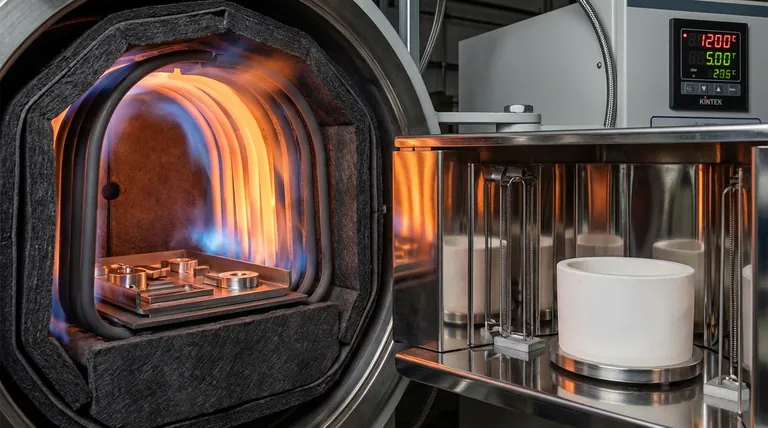
The Paradox of Containment
A vacuum furnace is a technological paradox.
Its primary function is to create "nothing"—a near-perfect vacuum. Yet, to sustain that nothingness while generating temperatures hot enough to melt steel, it requires a structure of immense resilience.
When you look at a vacuum furnace, you aren't just looking at a machine. You are looking at a series of engineering bets. It is a calculated trade-off between the desire for purity and the constraints of physics.
The materials used to build these furnaces dictate everything. They decide what you can process, how long the equipment lasts, and ultimately, whether your project succeeds or suffers a microscopic, invisible failure.
The Architecture of Heat
At the center of this system is the "Hot Zone."
Think of the hot zone as an operating theater. It must be insulated, sterile, and capable of withstanding extreme stress without contaminating the "patient" (your workload).
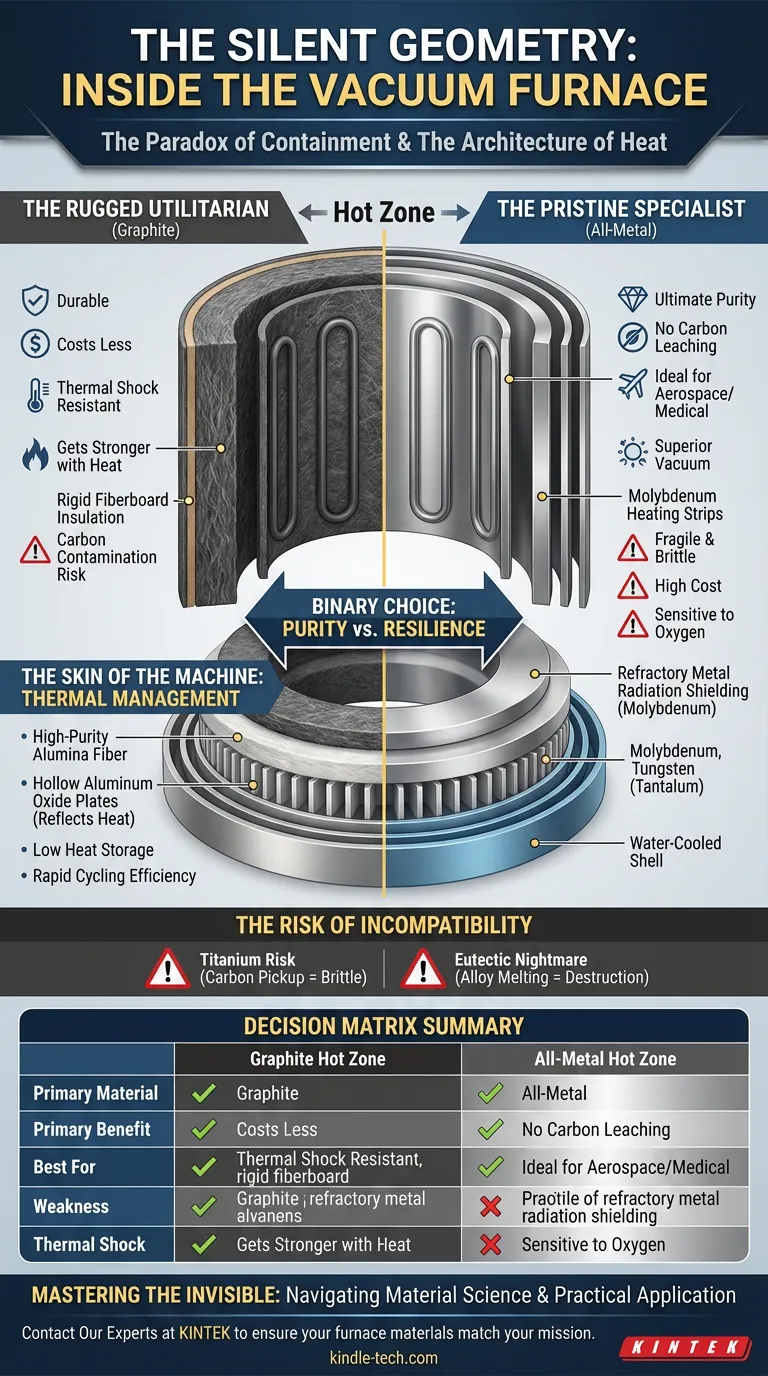
Engineers generally face a binary choice when designing this heart. They must choose between the Rugged Utilitarian (Graphite) and the Pristine Specialist (Refractory Metals).
The Case for Graphite: The Robust Standard
Graphite is the workhorse of the high-temperature world.
In roughly 80% of applications, graphite is the logical choice. It possesses a unique, almost romantic quality for an engineer: it gets stronger as it gets hotter.
- The Heating Elements: Lightweight, curved graphite.
- The Insulation: Rigid graphite fiberboard or soft felt.
It is durable. It handles thermal shock—the rapid shift from hot to cold—better than almost anything else. It is also cost-effective.
The catch? Carbon.
Graphite is carbon. For most steels, this is fine. But for highly sensitive materials, graphite can act like a slow poison, leaching carbon atoms into the alloy and altering its chemical structure.
The Case for Refractory Metals: The All-Metal Zone
When purity is the only metric that matters, graphite is abandoned. We turn to the "All-Metal" hot zone.
This system is constructed from refractory metals—materials with astronomically high melting points.
- Molybdenum: Used for heating element strips and radiation shielding.
- Tungsten & Tantalum: Employed for the most demanding thermal extremes.
An all-metal furnace is a cleaner environment. There is no carbon to leach. It creates a vacuum of superior quality, essential for aerospace components and medical implants where failure is not an option.
The catch? Fragility and cost.
Molybdenum becomes brittle after heating. One wrong move during loading, or one accidental spike in oxygen, and the internal components can shatter or oxidize. It is a high-performance system that demands respect.
The Skin of the Machine
Containing this heat requires more than just a strong wall. It requires thermal management that borders on art.
Outside the immediate hot zone lies the insulation layer. This barrier prevents the searing heat from reaching the water-cooled outer shell.
Modern furnaces rely on materials that defy the intuition of weight:
- High-purity alumina fiber
- Hollow aluminum oxide plates
These materials have low "heat storage." They don't soak up energy; they reflect it. This allows the furnace to heat up and cool down rapidly, cycling through jobs with efficiency rather than thermal lethargy.
The Risk of Incompatibility
The most dangerous thing in a vacuum furnace is not the heat. It is chemistry.
The vacuum environment prevents oxidation, which is good. But it also encourages other reactions. At 1,000°C, materials that are inert at room temperature can suddenly become aggressive solvents.
- The Titanium Risk: Titanium is highly reactive. If processed in a graphite furnace without barrier considerations, it may pick up carbon, becoming brittle.
- The Eutectic Nightmare: Some materials, when touching the heating elements, create a eutectic alloy—a new material with a lower melting point than either parent. The result? The materials melt instantly, destroying the workload and the furnace internals.
You are not just selecting a furnace; you are selecting a chemical ecosystem.
Summary: The Decision Matrix
To simplify the trade-offs, we can view the material selection through the lens of application:
| Feature | Graphite Hot Zone | All-Metal Hot Zone (Refractory) |
|---|---|---|
| Primary Material | Graphite Fiberboard / Felt | Molybdenum / Tungsten |
| Primary Benefit | Durability & Low Cost | Ultimate Purity |
| Best For | General heat treating, Brazing, Sintering steels | Medical implants, Aerospace, Titanium, Superalloys |
| Weakness | Potential for carbon contamination | Higher cost, brittle after use |
| Thermal Shock | Excellent resistance | Sensitive to rapid cycling |
Mastering the Invisible
The difference between a successful batch and a scrapped load often comes down to the invisible interaction between the furnace walls and the parts inside.
It is a game of specificities.
If your focus is general-purpose efficiency, the graphite system provides the durability you need. If your world is defined by the strict specifications of aerospace or medical regulation, the all-metal system is your only path.
At KINTEK, we understand that you aren't just buying equipment; you are buying a controlled outcome. We stand at the intersection of material science and practical application.
Whether you need the rugged reliability of graphite or the clinical precision of molybdenum, our engineers can help you navigate the risks.
Contact Our Experts to analyze your specific heat-treatment needs and ensure your furnace materials match your mission.
Visual Guide
Related Products
- Vacuum Hot Press Furnace Heated Vacuum Press Machine Tube Furnace
- 600T Vacuum Induction Hot Press Furnace for Heat Treat and Sintering
- Vacuum Heat Treat Furnace with Ceramic Fiber Liner
- Vacuum Heat Treat and Pressure Sintering Furnace for High Temperature Applications
- Vacuum Heat Treat Furnace and Levitation Induction Melting Furnace
Related Articles
- The Purity Paradox: Choosing the Heart of Your Vacuum Hot Press Furnace
- Comprehensive Guide to Vacuum Hot Press Furnace Application
- Vacuum Hot Press Furnace: A Comprehensive Guide
- Forging Perfection in a Void: The Physics of Ultra-Dense Materials
- Defeating the Void: The Quiet Power of Vacuum Hot Pressing



















