Heat is a destructive force.
In the world of material science, we often treat high temperature as a simple setting on a dial. We look at a datasheet, see "1700°C," and assume that is a static capability.
But a vacuum tube furnace is not a static box. It is a dynamic ecosystem.
Like a chain that breaks at its weakest link, a furnace’s maximum temperature is not defined by its strongest component, but by the interplay of its most fragile ones. The theoretical maximum is often an illusion; the operational reality is defined by physics.
Here is how the system actually works, and why the "maximum temperature" is a variable, not a constant.
The Hierarchy of Constraints
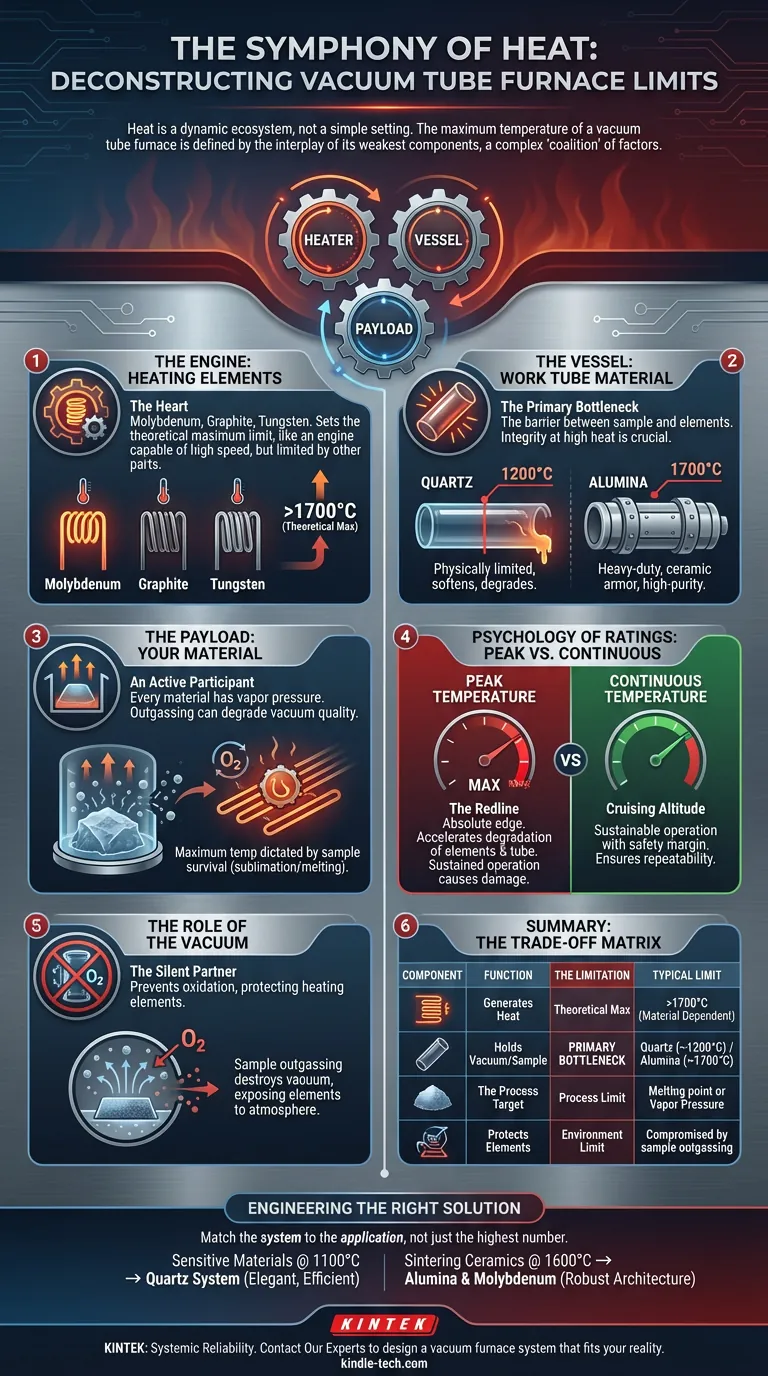
To understand the thermal ceiling of your equipment, you have to think like a systems engineer. You are managing a three-part coalition: the heater, the vessel, and the payload.
If any one of these fails, the process fails.
1. The Engine: Heating Elements
The heating element is the heart of the operation. Whether made of Molybdenum, Graphite, or Tungsten, these materials are chosen for their refusal to melt under extreme stress.
Technically, these elements set the absolute theoretical limit. They are the engine capable of hitting 200 mph. However, just because the engine can spin that fast doesn't mean the tires can handle the friction.
2. The Vessel: Work Tube Material
This is the most common bottleneck in laboratory settings. The work tube is the barrier between your sample and the heating elements. It must maintain structural integrity while transmitting heat.
- Quartz: Beautifully transparent and cost-effective, but physically limited. It begins to soften and degrade past 1200°C.
- Alumina: The heavy-duty alternative. A high-purity alumina tube is the ceramic armor required to push the system toward 1700°C.
If you push a Quartz tube to Tungsten temperatures, you don't get a hotter sample. You get a collapsed tube and a ruined furnace.
3. The Payload: Your Material
This is the factor most users overlook. We often forget that the sample is an active participant in the thermal reaction.
Every material has a vapor pressure. As heat rises, your sample may begin to outgas. In a high-vacuum environment, this outgassing can degrade the vacuum quality, allowing oxygen to attack the heating elements.
The "maximum temperature" is often dictated not by what the furnace can do, but by what your sample can survive without sublimating or melting into the tube floor.
The Psychology of Ratings: Peak vs. Continuous
There is a distinct difference between what a machine can do once, and what it can do forever.
Manufacturers list two numbers:
- Peak Temperature: The redline. The absolute edge of performance.
- Continuous Temperature: The cruising altitude.
Running a furnace at its peak temperature is like driving your car at the rev limiter. You can do it for a few minutes to pass a truck, but if you do it for an hour, you will blow a gasket.
Sustained operation at peak ratings accelerates the degradation of both the heating element and the work tube. The smart engineer always designs a process with a safety margin, operating slightly below the peak to ensure repeatability.
The Role of the Vacuum
The vacuum is the silent partner. It does not create heat, but it allows it to exist.
High temperatures usually invite oxidation—the rapid burning of materials. The vacuum removes the oxygen, protecting the graphite or molybdenum elements from turning to ash.
However, this is a double-edged sword. If your sample outgases at 1000°C, it destroys the vacuum. Without the vacuum, the protection is gone, and the "maximum temperature" of the heating elements drops strictly because they are now vulnerable to the atmosphere.
Summary: The Trade-Off Matrix
When selecting a furnace, you are engaging in a trade-off of materials. Use this guide to identify your bottleneck:
| Component | Function | The Limitation | Typical Limit |
|---|---|---|---|
| Heating Element | Generates Heat | Theoretical Max | >1700°C (Material Dependent) |
| Work Tube | Holds Vacuum/Sample | Primary Bottleneck | Quartz (~1200°C) / Alumina (~1700°C) |
| Sample | The Process Target | Process Limit | Melting point or Vapor Pressure |
| Vacuum | Protects Elements | Environment Limit | Compromised by sample outgassing |
Engineering the Right Solution
High-temperature processing is not about buying the furnace with the highest number on the sticker. It is about matching the system to the application.
If you are processing sensitive materials at 1100°C, a Quartz-based system is elegant and efficient. If you are sintering ceramics at 1600°C, you need the robust architecture of Alumina and Molybdenum.
At KINTEK, we don't just sell specs; we sell systemic reliability. We understand that your research depends on the weakest link holding strong. Whether you need the transparency of quartz or the brute thermal resistance of high-purity alumina, we help you configure the exact heating element and tube combination for your specific thermodynamics.
Do not let a mismatched component compromise your thermal ceiling. Contact Our Experts to design a vacuum furnace system that fits your reality.
Visual Guide
Related Products
- Vacuum Sealed Continuous Working Rotary Tube Furnace Rotating Tube Furnace
- Laboratory High Pressure Vacuum Tube Furnace
- Laboratory Vacuum Tilt Rotary Tube Furnace Rotating Tube Furnace
- Split Chamber CVD Tube Furnace with Vacuum Station Chemical Vapor Deposition System Equipment Machine
- 1200℃ Controlled Atmosphere Furnace Nitrogen Inert Atmosphere Furnace
Related Articles
- Unlocking Efficiency: The Ultimate Guide to Rotary Tube Furnaces
- Unlocking Efficiency: Exploring the Advantages and Applications of Rotary Tube Furnaces
- Exploring Rotary Tube Furnaces: A Comprehensive Guide
- Exploring the Functions and Advantages of Rotary Tube Furnaces
- The Geometry of Heat: Engineering the Perfect Thermal Environment