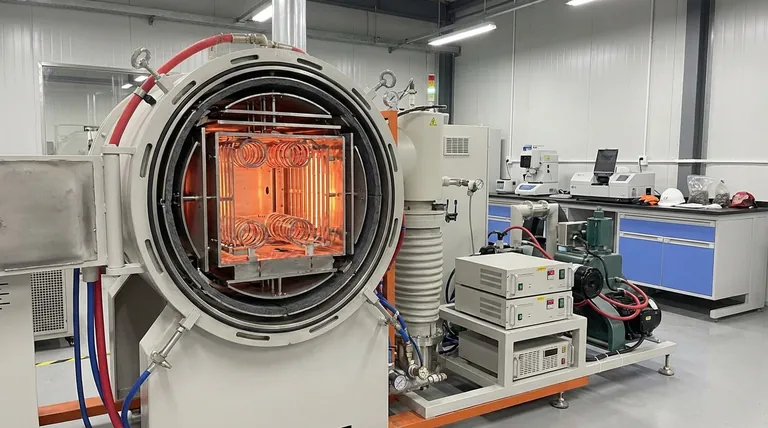
The Seduction of the Max Spec
There is a temptation in laboratory procurement to chase the highest number on the datasheet.
We assume that a vacuum furnace capable of 2500°C is inherently "better" than one rated for 1600°C. We treat temperature capacity like horsepower in a car engine—more is always better.
But in thermal engineering, this is a dangerous simplification.
A vacuum furnace is not a magic box that produces heat. It is a complex ecosystem of materials pushing against their own physical destruction points. The maximum temperature is not determined by a dial on a controller. It is determined by the specific melting points, vapor pressures, and chemical reactivities of the materials inside the "hot zone."
To choose the right equipment, you must look past the maximum rating and understand the anatomy of the heat itself.
The Anatomy of the Hot Zone
The "hot zone" is the heart of the furnace. It consists of two critical components: the heating elements (the source) and the insulation (the barrier).
The interaction between these two defines your thermal ceiling.
Heating Elements: The limiting factor
The element is the single most important variable. It dictates not just how hot you can go, but how clean your process remains.
- Nickel-Chromium (NiCr): The workhorse for lower temperatures. It is reliable but strictly limited by physics, typically maxing out around 1150°C (2100°F). Pushing it further invites failure.
- Molybdenum (Moly): The standard for mid-range industrial tasks. Capable of 1600°C (2912°F), it is ideal for brazing and heat-treating steels. It is robust, but not invincible.
- Graphite: The value leader. Graphite is unique because it gets stronger as it gets hotter. It can easily reach 2200°C (3992°F) and offers excellent uniformity. However, it is chemically active (more on this later).
- Tungsten: The heavyweight champion. For the most demanding applications—sintering advanced ceramics or refractory metals—tungsten is required. It can operate in excess of 2500°C (4532°F).
Insulation: The unsung hero
If the element is the engine, insulation is the cooling system that keeps the chassis from melting.
- Ceramic Fiber: Lightweight and economical, but generally restricted to lower temperature ranges.
- Graphite Felt: The standard partner for graphite elements. It creates a highly efficient thermal barrier for extreme heat.
- All-Metal Shields: Used in the most sensitive applications. These are reflective sheets of molybdenum or stainless steel. They are less thermally efficient than felt but offer zero particle shedding, essential for high-purity vacuums.
The Hidden Cost of "More"
Here is the psychological trap: You might buy a 2500°C tungsten furnace for a 1400°C process "just to be safe."
This is often a mistake.
The Financial Penalty There is a non-linear relationship between temperature and cost. A furnace designed for 2500°C requires exotic materials and complex power supplies. It can cost exponentially more than a 1300°C unit. You are paying for capacity you will never use.
The Chemistry Problem Materials interact. Graphite is a fantastic heating element, but at high temperatures, it tends to share its carbon atoms. If you are processing sensitive alloys, this leads to carburization—the unwanted absorption of carbon into your metal.
In this scenario, a "better" (hotter) graphite furnace is actually worse for your science than a lower-temperature all-metal furnace.
The Redline Principle
Consider the "Redline" on a tachometer.
Just because a car can hit 7,000 RPM doesn't mean you should drive it there all day. The same logic applies to vacuum furnaces.
Operating a furnace consistently at its maximum rated temperature degrades the heating elements and insulation rapidly. The physics of thermal expansion and material fatigue cannot be cheated.
The Golden Rule: Always select a furnace with a maximum rating comfortably above your daily operating temperature. This buffer zone ensures component longevity and reduces the frequency of expensive maintenance shutdowns.
Summary: Matching Physics to Process
Don't buy a temperature rating. Buy a process solution.
| Heating Element | Typical Max Temp | Best For... |
|---|---|---|
| Nickel-Chromium | ~1150°C | Tempering, aging, aluminum brazing |
| Molybdenum | ~1600°C | Hardening tool steels, stainless steel brazing |
| Graphite | 2200°C+ | General heat treating, sintering ceramics |
| Tungsten | 2500°C+ | Refractory metals, advanced research |
Precision is the Ultimate Luxury
In the laboratory, over-specification is as dangerous as under-specification. The goal is not the highest temperature; the goal is the right temperature, delivered reliably, in a chemical environment that protects your samples.
At KINTEK, we do not just sell specifications. We engineer solutions.
We help you navigate the trade-offs between Graphite, Molybdenum, and Tungsten to ensure you aren't paying for heat you don't need—or introducing contamination you can't afford.
Let us help you match the machine to the molecule. Contact Our Experts
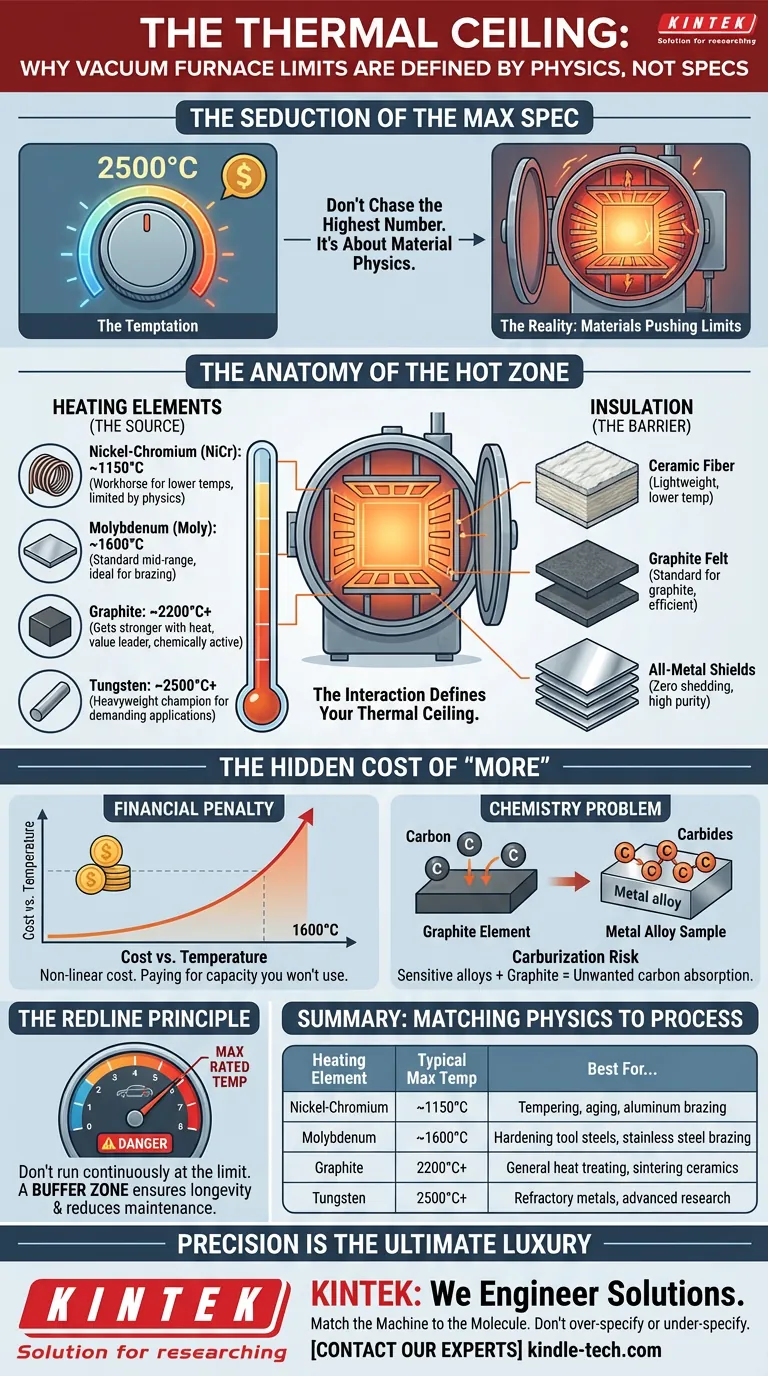
Visual Guide
Related Products
- Vacuum Hot Press Furnace Heated Vacuum Press Machine Tube Furnace
- 600T Vacuum Induction Hot Press Furnace for Heat Treat and Sintering
- Vacuum Hot Press Furnace Machine Heated Vacuum Press
- Vacuum Heat Treat Furnace and Levitation Induction Melting Furnace
- 2200 ℃ Tungsten Vacuum Heat Treat and Sintering Furnace
Related Articles
- The Purity Paradox: Choosing the Heart of Your Vacuum Hot Press Furnace
- Comprehensive Guide to Vacuum Hot Press Furnace Application
- Vacuum Hot Press Furnace: A Comprehensive Guide
- Forging Perfection in a Void: The Physics of Ultra-Dense Materials
- Defeating the Void: The Quiet Power of Vacuum Hot Pressing



















