The Seduction of High Numbers
In laboratory procurement, there is a psychological trap that is difficult to avoid: the allure of the maximum spec.
When asking, "How hot does a vacuum furnace get?" the instinct is to look for the highest number available. It feels safer. It feels like future-proofing.
But in thermodynamics, there is no free lunch.
A vacuum furnace is not a static box that simply gets hot. It is a complex, engineered ecosystem where thermal capacity is fighting a constant war against material degradation.
The maximum temperature is not determined by how much power you can pump in. It is determined by the component with the lowest tolerance for stress. It is a story of weak links.
The Architecture of Heat
To understand temperature limits, you must look at the "Hot Zone."
This is the heart of the furnace. It is where the battle between energy and containment happens. The limit of a furnace is defined by the materials chosen to build this zone.
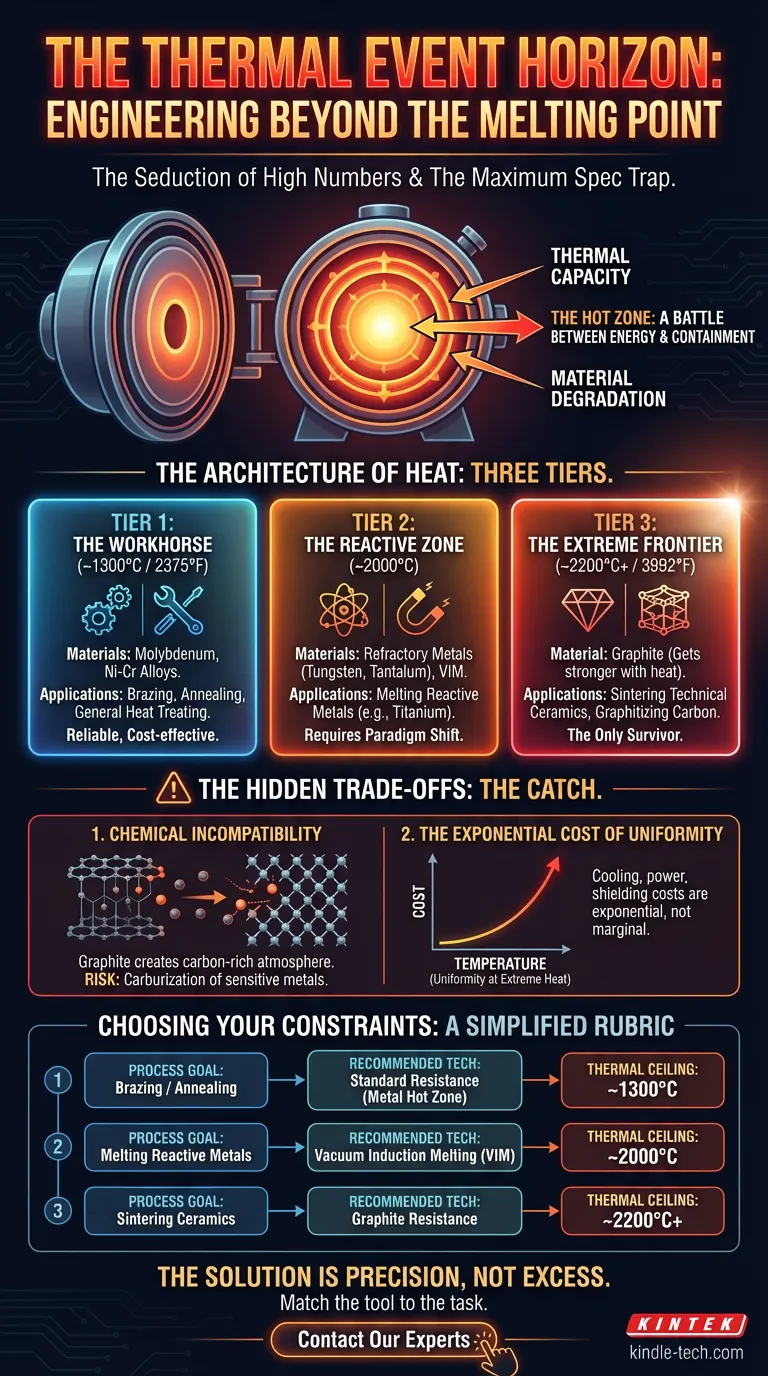
Engineers generally classify these thermal ceilings into three distinct tiers.
Tier 1: The Workhorse (Up to 1300°C)
For the vast majority of industrial applications—brazing, annealing, and general heat treating—you are operating in the realm of standard resistance.
These systems typically use Molybdenum or Nickel-Chromium alloys. They are reliable, relatively cost-effective, and clean.
Operating at 1300°C (2375°F) is sufficient to alter the microstructure of most standard alloys without pushing the physics of the furnace insulation to a breaking point.
Tier 2: The Reactive Zone (2000°C)
When you cross into the territory of superalloys and reactive metals like titanium, standard resistance fails. You need a paradigm shift.
This is the domain of Refractory Metals (Tungsten or Tantalum) and Vacuum Induction Melting (VIM).
VIM furnaces don’t just heat elements; they use electromagnetic induction to melt conductive materials in a chemically pure environment. They can hit 2000°C, but they require a different level of maintenance and environmental control.
Tier 3: The Extreme Frontier (2200°C+)
At 2200°C (3992°F), you are no longer just heating things. You are sintering technical ceramics or graphitizing carbon.
To survive this, you need Graphite.
Graphite heaters and insulation are the only materials that maintain structural integrity at these extremes. In fact, graphite gets stronger as it gets hotter.
However, it comes with a catch: Carbon.
The Hidden Trade-Offs
This is where the engineering mindset is crucial.
You might think, "I'll buy the 2200°C graphite furnace just to be safe, even if I only need 1200°C."
This is often a mistake.
1. Chemical Incompatibility A graphite hot zone creates a carbon-rich atmosphere. If you are processing sensitive metals, this carbon will leach into your material, causing carburization. You may have the heat, but you have ruined the chemistry.
2. The Exponential Cost of Uniformity Heat wants to be chaotic. Achieving temperature uniformity at 800°C is standard engineering. Achieving it at 2200°C is a feat of physics.
The cooling systems, the power supplies, and the radiation shielding required to contain 2200°C do not cost marginally more than a standard furnace. They cost exponentially more.
Choosing Your Constraints
The question is not "What is the maximum temperature?"
The better question is: "What is the precise thermal environment my material requires?"
Here is a simplified rubric for decision-making:
| Process Goal | Recommended Technology | Thermal Ceiling |
|---|---|---|
| Brazing / Annealing | Standard Resistance (Metal Hot Zone) | ~1300°C |
| Melting Reactive Metals | Vacuum Induction Melting (VIM) | ~2000°C |
| Sintering Ceramics | Graphite Resistance | ~2200°C+ |
The Solution is Precision, Not Excess
High-temperature engineering is about matching the tool to the task.
Over-specifying your furnace leads to unnecessary capital expenditure and potential chemical incompatibility. Under-specifying leads to process failure.
At KINTEK, we view laboratory equipment through the lens of your application, not just a spec sheet. Whether you are annealing standard alloys or pushing the boundaries of material science with high-temperature sintering, we provide the engineered systems that fit your reality.
We help you navigate the trade-offs between temperature, purity, and cost.
Visual Guide
Related Products
- Vacuum Hot Press Furnace Heated Vacuum Press Machine Tube Furnace
- 600T Vacuum Induction Hot Press Furnace for Heat Treat and Sintering
- Vacuum Hot Press Furnace Machine Heated Vacuum Press
- Vacuum Heat Treat Furnace and Levitation Induction Melting Furnace
- 2200 ℃ Tungsten Vacuum Heat Treat and Sintering Furnace
Related Articles
- The Purity Paradox: Choosing the Heart of Your Vacuum Hot Press Furnace
- Comprehensive Guide to Vacuum Hot Press Furnace Application
- Vacuum Hot Press Furnace: A Comprehensive Guide
- Forging Perfection in a Void: The Physics of Ultra-Dense Materials
- Defeating the Void: The Quiet Power of Vacuum Hot Pressing