Temperature is rarely just a number. In the world of materials science, it is a threshold.
Cross one threshold, and a metal relaxes, relieving the stress of its creation. Cross another, and it flows like water. Cross a third, and it fuses with ceramic to become something entirely new.
When engineers ask, "What is high temperature in a vacuum furnace?" they are usually looking for a single data point. But the answer isn't a number. It is a relationship between the furnace’s architecture and the material’s destiny.
Here is how to navigate the thermal landscape without getting burned by over-specification.
The Relativity of Heat
In human terms, "hot" is a feeling. In engineering, "hot" is a function.
A vacuum furnace does not have a single setting for "high temperature." Instead, it operates within ranges dictated by the laws of physics and the limitations of heating elements.
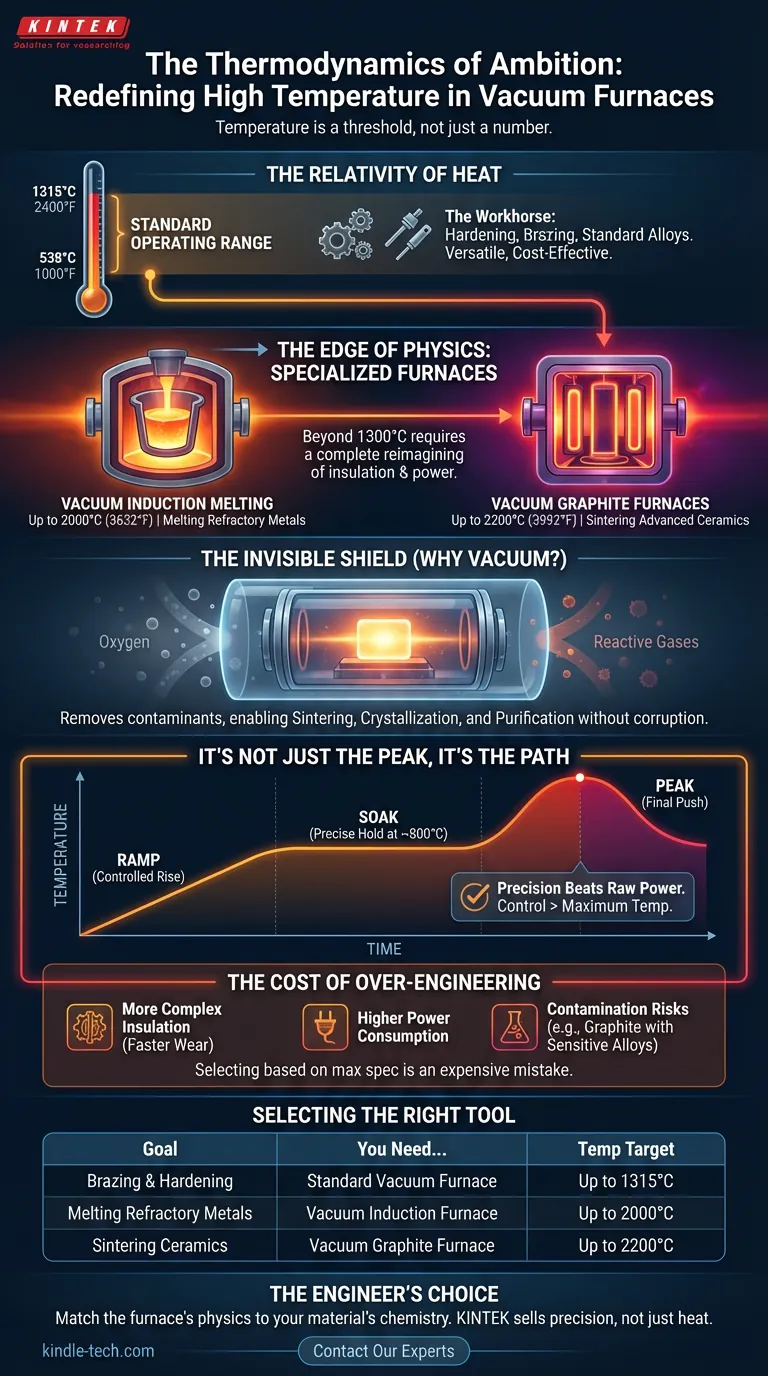
Most industrial thermal processing—the daily work of hardening gears or brazing sensors—happens in what we call the Standard Operating Range.
- Range: 538°C (1000°F) to 1315°C (2400°F).
- The Goal: Balance.
- The Logic: At 1300°C, you can treat the vast majority of steels and standard alloys. A furnace built for this range is a workhorse: versatile, cost-effective, and durable.
But for those pushing the boundaries of material science, "standard" is insufficient.
The Edge of Physics: Specialized Furnaces
When you leave the standard range, you enter a different domain of engineering.
Here, you are dealing with refractory metals, advanced ceramics, and synthetic alloys that laugh at 1300°C. To manipulate these materials, you need a system designed for extremity.
This is where the "High Temperature" definition shifts dramatically:
- Vacuum Induction Melting: Designed to melt metal rather than just heat it. These systems push to 2000°C (3632°F).
- Vacuum Graphite Furnaces: Using graphite heating elements, these giants can achieve 2200°C (3992°F).
This isn't just about turning a dial. Reaching 2200°C requires a complete reimagining of insulation, power delivery, and vacuum integrity. It is the difference between a commercial jet and a rocket.
The Invisible Shield
Why go this high in a vacuum?
Heat is an accelerant. In the open air, heating a superalloy to 2000°C would not result in a stronger part; it would result in a pile of oxidized dust.
The vacuum is the invisible shield. By removing oxygen and other reactive gases, the furnace allows the heat to do its work—melting, sintering, or growing crystals—without chemical corruption.
This allows for:
- Sintering: Fusing powders into dense solids below their melting point.
- Crystallization: Growing single crystals for semiconductors.
- Purification: Melting ingots to achieve perfect uniformity.
It’s Not Just the Peak, It’s the Path
There is a psychological trap in buying lab equipment: we obsess over the maximum specs. We buy the car with the highest top speed, even if we only drive in the city.
In thermal processing, the maximum temperature is often less important than the control of that temperature.
A material’s properties are forged in the journey, not just the destination. A typical high-performance cycle involves:
- The Ramp: A controlled rise in temperature (e.g., 10°C per minute).
- The Soak: A precise hold at 800°C to equalize thermal gradients.
- The Peak: The final push to 1100°C or higher.
If your furnace can reach 2200°C but cannot hold a steady 800°C "soak" without fluctuation, your advanced alloy will fail. Precision beats raw power.
The Cost of Over-Engineering
Selecting a furnace based on the highest possible number is an expensive mistake.
Higher temperatures demand:
- More complex insulation (which wears out faster).
- Higher power consumption.
- Specific heating elements (like graphite) that might chemically react with certain sensitive alloys.
If your process requires 1200°C, buying a 2200°C furnace introduces unnecessary complexity and potential contamination risks.
Selecting the Right Tool
To choose the right equipment, ignore the marketing brochure’s maximum number for a moment. Instead, look at your material's chemistry.
| If your goal is... | You need... | Temperature Target |
|---|---|---|
| Brazing & Hardening | Standard Vacuum Furnace | Up to 1315°C |
| Melting Refractory Metals | Vacuum Induction Furnace | Up to 2000°C |
| Sintering Ceramics | Vacuum Graphite Furnace | Up to 2200°C |
The Engineer's Choice
High temperature is not a badge of honor; it is a parameter of necessity.
The best furnace is not the one that gets the hottest. It is the one that provides the exact thermal environment your specific material requires to transform from what it is, into what it needs to be.
At KINTEK, we don't just sell heat; we sell precision. Whether you are annealing standard steel or sintering the next generation of ceramics, our experts help you match the physics of the furnace to the chemistry of your lab.
Visual Guide
Related Products
- Vacuum Hot Press Furnace Heated Vacuum Press Machine Tube Furnace
- 600T Vacuum Induction Hot Press Furnace for Heat Treat and Sintering
- Vacuum Hot Press Furnace Machine Heated Vacuum Press
- Vacuum Heat Treat Furnace and Levitation Induction Melting Furnace
- 2200 ℃ Tungsten Vacuum Heat Treat and Sintering Furnace
Related Articles
- The Purity Paradox: Choosing the Heart of Your Vacuum Hot Press Furnace
- Comprehensive Guide to Vacuum Hot Press Furnace Application
- Vacuum Hot Press Furnace: A Comprehensive Guide
- Forging Perfection in a Void: The Physics of Ultra-Dense Materials
- Defeating the Void: The Quiet Power of Vacuum Hot Pressing