The Fortress Against Entropy
In the world of material science, oxygen is often the enemy. It creates oxides. It dulls surfaces. It compromises structural integrity.
To fight this, engineers created the vacuum furnace.
It is easy to mistake a vacuum furnace for a simple industrial oven. That would be a mistake. An oven merely makes things hot. A vacuum furnace is a precisely engineered environment designed to do something much harder: maintain a profound absence of things.
It is an integrated system designed to heat materials in a space stripped of chaos.
When you look at this machine, you are looking at a battle between the immense pressure of the atmosphere outside and the need for absolute purity inside.
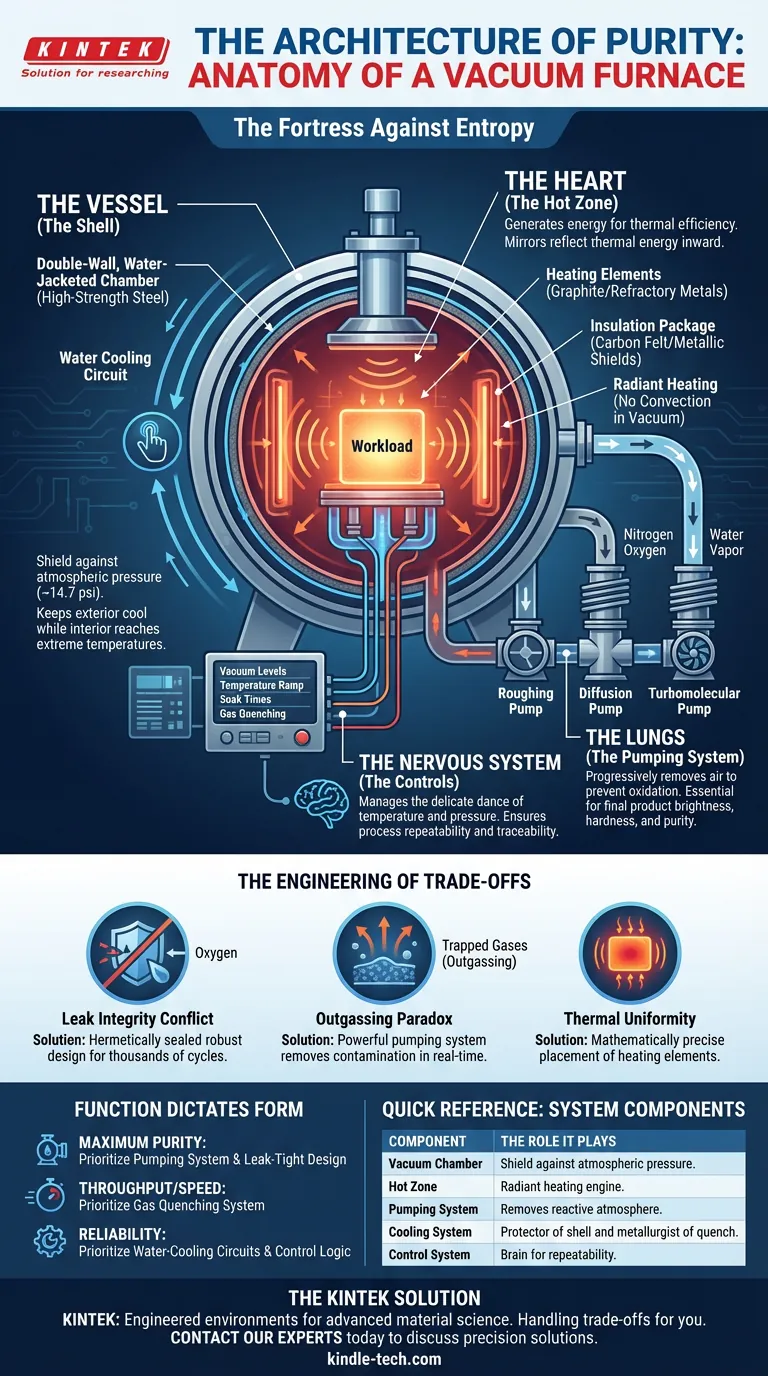
The Vessel (The Shell)
The first line of defense is the vacuum chamber.
Consider the physics here. When a vacuum is pulled, the atmosphere exerts roughly 14.7 pounds of pressure per square inch on the vessel. The chamber is not just a container; it is a shield holding back the weight of the world.
Most modern chambers use a double-wall, water-jacketed design. They are crafted from high-strength steel.
While the interior reaches temperatures that could melt common metals, the exterior remains cool to the touch. This water cooling circuit is essential. It protects the structural integrity of the steel and, more importantly, the safety of the operators standing next to it.
The Heart (The Hot Zone)
Inside the silent void of the chamber lies the hot zone.
This is where the energy is generated. The hot zone is composed of heating elements and an insulation package. In a standard oven, heat transfer relies heavily on convection (air movement). In a vacuum, there is no air to move.
Therefore, the hot zone relies on radiation.
The heating elements—typically graphite or refractory metals—glow with intense energy. The surrounding insulation (often carbon felt or metallic shields) acts as a mirror, reflecting that thermal energy inward toward the workload. It is a system designed for maximum thermal efficiency in a medium that resists heat transfer.
The Lungs (The Pumping System)
The defining feature of the furnace is the vacuum pumping system.
This is the machinery that removes the air. It is a progressive series of pumps designed to evacuate nitrogen, oxygen, and water vapor.
The quality of the final product—its brightness, its hardness, its purity—is directly correlated to the efficiency of these pumps. They must create a vacuum deep enough to prevent oxidation, allowing metallurgical changes to happen without chemical interference.
The Nervous System (The Controls)
A vacuum furnace is blind without a brain. The control system manages the delicate dance between temperature and pressure.
It integrates:
- Vacuum levels
- Temperature ramp rates
- Soak times
- Gas quenching (cooling)
Modern systems log every second of data. In high-stakes R&D or aerospace production, traceability is not a luxury; it is a requirement. The control system ensures that the process is repeatable, removing human error from the equation.
The Engineering of Trade-offs
Designing a vacuum furnace is an exercise in managing conflict.
1. The Leak Integrity Conflict The entire process relies on the chamber remaining hermetically sealed. A single compromised seal or a microscopic crack creates a "virtual leak," introducing oxygen and ruining the batch. The engineering must be robust enough to withstand thousands of cycles without failing.
2. The Outgassing Paradox The goal is purity, but the materials inside the furnace often release trapped gases when heated (outgassing). The pumping system must be powerful enough to overcome this new contamination in real-time.
3. Thermal Uniformity Without air to circulate heat, achieving the same temperature at the top and bottom of the workload is difficult. The placement of heating elements must be mathematically precise.
Function Dictates Form
The way a furnace is built tells you what it is good for. When selecting equipment for your lab, look at the architecture:
- For maximum purity: Prioritize the vacuum pumping system and leak-tight design.
- For throughput/speed: Prioritize the power of the gas quenching system.
- For reliability: Prioritize the water-cooling circuits and control logic.
Quick Reference: System Components
| Component | The Role it Plays |
|---|---|
| Vacuum Chamber | The shield against atmospheric pressure. |
| Hot Zone | The radiant heating engine. |
| Pumping System | The mechanism that removes the reactive atmosphere. |
| Cooling System | The protector of the shell and the metallurgist of the quench. |
| Control System | The brain that ensures repeatability. |
The KINTEK Solution
A vacuum furnace is not just a collection of parts; it is a philosophy of control.
At KINTEK, we understand that the difference between a failed experiment and a breakthrough often lies in the quality of the vacuum. We don't just supply equipment; we provide the engineered environments necessary for advanced material science.
Whether you need high-purity processing or rapid quenching capabilities, our systems are built to handle the trade-offs so you don't have to.
Contact Our Experts today to discuss how our vacuum furnace solutions can bring precision to your laboratory.
Visual Guide
Related Products
- Vacuum Hot Press Furnace Heated Vacuum Press Machine Tube Furnace
- 600T Vacuum Induction Hot Press Furnace for Heat Treat and Sintering
- Vacuum Hot Press Furnace Machine Heated Vacuum Press
- Vacuum Heat Treat Furnace and Levitation Induction Melting Furnace
- 2200 ℃ Tungsten Vacuum Heat Treat and Sintering Furnace
Related Articles
- The Purity Paradox: Choosing the Heart of Your Vacuum Hot Press Furnace
- Comprehensive Guide to Vacuum Hot Press Furnace Application
- Vacuum Hot Press Furnace: A Comprehensive Guide
- Forging Perfection in a Void: The Physics of Ultra-Dense Materials
- Defeating the Void: The Quiet Power of Vacuum Hot Pressing