Imagine this: you’ve just spent hours in the lab preparing a delicate composite layup or a high-value laminate. The press cycle finishes, and at first glance, everything looks perfect. But as it cools, you spot it—a tiny air bubble trapped beneath the surface. Or worse, a corner starts to peel away.
The entire piece is a failure. Hours of work and expensive materials are now scrap. For any researcher or technician working with composites, laminates, or molded materials, this scenario is frustratingly common.
Why Do Our Best Efforts at Bonding Still Fail?
If you've faced this problem, you've likely gone through the classic troubleshooting checklist.
- "Is it the adhesive?" You spend time and money testing different brands, hoping for a magical formula.
- "Maybe we need more force?" You crank up the pressure on your mechanical press, sometimes to the point where you risk damaging the material itself.
- "Is the temperature wrong?" You experiment with external heat guns or ovens, struggling to maintain a consistent temperature across the entire piece.
Despite these efforts, the results remain unpredictable. One day you get a perfect bond; the next, you're faced with delamination, voids, and warped parts.
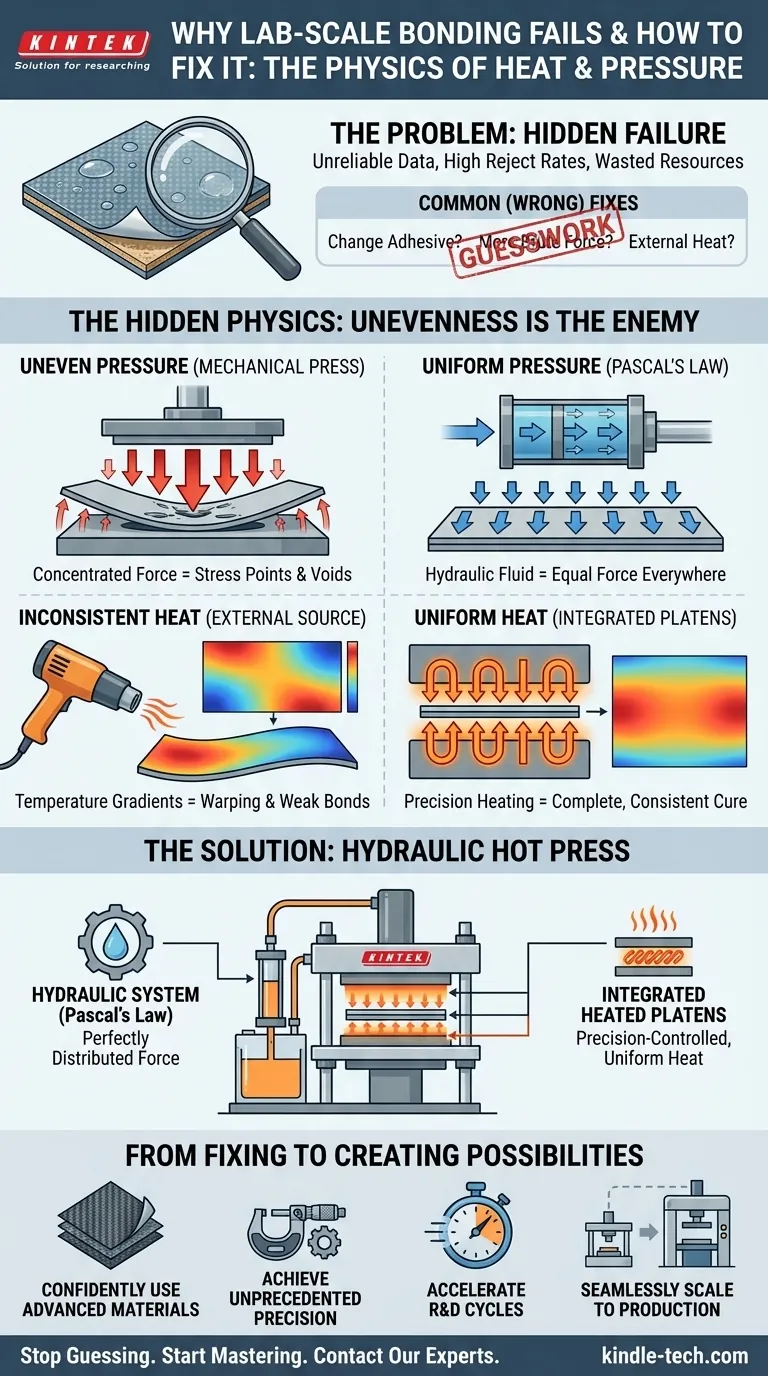
This isn't just a technical headache; it has serious business consequences. In a research setting, it means unreliable data and delayed discoveries. In a production environment, it leads to high reject rates, soaring material costs, and an inability to scale up promising new designs. The core issue is that these "solutions" are just guesses—they fail to address the real, underlying cause.
Beyond Brute Force: The Two-Part Physics of a Perfect Bond
The frustrating truth is that most bonding failures aren't caused by bad adhesives or a simple lack of force. They are caused by a lack of uniformity. To create a strong, flawless, and repeatable bond, you must master two physical principles simultaneously.
The Problem with Uneven Pressure
Most standard mechanical or screw presses apply force from a single point. While the total force might be immense, it's not distributed evenly. The center of your material gets squeezed much harder than the edges. This creates hidden stress points, forces adhesive to the sides, and leaves microscopic gaps—the perfect breeding ground for bubbles and weak spots.
The solution lies in a principle called Pascal's Law. It states that pressure applied to a contained fluid (like hydraulic oil) is transmitted equally in all directions. A hydraulic system uses this law to exert the exact same amount of pressure on every single square millimeter of your material. No hot spots, no weak edges—just perfectly uniform force.
The Problem with Inconsistent Heat
Heat is essential for activating thermosetting adhesives or making materials like plastics pliable. But if one part of your material gets hotter or heats up faster than another, the bonding or curing process will be inconsistent. This can cause warping or create a bond that looks solid but will fail under stress.
True success requires delivering the exact same temperature across the entire surface at the same time. This is something an external heat source can never guarantee. The heat must be integrated directly into the pressing surfaces.
This is why your previous attempts failed. Simply adding more force to a mechanical press only exaggerates the uneven pressure. And using an external oven creates a time lag and temperature gradient that ruins a uniform cure. You were treating the symptoms, not the disease.
The Right Tool for the Job: How a Hydraulic Hot Press Masters Heat and Pressure
To permanently solve this, you don't need to work harder; you need a tool that is fundamentally smarter about physics. You need a system engineered from the ground up to deliver uniform heat and uniform pressure with absolute precision.
This is the exact purpose of a hydraulic hot press. It’s not just another piece of equipment; it is the physical embodiment of the solution to this deep-rooted problem.
At KINTEK, our hydraulic hot presses are designed with this core principle in mind.
- The Hydraulic System: Our presses leverage Pascal's Law to guarantee that the immense force generated is distributed perfectly and evenly across your entire workpiece. This eliminates the root cause of voids and uneven bonds.
- The Integrated Heated Platens: The platens—the surfaces that contact your material—have built-in, precision-controlled heating elements. This ensures your entire piece reaches and maintains the target temperature uniformly, enabling a complete and consistent cure or bond every single time.
A KINTEK hydraulic hot press isn't just a machine that gets hot and squeezes. It's a precision instrument designed to give you total control over the two most critical variables in your process, turning an unpredictable art into a reliable science.
From Fixing Problems to Creating Possibilities
Once you stop wasting time and resources fighting inconsistent results, what becomes possible?
By mastering heat and pressure, you move beyond basic troubleshooting and into the realm of true innovation. You can now:
- Work confidently with advanced materials: Use expensive carbon fiber or delicate, multi-layer laminates without the fear of costly failures.
- Achieve unprecedented precision: Create thinner, stronger, and more complex parts that were previously too difficult to manufacture reliably.
- Accelerate R&D cycles: Get reliable, repeatable data from your material tests, allowing you to move from concept to validated result faster than ever before.
- Seamlessly scale from lab to production: Develop a process in the lab that you know can be replicated at a larger scale, because it’s built on a foundation of sound physics, not guesswork.
Resolving the challenge of bonding isn't just about reducing scrap. It's about unlocking the full potential of your materials and your team's creativity.
Our expertise isn't just in the equipment itself, but in helping you perfect the process it enables. If you're tired of the cycle of trial-and-error and ready to achieve consistent, high-quality results in your lab, let's discuss your project's specific challenges. Contact Our Experts.
Visual Guide
Related Products
- Vacuum Hot Press Furnace Machine for Lamination and Heating
- Touchscreen Automatic Vacuum Heat Press
- Electric Heated Hydraulic Vacuum Heat Press for Lab
- Warm Isostatic Press for Solid State Battery Research
- Lab Infrared Press Mold
Related Articles
- Forging Perfection in a Void: The Physics of Ultra-Dense Materials
- Vacuum Hot Press Furnace: A Comprehensive Guide
- Comprehensive Guide to Vacuum Hot Press Furnace Application
- The Purity Paradox: Choosing the Heart of Your Vacuum Hot Press Furnace
- The Physics of Perfection: How Vacuum Hot Presses Overcome the Invisible Barriers in Material Science