Knowledge At what temperature does annealing take place? A Guide to Material-Specific Heat Treatment
Author avatar

Tech Team · Kintek Solution

Updated 6 days ago

At what temperature does annealing take place? A Guide to Material-Specific Heat Treatment


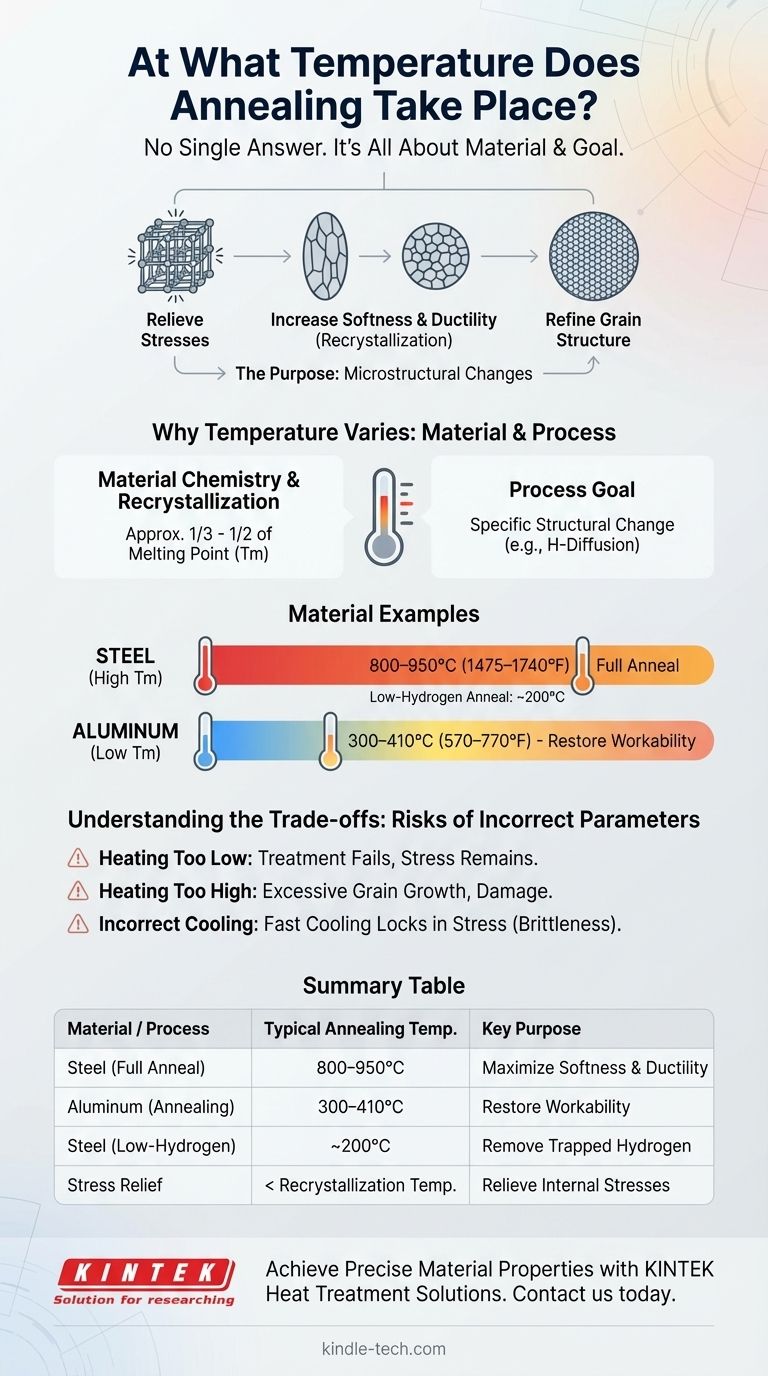
Ultimately, there is no single temperature for annealing. The correct temperature is determined entirely by the specific material being treated and the desired outcome. For example, a low-hydrogen annealing process for steel may require a minimum of 200°C to allow hydrogen atoms to diffuse out, whereas a full anneal to soften the same steel would require much higher temperatures.

Annealing is not one process but a family of heat treatments. The target temperature is a carefully chosen variable, selected based on the material's unique properties—like its recrystallization point—and the specific goal, whether that's relieving stress, increasing softness, or refining the atomic structure.
At what temperature does annealing take place? A Guide to Material-Specific Heat Treatment

The Purpose of Annealing: More Than Just Heating

To understand why temperature varies, you must first understand what annealing accomplishes at a microscopic level. The goal is to induce specific changes in a material's crystal structure, or "microstructure."

Relieving Internal Stresses

Processes like bending, welding, or machining introduce stress into a material's atomic lattice. Heating the material gives the atoms enough energy to move slightly, allowing them to settle into more stable, lower-energy positions. This relieves the internal stress without changing the material's fundamental properties.

Increasing Softness and Ductility

When a metal is "cold worked" (shaped at room temperature), its crystal grains become distorted and elongated, making it harder and more brittle. Annealing heats the material above its recrystallization temperature, allowing new, strain-free grains to form. This process, called recrystallization, effectively resets the microstructure, restoring softness and ductility.

Refining Grain Structure

The size and uniformity of a material's crystal grains significantly impact its mechanical properties. By carefully controlling the annealing temperature and cooling rate, engineers can produce a fine, uniform grain structure that often provides an optimal balance of strength and toughness.

Why Temperature Varies: Material and Process

The required temperature is a direct function of the material's chemistry and the specific structural change you want to achieve.

The Role of Recrystallization Temperature

For most metals, the most important factor is the recrystallization temperature. This is the temperature at which new grains begin to form in a cold-worked material. A common rule of thumb is that this temperature is approximately one-third to one-half of the material's melting point (measured in an absolute scale like Kelvin).

Example: Steel vs. Aluminum

The difference is clear when comparing materials.

  • Steel: As a high-melting-point alloy, steel requires high annealing temperatures. A "full anneal" typically occurs between 800–950°C (1475–1740°F).
  • Aluminum: With a much lower melting point, aluminum can be annealed at significantly lower temperatures, generally between 300–410°C (570–770°F).

Process-Specific Temperatures

Sometimes, the goal isn't full recrystallization. The reference to low hydrogen annealing (or "hydrogen bake-out") is a perfect example. Here, the goal is simply to give trapped hydrogen atoms enough thermal energy to diffuse out of the steel, preventing hydrogen embrittlement. This requires a much lower temperature—around 200°C—than a full anneal because you are not trying to regrow the crystal grains.

Understanding the Trade-offs

Selecting the wrong temperature or process parameters can be worse than not annealing at all.

Heating Too Low

If the temperature does not reach the necessary threshold for the intended process (e.g., recrystallization), the treatment will fail. You will have expended energy and time with no benefit, and the material will remain stressed or brittle.

Heating Too High (Overshooting)

Exceeding the optimal annealing temperature can cause excessive grain growth. Large grains can decrease a material's strength and toughness. In extreme cases, overheating can lead to permanent damage or even begin to melt the material.

Incorrect Cooling Rate

Annealing is a two-part process: heating and cooling. The cooling rate is just as critical as the temperature. Cooling too quickly can lock in stress or create a hard, brittle structure (like martensite in steel), completely defeating the purpose of making the material softer. A proper anneal almost always involves very slow cooling.

Determining the Correct Annealing Temperature

To apply this correctly, you must first define your objective. Consult material-specific datasheets for precise temperature ranges.

  • If your primary focus is stress relief after machining or welding: You can often use a lower-temperature process, known as sub-critical annealing, that doesn't fundamentally change the grain structure.
  • If your primary focus is to maximize softness for forming: You must perform a full anneal by heating the material above its upper critical temperature and ensuring a very slow cooling rate.
  • If your primary focus is removing trapped gases like hydrogen: A specific low-temperature bake-out, often between 200-300°C for steels, is sufficient and avoids altering the material's core strength.

Successful annealing depends on treating temperature not as a fixed number, but as a precise tool to achieve a specific microstructural goal.

Summary Table:

Material / Process Typical Annealing Temperature Range Key Purpose
Steel (Full Anneal) 800–950°C (1475–1740°F) Maximize softness & ductility
Aluminum (Annealing) 300–410°C (570–770°F) Restore workability
Steel (Low-Hydrogen Anneal) ~200°C (392°F) Remove trapped hydrogen
Stress Relief (Sub-critical) Below recrystallization temperature Relieve internal stresses

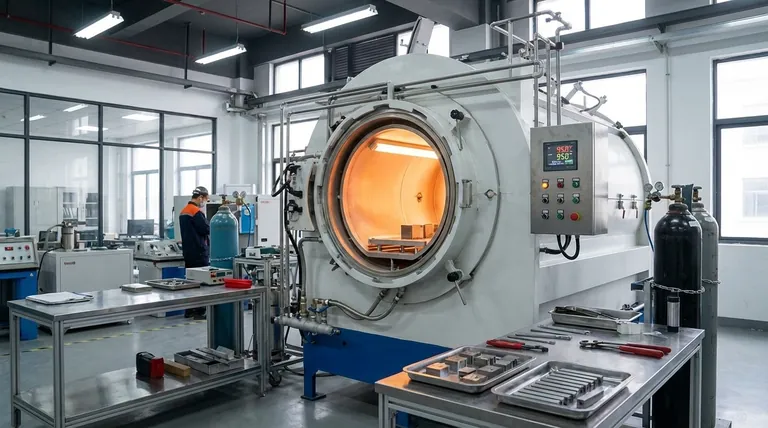
Achieve precise material properties with the right annealing equipment. The correct temperature is critical for success—whether you're working with steel, aluminum, or other metals. KINTEK specializes in lab furnaces and thermal processing equipment designed for accurate, repeatable heat treatment. Our solutions help you relieve stress, improve ductility, and refine grain structure with confidence. Contact us today to discuss your laboratory's annealing needs and discover how our expertise can enhance your results.

Get a Custom Quote for Your Lab

Visual Guide
At what temperature does annealing take place? A Guide to Material-Specific Heat Treatment Visual Guide

Related Products

People Also Ask

Related Products

Vacuum Heat Treat Sintering Brazing Furnace

Vacuum Heat Treat Sintering Brazing Furnace

A vacuum brazing furnace is a type of industrial furnace used for brazing, a metalworking process that joins two pieces of metal using a filler metal that melts at a lower temperature than the base metals. Vacuum brazing furnaces are typically used for high-quality applications where a strong, clean joint is required.

Vacuum Heat Treat Furnace with Ceramic Fiber Liner

Vacuum Heat Treat Furnace with Ceramic Fiber Liner

Vacuum furnace with polycrystalline ceramic fiber insulation liner for excellent heat insulation and uniform temperature field. Choose from 1200℃ or 1700℃ max. working temperature with high vacuum performance and precise temperature control.

Molybdenum Vacuum Heat Treat Furnace

Molybdenum Vacuum Heat Treat Furnace

Discover the benefits of a high-configuration molybdenum vacuum furnace with heat shield insulation. Ideal for high-purity, vacuum environments like sapphire crystal growth and heat treatment.

2200 ℃ Tungsten Vacuum Heat Treat and Sintering Furnace

2200 ℃ Tungsten Vacuum Heat Treat and Sintering Furnace

Experience the ultimate refractory metal furnace with our Tungsten vacuum furnace. Capable of reaching 2200℃, perfect for sintering advanced ceramics and refractory metals. Order now for high-quality results.

Graphite Vacuum Furnace High Thermal Conductivity Film Graphitization Furnace

Graphite Vacuum Furnace High Thermal Conductivity Film Graphitization Furnace

The high thermal conductivity film graphitization furnace has uniform temperature, low energy consumption and can operate continuously.

Vacuum Heat Treat and Molybdenum Wire Sintering Furnace for Vacuum Sintering

Vacuum Heat Treat and Molybdenum Wire Sintering Furnace for Vacuum Sintering

A vacuum molybdenum wire sintering furnace is a vertical or bedroom structure, which is suitable for withdrawal, brazing, sintering and degassing of metal materials under high vacuum and high temperature conditions. It is also suitable for dehydroxylation treatment of quartz materials.

Laboratory Quartz Tube Furnace Tubular RTP Heating Furnace

Laboratory Quartz Tube Furnace Tubular RTP Heating Furnace

Get lightning-fast heating with our RTP Rapid Heating Tube Furnace. Designed for precise, high-speed heating and cooling with convenient sliding rail and TFT touch screen controller. Order now for ideal thermal processing!

600T Vacuum Induction Hot Press Furnace for Heat Treat and Sintering

600T Vacuum Induction Hot Press Furnace for Heat Treat and Sintering

Discover the 600T Vacuum Induction Hot Press Furnace, designed for high-temperature sintering experiments in vacuum or protected atmospheres. Its precise temperature and pressure control, adjustable working pressure, and advanced safety features make it ideal for nonmetal materials, carbon composites, ceramics, and metal powders.

Vacuum Dental Porcelain Sintering Furnace

Vacuum Dental Porcelain Sintering Furnace

Get precise and reliable results with KinTek's Vacuum Porcelain Furnace. Suitable for all porcelain powders, it features hyperbolic ceramic furnace function, voice prompt, and automatic temperature calibration.

Small Vacuum Heat Treat and Tungsten Wire Sintering Furnace

Small Vacuum Heat Treat and Tungsten Wire Sintering Furnace

The small vacuum tungsten wire sintering furnace is a compact experimental vacuum furnace specially designed for universities and scientific research institutes. The furnace features a CNC welded shell and vacuum piping to ensure leak-free operation. Quick-connect electrical connections facilitate relocation and debugging, and the standard electrical control cabinet is safe and convenient to operate.

Ultra-High Temperature Graphite Vacuum Graphitization Furnace

Ultra-High Temperature Graphite Vacuum Graphitization Furnace

The ultra-high temperature graphitization furnace utilizes medium frequency induction heating in a vacuum or inert gas environment. The induction coil generates an alternating magnetic field, inducing eddy currents in the graphite crucible, which heats up and radiates heat to the workpiece, bringing it to the desired temperature. This furnace is primarily used for graphitization and sintering of carbon materials, carbon fiber materials, and other composite materials.

Graphite Vacuum Furnace IGBT Experimental Graphitization Furnace

Graphite Vacuum Furnace IGBT Experimental Graphitization Furnace

IGBT experimental graphitization furnace, a tailored solution for universities and research institutions, with high heating efficiency, user-friendliness, and precise temperature control.

Vacuum Hot Press Furnace Machine for Lamination and Heating

Vacuum Hot Press Furnace Machine for Lamination and Heating

Experience clean and precise lamination with Vacuum Lamination Press. Perfect for wafer bonding, thin-film transformations, and LCP lamination. Order now!

High Temperature Muffle Oven Furnace for Laboratory Debinding and Pre Sintering

High Temperature Muffle Oven Furnace for Laboratory Debinding and Pre Sintering

KT-MD High temperature debinding and pre-sintering furnace for ceramic materials with various molding processes. Ideal for electronic components such as MLCC and NFC.

1700℃ Muffle Oven Furnace for Laboratory

1700℃ Muffle Oven Furnace for Laboratory

Get superior heat control with our 1700℃ Muffle Furnace. Equipped with intelligent temperature microprocessor, TFT touch screen controller & advanced insulation materials for precise heating up to 1700C. Order now!

Dental Porcelain Zirconia Sintering Ceramic Furnace Chairside with Transformer

Dental Porcelain Zirconia Sintering Ceramic Furnace Chairside with Transformer

Experience top-notch sintering with Chairside Sintering Furnace with Transformer. Easy to operate, noise-free pallet, and automatic temperature calibration. Order now!

Engineering Advanced Fine Ceramics Aluminum Oxide Al2O3 Heat Sink for Insulation

Engineering Advanced Fine Ceramics Aluminum Oxide Al2O3 Heat Sink for Insulation

The hole structure of the ceramic heat sink increases the heat dissipation area in contact with the air, which greatly enhances the heat dissipation effect, and the heat dissipation effect is better than that of super copper and aluminum.

HFCVD Machine System Equipment for Drawing Die Nano-Diamond Coating

HFCVD Machine System Equipment for Drawing Die Nano-Diamond Coating

The nano-diamond composite coating drawing die uses cemented carbide (WC-Co) as the substrate, and uses the chemical vapor phase method ( CVD method for short ) to coat the conventional diamond and nano-diamond composite coating on the surface of the inner hole of the mold.

Laboratory Sterilizer Lab Autoclave Pulse Vacuum Lifting Sterilizer

Laboratory Sterilizer Lab Autoclave Pulse Vacuum Lifting Sterilizer

The pulse vacuum lifting sterilizer is a state-of-the-art equipment for efficient and precise sterilization. It uses pulsating vacuum technology, customizable cycles, and a user-friendly design for easy operation and safety.

Benchtop Laboratory Vacuum Freeze Dryer

Benchtop Laboratory Vacuum Freeze Dryer

Benchtop laboratory freeze dryer for efficient lyophilization of biological, pharmaceutical, and food samples. Features intuitive touchscreen, high-performance refrigeration, and durable design. Preserve sample integrity—consult now!


Leave Your Message