Knowledge tube furnace At what temperature does wood pyrolysis begin? Control the Process for Biochar, Bio-Oil, or Syngas
Author avatar

Tech Team · Kintek Solution

Updated 2 months ago

At what temperature does wood pyrolysis begin? Control the Process for Biochar, Bio-Oil, or Syngas


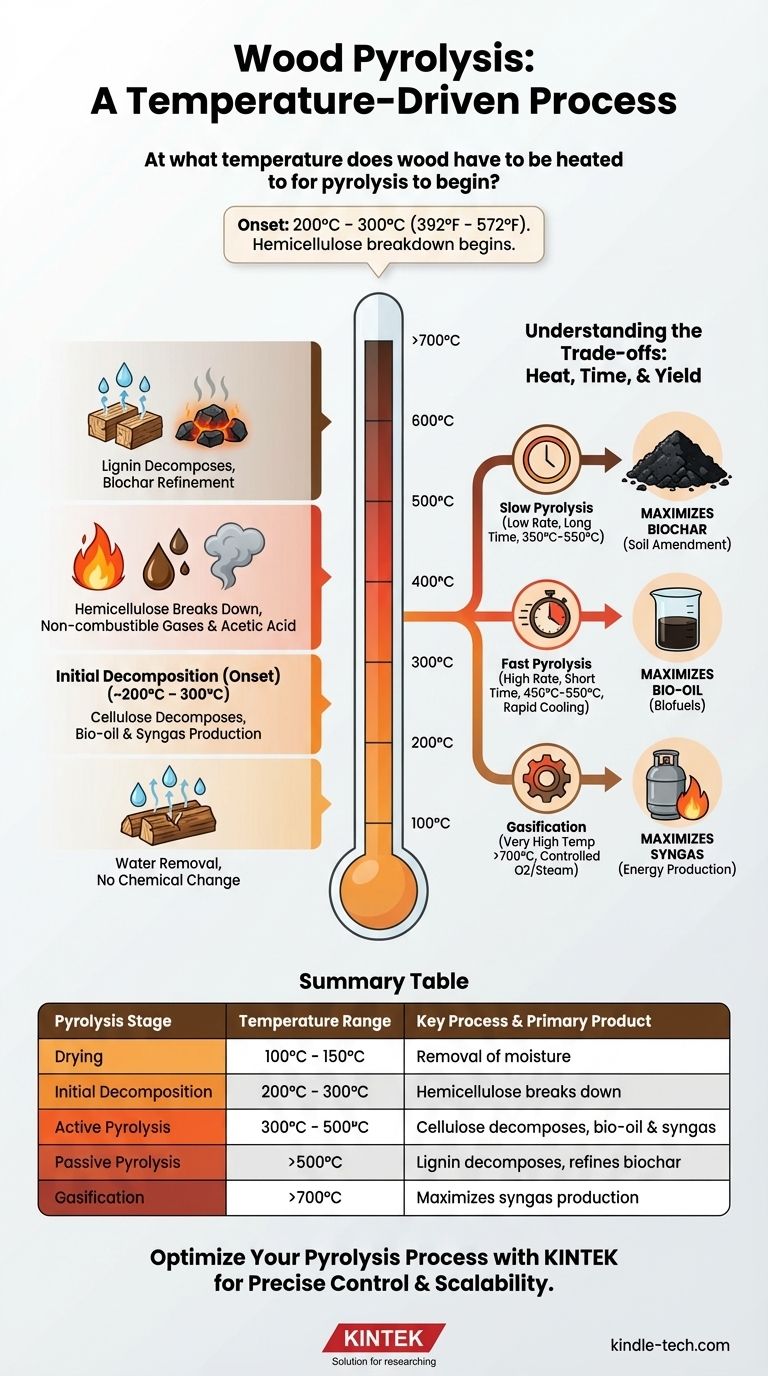
While significant thermal conversion occurs at higher temperatures, the initial stages of wood pyrolysis actually begin at a much lower threshold, typically between 200°C and 300°C (392°F - 572°F). At this point, in the absence of oxygen, the least stable chemical components of the wood start to irreversibly break down, marking the true onset of the process.

Pyrolysis is not an on/off switch flipped at a single temperature. It is a continuous process that unfolds across a wide temperature range, where controlling the heat and duration allows you to precisely determine whether the final output is dominated by solid char, liquid bio-oil, or flammable gas.
At what temperature does wood pyrolysis begin? Control the Process for Biochar, Bio-Oil, or Syngas

The Stages of Wood Pyrolysis: A Temperature-Driven Process

To truly understand wood pyrolysis, you must view it as a sequence of events, not a single reaction. Wood is a composite of three main polymers—hemicellulose, cellulose, and lignin—each of which decomposes at a different temperature range.

Stage 1: Drying (~100°C – 150°C)

Before any chemical breakdown occurs, the free and bound water within the wood must be removed. This initial heating phase, just above the boiling point of water, consumes significant energy but does not yet constitute pyrolysis.

Effective drying is a critical prerequisite for an efficient and controllable pyrolysis process.

Stage 2: Initial Decomposition (Onset) (~200°C – 300°C)

This is the range where pyrolysis technically begins. The first component to break down is hemicellulose, the least stable polymer in wood.

This decomposition releases non-combustible gases like carbon dioxide and water vapor, along with some acetic acid. This early stage is sometimes referred to as torrefaction, which makes the wood brittle and more energy-dense.

Stage 3: Active Pyrolysis (~300°C – 500°C)

This is the main event and the most vigorous phase of pyrolysis. Within this range, the primary structural component of wood, cellulose, rapidly decomposes.

This stage is characterized by the significant production of condensable vapors, which form bio-oil (tar), and flammable gases like hydrogen, methane, and carbon monoxide, often called syngas. The remaining solid material is now becoming carbon-rich biochar.

Stage 4: Passive Pyrolysis (>500°C)

Once the hemicellulose and cellulose are mostly gone, the final and most resilient component, lignin, continues its slow decomposition. This process can extend to 900°C and beyond.

Heating within this higher range drives off any remaining volatile compounds from the biochar, increasing its carbon content, porosity, and stability. The final temperature directly dictates the final properties of the char.

Understanding the Trade-offs: Heat, Time, and Yield

The temperature at which you conduct pyrolysis is not just a threshold to be crossed; it is the primary control lever that determines the final products. The heating rate and residence time are equally critical.

Slow Pyrolysis: Maximizing Biochar

By heating the wood slowly (a low heating rate) over a long period to a relatively moderate peak temperature (e.g., 350°C - 550°C), you favor the production of biochar.

The slow process allows vapors to undergo secondary reactions, cracking and re-condensing on the surface of the solid, which increases the overall char yield.

Fast Pyrolysis: Maximizing Bio-Oil

By heating the wood very rapidly (a high heating rate) to a moderate temperature (e.g., 450°C - 550°C) and then quickly cooling the vapors, you can maximize the yield of bio-oil.

The goal is to get the vapors out of the hot reaction zone in less than two seconds to prevent them from breaking down further into gas or re-forming into char.

Gasification: Maximizing Syngas

When pyrolysis is conducted at very high temperatures (>700°C), often with the introduction of a controlled amount of oxygen or steam, the process favors the breakdown of all components into syngas.

This shifts the goal from creating solid or liquid products to creating a combustible gas for generating heat or power.

Making the Right Choice for Your Goal

The "correct" temperature for pyrolysis is entirely dependent on your desired outcome. Use your target product as your guide.

  • If your primary focus is high-quality biochar (for soil amendment or filtration): Use a slow pyrolysis process with a peak temperature between 450°C and 600°C to balance yield with high carbon content.
  • If your primary focus is liquid bio-oil (for biofuels or chemicals): Use a fast pyrolysis process with a peak temperature between 450°C and 550°C and ensure rapid vapor quenching.
  • If your primary focus is syngas (for energy production): Operate at very high temperatures, typically above 700°C, to maximize the conversion of all materials into non-condensable gases.

Ultimately, mastering pyrolysis means understanding that temperature is the tool you use to steer the chemical decomposition of wood toward your intended result.

Summary Table:

Pyrolysis Stage Temperature Range Key Process & Primary Product
Drying 100°C - 150°C Removal of moisture (no chemical change)
Initial Decomposition 200°C - 300°C Hemicellulose breaks down (onset of pyrolysis)
Active Pyrolysis 300°C - 500°C Cellulose decomposes; produces bio-oil & syngas
Passive Pyrolysis >500°C Lignin decomposes; refines biochar properties
Gasification >700°C Maximizes syngas production

Ready to Optimize Your Pyrolysis Process?

Whether your goal is to produce high-quality biochar, maximize bio-oil yield, or generate syngas for energy, precise temperature control is critical. KINTEK specializes in advanced laboratory furnaces and pyrolysis systems that deliver the exact heating profiles and thermal stability you need for reproducible results.

Our equipment helps researchers and engineers like you:

  • Achieve precise temperature control from 200°C to 1200°C
  • Optimize heating rates for slow or fast pyrolysis protocols
  • Scale your process from lab research to pilot production

Contact us today to discuss how KINTEK's pyrolysis solutions can help you achieve your specific biomass conversion goals. Get in touch →

Visual Guide
At what temperature does wood pyrolysis begin? Control the Process for Biochar, Bio-Oil, or Syngas Visual Guide

Related Products

People Also Ask

Related Products

Electric Rotary Kiln Small Rotary Furnace Biomass Pyrolysis Plant

Electric Rotary Kiln Small Rotary Furnace Biomass Pyrolysis Plant

Learn about Rotary Biomass Pyrolysis Furnaces & how they decompose organic material at high temps without oxygen. Use for biofuels, waste processing, chemicals & more.

Electric Rotary Kiln Pyrolysis Furnace Plant Machine Calciner Small Rotary Kiln Rotating Furnace

Electric Rotary Kiln Pyrolysis Furnace Plant Machine Calciner Small Rotary Kiln Rotating Furnace

Electric rotary kiln - precisely controlled, it's ideal for calcination and drying of materials like lithium cobalate, rare earths, and non-ferrous metals.

Electric Rotary Kiln Continuous Working Small Rotary Furnace Heating Pyrolysis Plant

Electric Rotary Kiln Continuous Working Small Rotary Furnace Heating Pyrolysis Plant

Efficiently calcine and dry bulk powder and lump fluid materials with an electric heating rotary furnace. Ideal for processing lithium ion battery materials and more.

High Temperature Muffle Oven Furnace for Laboratory Debinding and Pre Sintering

High Temperature Muffle Oven Furnace for Laboratory Debinding and Pre Sintering

KT-MD High temperature debinding and pre-sintering furnace for ceramic materials with various molding processes. Ideal for electronic components such as MLCC and NFC.

Ultra-High Temperature Graphite Vacuum Graphitization Furnace

Ultra-High Temperature Graphite Vacuum Graphitization Furnace

The ultra-high temperature graphitization furnace utilizes medium frequency induction heating in a vacuum or inert gas environment. The induction coil generates an alternating magnetic field, inducing eddy currents in the graphite crucible, which heats up and radiates heat to the workpiece, bringing it to the desired temperature. This furnace is primarily used for graphitization and sintering of carbon materials, carbon fiber materials, and other composite materials.

Vertical High Temperature Graphite Vacuum Graphitization Furnace

Vertical High Temperature Graphite Vacuum Graphitization Furnace

Vertical high temperature graphitization furnace for carbonization and graphitization of carbon materials up to 3100℃.Suitable for shaped graphitization of carbon fiber filaments and other materials sintered in a carbon environment.Applications in metallurgy, electronics, and aerospace for producing high-quality graphite products like electrodes and crucibles.

Horizontal High Temperature Graphite Vacuum Graphitization Furnace

Horizontal High Temperature Graphite Vacuum Graphitization Furnace

Horizontal Graphitization Furnace: This type of furnace is designed with the heating elements placed horizontally, allowing for uniform heating of the sample. It's well-suited for graphitizing large or bulky samples that require precise temperature control and uniformity.

Large Vertical Graphite Vacuum Graphitization Furnace

Large Vertical Graphite Vacuum Graphitization Furnace

A large vertical high-temperature graphitization furnace is a type of industrial furnace used for the graphitization of carbon materials, such as carbon fiber and carbon black. It is a high-temperature furnace that can reach temperatures of up to 3100°C.

Graphite Vacuum Furnace Bottom Discharge Graphitization Furnace for Carbon Materials

Graphite Vacuum Furnace Bottom Discharge Graphitization Furnace for Carbon Materials

Bottom-out graphitization furnace for carbon materials, ultra-high temperature furnace up to 3100°C, suitable for graphitization and sintering of carbon rods and carbon blocks. Vertical design, bottom discharging, convenient feeding and discharging, high temperature uniformity, low energy consumption, good stability, hydraulic lifting system, convenient loading and unloading.

Graphite Vacuum Furnace High Thermal Conductivity Film Graphitization Furnace

Graphite Vacuum Furnace High Thermal Conductivity Film Graphitization Furnace

The high thermal conductivity film graphitization furnace has uniform temperature, low energy consumption and can operate continuously.

Spark Plasma Sintering Furnace SPS Furnace

Spark Plasma Sintering Furnace SPS Furnace

Discover the benefits of Spark Plasma Sintering Furnaces for rapid, low-temperature material preparation. Uniform heating, low cost & eco-friendly.

Vacuum Arc Induction Melting Furnace

Vacuum Arc Induction Melting Furnace

Discover the power of Vacuum Arc Furnace for melting active & refractory metals. High-speed, remarkable degassing effect, and free of contamination. Learn more now!

Graphite Vacuum Continuous Graphitization Furnace

Graphite Vacuum Continuous Graphitization Furnace

High-temperature graphitization furnace is a professional equipment for graphitization treatment of carbon materials. It is a key equipment for the production of high-quality graphite products. It has high temperature, high efficiency and uniform heating. It is suitable for various high-temperature treatments and graphitization treatments. It is widely used in metallurgy, electronics, aerospace, etc. industry.

Vacuum Heat Treat and Pressure Sintering Furnace for High Temperature Applications

Vacuum Heat Treat and Pressure Sintering Furnace for High Temperature Applications

Vacuum pressure sintering furnaces are designed for high temperature hot pressing applications in metal and ceramic sintering. Its advanced features ensure precise temperature control, reliable pressure maintenance, and a robust design for seamless operation.

600T Vacuum Induction Hot Press Furnace for Heat Treat and Sintering

600T Vacuum Induction Hot Press Furnace for Heat Treat and Sintering

Discover the 600T Vacuum Induction Hot Press Furnace, designed for high-temperature sintering experiments in vacuum or protected atmospheres. Its precise temperature and pressure control, adjustable working pressure, and advanced safety features make it ideal for nonmetal materials, carbon composites, ceramics, and metal powders.

Controlled Nitrogen Inert Hydrogen Atmosphere Furnace

Controlled Nitrogen Inert Hydrogen Atmosphere Furnace

KT-AH Hydrogen atmosphere furnace - induction gas furnace for sintering/annealing with built-in safety features, dual housing design, and energy-saving efficiency. Ideal for lab and industrial use.

Laboratory Muffle Oven Furnace Bottom Lifting Muffle Furnace

Laboratory Muffle Oven Furnace Bottom Lifting Muffle Furnace

Efficiently produce batches with excellent temperature uniformity using our Bottom Lifting Furnace. Features two electric lifting stages and advanced temperature control up to 1600℃.

Non Consumable Vacuum Arc Induction Melting Furnace

Non Consumable Vacuum Arc Induction Melting Furnace

Explore the benefits of Non-Consumable Vacuum Arc Furnace with high melting point electrodes. Small, easy to operate & eco-friendly. Ideal for laboratory research on refractory metals & carbides.

1700℃ Controlled Atmosphere Furnace Nitrogen Inert Atmosphere Furnace

1700℃ Controlled Atmosphere Furnace Nitrogen Inert Atmosphere Furnace

KT-17A Controlled atmosphere furnace: 1700℃ heating, vacuum sealing technology, PID temperature control, and versatile TFT smart touch screen controller for laboratory and industrial use.

Graphite Vacuum Furnace IGBT Experimental Graphitization Furnace

Graphite Vacuum Furnace IGBT Experimental Graphitization Furnace

IGBT experimental graphitization furnace, a tailored solution for universities and research institutions, with high heating efficiency, user-friendliness, and precise temperature control.


Leave Your Message