Knowledge vacuum induction melting furnace Can you melt aluminum with induction? Discover the Superior Method for High-Purity Melting
Author avatar

Tech Team · Kintek Solution

Updated 2 months ago

Can you melt aluminum with induction? Discover the Superior Method for High-Purity Melting


Yes, you can absolutely melt aluminum with induction heating. In fact, for many industrial and high-purity applications, induction is not just a viable option but the preferred method. Its efficiency, speed, and precision make it exceptionally well-suited for processing aluminum and its alloys.

Induction is a superior technology for melting aluminum in professional settings because it generates heat directly within the metal itself. This provides unparalleled speed, energy efficiency, and metallurgical control that older methods cannot match.
Can you melt aluminum with induction? Discover the Superior Method for High-Purity Melting

Why Induction Excels for Melting Aluminum

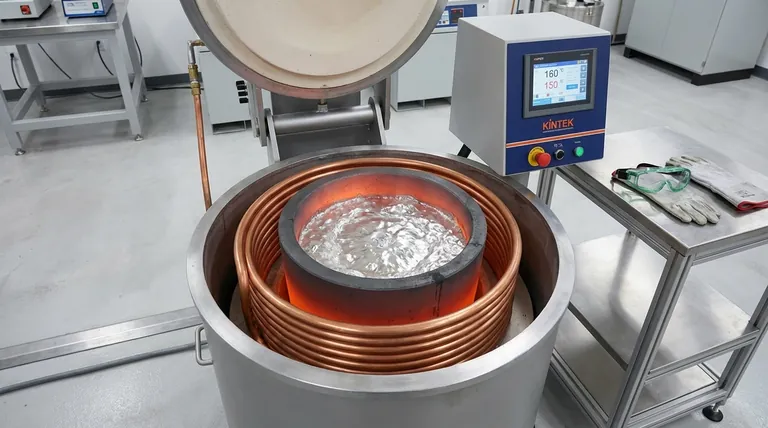
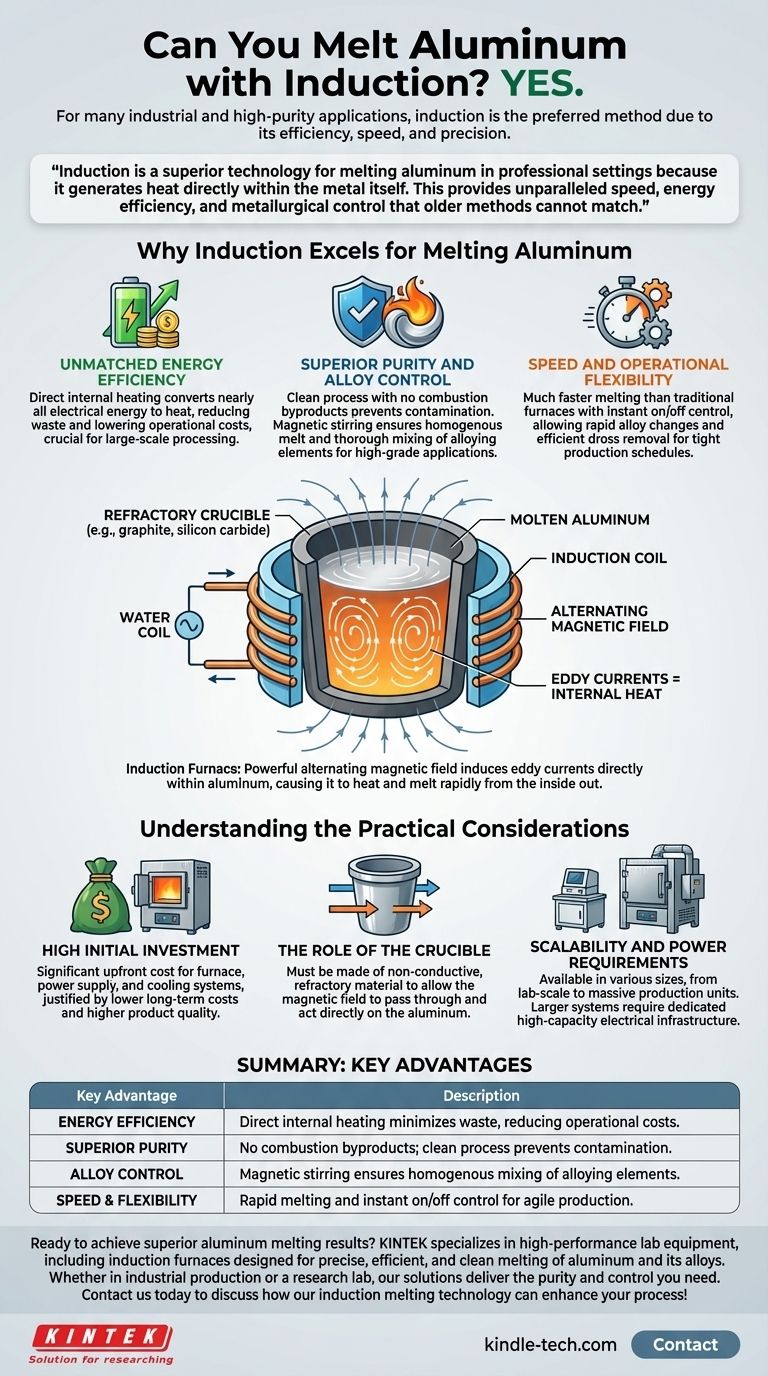
The core of induction heating lies in its method. Instead of applying external heat from a flame or a resistive element, an induction furnace uses a powerful, alternating magnetic field. This field induces strong electrical currents—known as eddy currents—directly within the aluminum, causing it to heat up and melt rapidly from the inside out.

Unmatched Energy Efficiency

Aluminum has a high specific heat and latent heat of fusion, meaning it requires a significant amount of energy to melt. Induction furnaces are highly efficient because nearly all the electrical energy is converted directly into heat within the aluminum charge, with very little waste. This translates directly to lower energy consumption and reduced operational costs, a critical factor in large-scale aluminum processing.

Superior Purity and Alloy Control

Because no combustion byproducts are involved, induction melting is an exceptionally clean process. This prevents impurities from being introduced into the melt. Furthermore, the magnetic field creates a natural stirring action, ensuring the molten metal is homogenous and that alloying elements are mixed thoroughly and evenly. This level of control is essential for producing high-grade aluminum alloys for demanding industries like aerospace.

Speed and Operational Flexibility

Induction furnaces can melt aluminum much faster than traditional furnaces. The ability to start and stop the heating process almost instantly allows for rapid alloy changes and efficient dross removal. This operational agility is a significant advantage in modern casting facilities where production schedules are tight and product specifications vary.

Understanding the Practical Considerations

While highly effective, induction melting is a sophisticated process with specific requirements. Understanding these trade-offs is key to determining if it's the right choice for your specific application.

High Initial Investment

The primary barrier to entry for induction melting is the cost of the equipment. An induction furnace, its power supply, and the associated cooling systems represent a significantly higher upfront investment compared to a simple gas-fired or resistance furnace. This cost is typically justified by lower long-term operating costs and higher product quality in commercial settings.

The Role of the Crucible

The aluminum must be held in a container called a crucible. For induction melting, this crucible must be made of a non-conductive, refractory material like graphite or silicon carbide. This allows the magnetic field to pass through the crucible and act directly on the aluminum. Using the wrong type of crucible will render the process ineffective.

Scalability and Power Requirements

Induction systems range from small, benchtop units for jewelers and labs to massive furnaces capable of melting many tons of metal. The size and power of the unit must be matched to the volume of aluminum you intend to melt. Larger systems require a dedicated, high-capacity electrical infrastructure.

Making the Right Choice for Your Goal

Selecting a melting method depends entirely on your project's scale, budget, and quality requirements.

  • If your primary focus is high-volume industrial production or casting critical alloys: Induction is the industry standard due to its efficiency, speed, and superior metallurgical control.
  • If your primary focus is small-scale or hobbyist metal casting: Induction is a premium option that offers excellent results, but you must weigh its high initial cost against simpler and cheaper methods like propane forges.
  • If your primary focus is achieving the highest possible purity: The clean, contained nature of induction melting makes it the ideal choice for applications where contamination is not an option.

By understanding these core principles, you can confidently determine whether induction technology is the correct tool for your aluminum melting objectives.

Summary Table:

Key Advantage Description
Energy Efficiency Direct internal heating minimizes energy waste, reducing operational costs.
Superior Purity No combustion byproducts; clean process prevents contamination.
Alloy Control Magnetic stirring ensures homogenous mixing of alloying elements.
Speed & Flexibility Rapid melting and instant on/off control for agile production.

Ready to achieve superior aluminum melting results?

KINTEK specializes in high-performance lab equipment, including induction furnaces designed for precise, efficient, and clean melting of aluminum and its alloys. Whether you're in industrial production or a research lab, our solutions deliver the purity and control you need.

Contact us today to discuss how our induction melting technology can enhance your process!

Visual Guide
Can you melt aluminum with induction? Discover the Superior Method for High-Purity Melting Visual Guide

Related Products

People Also Ask

Related Products

Lab-Scale Vacuum Induction Melting Furnace

Lab-Scale Vacuum Induction Melting Furnace

Get precise alloy composition with our Vacuum Induction Melting Furnace. Ideal for aerospace, nuclear energy, and electronic industries. Order now for effective smelting and casting of metals and alloys.

Non Consumable Vacuum Arc Induction Melting Furnace

Non Consumable Vacuum Arc Induction Melting Furnace

Explore the benefits of Non-Consumable Vacuum Arc Furnace with high melting point electrodes. Small, easy to operate & eco-friendly. Ideal for laboratory research on refractory metals & carbides.

Vacuum Heat Treat Furnace and Levitation Induction Melting Furnace

Vacuum Heat Treat Furnace and Levitation Induction Melting Furnace

Experience precise melting with our Vacuum Levitation Melting Furnace. Ideal for high melting point metals or alloys, with advanced technology for effective smelting. Order now for high-quality results.

Vacuum Arc Induction Melting Furnace

Vacuum Arc Induction Melting Furnace

Discover the power of Vacuum Arc Furnace for melting active & refractory metals. High-speed, remarkable degassing effect, and free of contamination. Learn more now!

600T Vacuum Induction Hot Press Furnace for Heat Treat and Sintering

600T Vacuum Induction Hot Press Furnace for Heat Treat and Sintering

Discover the 600T Vacuum Induction Hot Press Furnace, designed for high-temperature sintering experiments in vacuum or protected atmospheres. Its precise temperature and pressure control, adjustable working pressure, and advanced safety features make it ideal for nonmetal materials, carbon composites, ceramics, and metal powders.

High Temperature Alumina (Al2O3) Furnace Tube for Engineering Advanced Fine Ceramics

High Temperature Alumina (Al2O3) Furnace Tube for Engineering Advanced Fine Ceramics

High temperature alumina furnace tube combines the advantages of high hardness of alumina, good chemical inertness and steel, and has excellent wear resistance, thermal shock resistance and mechanical shock resistance.

1400℃ Laboratory High Temperature Tube Furnace with Alumina Tube

1400℃ Laboratory High Temperature Tube Furnace with Alumina Tube

Looking for a tube furnace for high-temperature applications? Our 1400℃ Tube Furnace with Alumina Tube is perfect for research and industrial use.

1700℃ Laboratory High Temperature Tube Furnace with Alumina Tube

1700℃ Laboratory High Temperature Tube Furnace with Alumina Tube

Looking for a high-temperature tube furnace? Check out our 1700℃ Tube Furnace with Alumina Tube. Perfect for research and industrial applications up to 1700C.

Engineering Advanced Fine Alumina Al2O3 Ceramic Crucible for Laboratory Muffle Furnace

Engineering Advanced Fine Alumina Al2O3 Ceramic Crucible for Laboratory Muffle Furnace

Alumina ceramic crucibles are used in some materials and metal melting tools, and flat-bottomed crucibles are suitable for melting and processing larger batches of materials with better stability and uniformity.

High Temperature Muffle Oven Furnace for Laboratory Debinding and Pre Sintering

High Temperature Muffle Oven Furnace for Laboratory Debinding and Pre Sintering

KT-MD High temperature debinding and pre-sintering furnace for ceramic materials with various molding processes. Ideal for electronic components such as MLCC and NFC.

Controlled Nitrogen Inert Hydrogen Atmosphere Furnace

Controlled Nitrogen Inert Hydrogen Atmosphere Furnace

KT-AH Hydrogen atmosphere furnace - induction gas furnace for sintering/annealing with built-in safety features, dual housing design, and energy-saving efficiency. Ideal for lab and industrial use.

Vacuum Heat Treat and Molybdenum Wire Sintering Furnace for Vacuum Sintering

Vacuum Heat Treat and Molybdenum Wire Sintering Furnace for Vacuum Sintering

A vacuum molybdenum wire sintering furnace is a vertical or bedroom structure, which is suitable for withdrawal, brazing, sintering and degassing of metal materials under high vacuum and high temperature conditions. It is also suitable for dehydroxylation treatment of quartz materials.

Vacuum Heat Treat Sintering Brazing Furnace

Vacuum Heat Treat Sintering Brazing Furnace

A vacuum brazing furnace is a type of industrial furnace used for brazing, a metalworking process that joins two pieces of metal using a filler metal that melts at a lower temperature than the base metals. Vacuum brazing furnaces are typically used for high-quality applications where a strong, clean joint is required.

Mesh belt controlled atmosphere furnace

Mesh belt controlled atmosphere furnace

Discover our KT-MB mesh belt sintering furnace - perfect for high-temperature sintering of electronic components & glass insulators. Available for open air or controlled atmosphere environments.

Graphite Vacuum Furnace High Thermal Conductivity Film Graphitization Furnace

Graphite Vacuum Furnace High Thermal Conductivity Film Graphitization Furnace

The high thermal conductivity film graphitization furnace has uniform temperature, low energy consumption and can operate continuously.

Vacuum Heat Treat and Pressure Sintering Furnace for High Temperature Applications

Vacuum Heat Treat and Pressure Sintering Furnace for High Temperature Applications

Vacuum pressure sintering furnaces are designed for high temperature hot pressing applications in metal and ceramic sintering. Its advanced features ensure precise temperature control, reliable pressure maintenance, and a robust design for seamless operation.

Laboratory Muffle Oven Furnace Bottom Lifting Muffle Furnace

Laboratory Muffle Oven Furnace Bottom Lifting Muffle Furnace

Efficiently produce batches with excellent temperature uniformity using our Bottom Lifting Furnace. Features two electric lifting stages and advanced temperature control up to 1600℃.

Ultra-High Temperature Graphite Vacuum Graphitization Furnace

Ultra-High Temperature Graphite Vacuum Graphitization Furnace

The ultra-high temperature graphitization furnace utilizes medium frequency induction heating in a vacuum or inert gas environment. The induction coil generates an alternating magnetic field, inducing eddy currents in the graphite crucible, which heats up and radiates heat to the workpiece, bringing it to the desired temperature. This furnace is primarily used for graphitization and sintering of carbon materials, carbon fiber materials, and other composite materials.

1700℃ Muffle Oven Furnace for Laboratory

1700℃ Muffle Oven Furnace for Laboratory

Get superior heat control with our 1700℃ Muffle Furnace. Equipped with intelligent temperature microprocessor, TFT touch screen controller & advanced insulation materials for precise heating up to 1700C. Order now!

Horizontal High Temperature Graphite Vacuum Graphitization Furnace

Horizontal High Temperature Graphite Vacuum Graphitization Furnace

Horizontal Graphitization Furnace: This type of furnace is designed with the heating elements placed horizontally, allowing for uniform heating of the sample. It's well-suited for graphitizing large or bulky samples that require precise temperature control and uniformity.


Leave Your Message