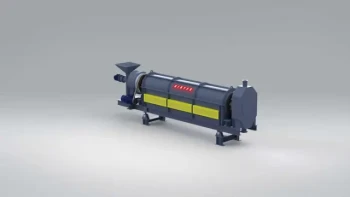
Knowledge Electric Rotary Kiln Can you restore activated carbon? Understanding the Industrial Reactivation Process
Author avatar

Tech Team · Kintek Solution

Updated 2 months ago

Can you restore activated carbon? Understanding the Industrial Reactivation Process


Yes, activated carbon can be restored, but not in the way most people think. The process, known as thermal reactivation, is a highly specialized industrial procedure that uses extreme heat to burn off trapped contaminants, making the carbon reusable. It is not a process that can be done at home.

While it is technically possible to restore activated carbon, the method requires industrial-grade equipment and temperatures exceeding 800°C (1500°F). For nearly all home, aquarium, or small-scale commercial uses, replacement is the only practical and safe option.
Can you restore activated carbon? Understanding the Industrial Reactivation Process

How Activated Carbon is Restored: Thermal Reactivation

The ability of activated carbon to work depends entirely on its vast internal surface area and porous structure, where it traps contaminants via a process called adsorption. Reactivation is designed to clear these pores, effectively resetting the carbon for another cycle.

The Core Principle: Incinerating Contaminants

At its heart, reactivation involves heating the spent carbon in a highly controlled, multi-stage process. The intense heat is designed to break down and vaporize the organic contaminants that have been adsorbed onto the carbon's surface.

A Multi-Stage Industrial Process

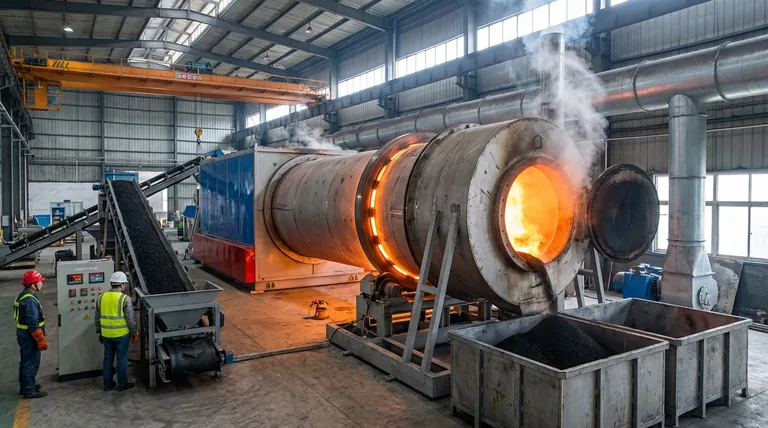
This isn't a simple baking process. It takes place in large, rotating kilns or vertical furnaces and involves several precise steps:

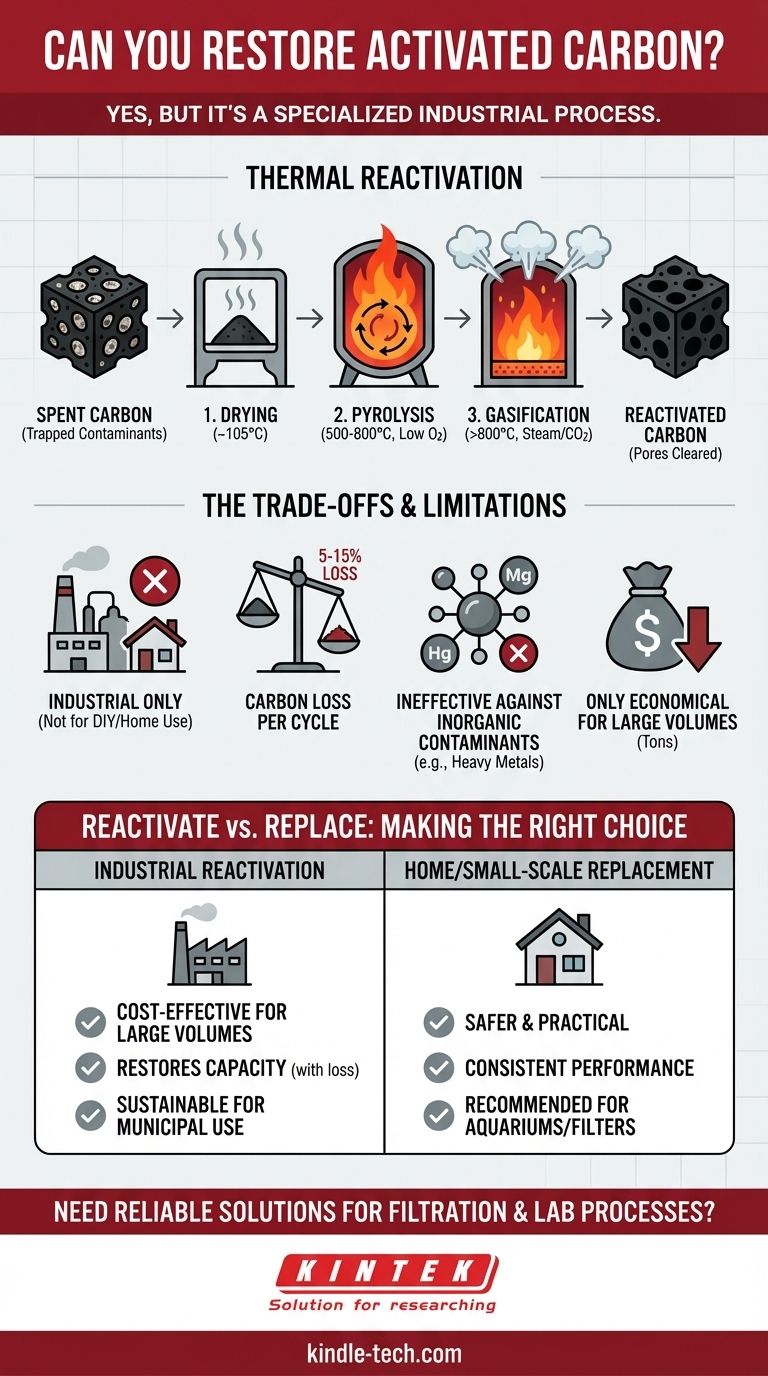
  1. Drying: The carbon is first heated to around 105°C (220°F) to remove all water.
  2. Pyrolysis (Desorption): The temperature is then raised to 500-800°C (930-1500°F) in a low-oxygen environment. This "bakes off" the volatile organic compounds without burning the carbon itself.
  3. Gasification: Finally, the temperature is increased above 800°C (1500°F) as steam or carbon dioxide is injected. This final, crucial step burns away any remaining char and re-exposes the carbon's original porous structure, "reactivating" it.

Why This Process Works

The high-temperature gasification step is what truly restores the carbon. It selectively removes the residual contaminant molecules and char, clearing the microscopic pores and restoring the immense surface area needed for effective adsorption.

Understanding the Trade-offs and Limitations

While effective, thermal reactivation is a process of diminishing returns and is only suitable for specific scenarios. Understanding its limitations is key to making a sound decision.

It's an Industrial Process, Not a DIY Task

The primary limitation is the equipment. The process requires precise temperature control, a controlled atmosphere to prevent the carbon from simply turning to ash, and safety measures to handle the off-gassing of vaporized contaminants. This cannot be replicated in a home oven or with a blowtorch.

Inevitable Carbon Loss

Each reactivation cycle is abrasive and burns off a small amount of the carbon itself. Typically, there is a 5-15% loss of carbon material with every cycle. This means the carbon cannot be restored indefinitely.

Contaminant-Specific Challenges

Reactivation works best for carbon that has adsorbed organic compounds. It is ineffective against inorganic contaminants like heavy metals, which do not vaporize and will remain in the carbon's structure, permanently reducing its effectiveness.

Economic Viability

The significant energy and capital costs of running a reactivation facility mean it is only economical for very large quantities of activated carbon, typically measured in tons. For smaller amounts, the cost of reactivation would far exceed the price of new carbon.

Making the Right Choice: Reactivate or Replace?

The decision is not about which method is better, but which is appropriate for your specific application and scale.

  • For large-scale industrial or municipal operations: Reactivation is often the most cost-effective and sustainable solution for managing large volumes of spent carbon.
  • For home use (e.g., aquariums, water filters, air purifiers): Always opt for replacement. Attempting to restore carbon at home is impractical, ineffective, and potentially hazardous.
  • For small-to-medium business use: Replacement remains the standard procedure unless you are generating multiple tons of spent carbon on a consistent basis.

Ultimately, knowing the difference between industrial reactivation and practical replacement is key to using activated carbon effectively and safely.

Summary Table:

Aspect Industrial Reactivation Home/DIY Attempts
Process Multi-stage thermal treatment (>800°C) Baking, boiling, or torching
Effectiveness Restores adsorption capacity Ineffective; can damage carbon
Safety Controlled environment, handles off-gassing Hazardous; risk of fire and toxic fumes
Cost-Effectiveness Economical for large volumes (tons) Not economical; cost exceeds new carbon
Best For Large-scale industrial/municipal use Not recommended; replacement is advised

Need reliable activated carbon or lab equipment for your filtration processes?

At KINTEK, we specialize in providing high-quality laboratory equipment and consumables to ensure your operations run efficiently and safely. Whether you're managing an industrial-scale reactivation facility or need consistent, high-performance activated carbon for your applications, our expertise and products are tailored to meet your needs.

Let us help you optimize your process. Contact our experts today for a personalized solution!

Visual Guide
Can you restore activated carbon? Understanding the Industrial Reactivation Process Visual Guide

Related Products

People Also Ask

Related Products

Electric Rotary Kiln Small Rotary Furnace for Activated Carbon Regeneration

Electric Rotary Kiln Small Rotary Furnace for Activated Carbon Regeneration

Revitalize your activated carbon with KinTek's Electric Regeneration Furnace. Achieve efficient and cost-effective regeneration with our highly automated rotary kiln and intelligent thermal controller.

Graphite Vacuum Furnace Bottom Discharge Graphitization Furnace for Carbon Materials

Graphite Vacuum Furnace Bottom Discharge Graphitization Furnace for Carbon Materials

Bottom-out graphitization furnace for carbon materials, ultra-high temperature furnace up to 3100°C, suitable for graphitization and sintering of carbon rods and carbon blocks. Vertical design, bottom discharging, convenient feeding and discharging, high temperature uniformity, low energy consumption, good stability, hydraulic lifting system, convenient loading and unloading.

Laboratory Rapid Thermal Processing (RTP) Quartz Tube Furnace

Laboratory Rapid Thermal Processing (RTP) Quartz Tube Furnace

Get lightning-fast heating with our RTP Rapid Heating Tube Furnace. Designed for precise, high-speed heating and cooling with convenient sliding rail and TFT touch screen controller. Order now for ideal thermal processing!

Electric Rotary Kiln Small Rotary Furnace Biomass Pyrolysis Plant

Electric Rotary Kiln Small Rotary Furnace Biomass Pyrolysis Plant

Learn about Rotary Biomass Pyrolysis Furnaces & how they decompose organic material at high temps without oxygen. Use for biofuels, waste processing, chemicals & more.

Large Vertical Graphite Vacuum Graphitization Furnace

Large Vertical Graphite Vacuum Graphitization Furnace

A large vertical high-temperature graphitization furnace is a type of industrial furnace used for the graphitization of carbon materials, such as carbon fiber and carbon black. It is a high-temperature furnace that can reach temperatures of up to 3100°C.

Vacuum Arc Induction Melting Furnace

Vacuum Arc Induction Melting Furnace

Discover the power of Vacuum Arc Furnace for melting active & refractory metals. High-speed, remarkable degassing effect, and free of contamination. Learn more now!

Graphite Vacuum Continuous Graphitization Furnace

Graphite Vacuum Continuous Graphitization Furnace

High-temperature graphitization furnace is a professional equipment for graphitization treatment of carbon materials. It is a key equipment for the production of high-quality graphite products. It has high temperature, high efficiency and uniform heating. It is suitable for various high-temperature treatments and graphitization treatments. It is widely used in metallurgy, electronics, aerospace, etc. industry.

1400℃ Controlled Atmosphere Furnace with Nitrogen and Inert Atmosphere

1400℃ Controlled Atmosphere Furnace with Nitrogen and Inert Atmosphere

Achieve precise heat treatment with KT-14A controlled atmosphere furnace. Vacuum sealed with a smart controller, it's ideal for lab and industrial use up to 1400℃.

Graphite Vacuum Furnace High Thermal Conductivity Film Graphitization Furnace

Graphite Vacuum Furnace High Thermal Conductivity Film Graphitization Furnace

The high thermal conductivity film graphitization furnace has uniform temperature, low energy consumption and can operate continuously.

High Temperature Muffle Oven Furnace for Laboratory Debinding and Pre Sintering

High Temperature Muffle Oven Furnace for Laboratory Debinding and Pre Sintering

KT-MD High temperature debinding and pre-sintering furnace for ceramic materials with various molding processes. Ideal for electronic components such as MLCC and NFC.

Graphite Vacuum Furnace Negative Material Graphitization Furnace

Graphite Vacuum Furnace Negative Material Graphitization Furnace

Graphitization furnace for battery production has uniform temperature and low energy consumption. Graphitization furnace for negative electrode materials: an efficient graphitization solution for battery production and advanced functions to enhance battery performance.

Vertical Laboratory Tube Furnace

Vertical Laboratory Tube Furnace

Elevate your experiments with our Vertical Tube Furnace. Versatile design allows for operation under various environments and heat treatment applications. Order now for precise results!

Multi-zone Laboratory Tube Furnace

Multi-zone Laboratory Tube Furnace

Experience precise, efficient thermal testing with our Multi Zone Tube Furnace. Independent heating zones and temperature sensors allow for controlled high-temperature gradient heating fields. Order now for advanced thermal analysis!

Non Consumable Vacuum Arc Induction Melting Furnace

Non Consumable Vacuum Arc Induction Melting Furnace

Explore the benefits of Non-Consumable Vacuum Arc Furnace with high melting point electrodes. Small, easy to operate & eco-friendly. Ideal for laboratory research on refractory metals & carbides.

Horizontal High Temperature Graphite Vacuum Graphitization Furnace

Horizontal High Temperature Graphite Vacuum Graphitization Furnace

Horizontal Graphitization Furnace: This type of furnace is designed with the heating elements placed horizontally, allowing for uniform heating of the sample. It's well-suited for graphitizing large or bulky samples that require precise temperature control and uniformity.

Vacuum Heat Treat and Pressure Sintering Furnace for High Temperature Applications

Vacuum Heat Treat and Pressure Sintering Furnace for High Temperature Applications

Vacuum pressure sintering furnaces are designed for high temperature hot pressing applications in metal and ceramic sintering. Its advanced features ensure precise temperature control, reliable pressure maintenance, and a robust design for seamless operation.

Vertical High Temperature Graphite Vacuum Graphitization Furnace

Vertical High Temperature Graphite Vacuum Graphitization Furnace

Vertical high temperature graphitization furnace for carbonization and graphitization of carbon materials up to 3100℃.Suitable for shaped graphitization of carbon fiber filaments and other materials sintered in a carbon environment.Applications in metallurgy, electronics, and aerospace for producing high-quality graphite products like electrodes and crucibles.

Vacuum Heat Treat Furnace with Ceramic Fiber Liner

Vacuum Heat Treat Furnace with Ceramic Fiber Liner

Vacuum furnace with polycrystalline ceramic fiber insulation liner for excellent heat insulation and uniform temperature field. Choose from 1200℃ or 1700℃ max. working temperature with high vacuum performance and precise temperature control.

Ultra-High Temperature Graphite Vacuum Graphitization Furnace

Ultra-High Temperature Graphite Vacuum Graphitization Furnace

The ultra-high temperature graphitization furnace utilizes medium frequency induction heating in a vacuum or inert gas environment. The induction coil generates an alternating magnetic field, inducing eddy currents in the graphite crucible, which heats up and radiates heat to the workpiece, bringing it to the desired temperature. This furnace is primarily used for graphitization and sintering of carbon materials, carbon fiber materials, and other composite materials.

Controlled Nitrogen Inert Hydrogen Atmosphere Furnace

Controlled Nitrogen Inert Hydrogen Atmosphere Furnace

KT-AH Hydrogen atmosphere furnace - induction gas furnace for sintering/annealing with built-in safety features, dual housing design, and energy-saving efficiency. Ideal for lab and industrial use.


Leave Your Message