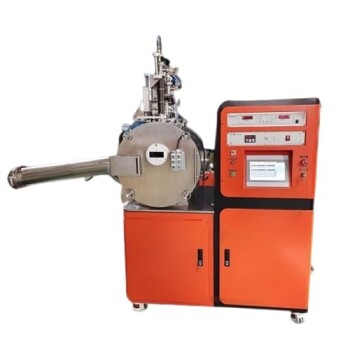
A precision thermostat and a platinum-rhodium thermocouple operate as a tightly integrated feedback loop to maintain rigorous thermal stability during the Aerosol-Assisted Chemical Vapor Deposition (AACVD) process. The thermocouple serves as the high-accuracy sensor, continuously monitoring the substrate's temperature, while the thermostat acts as the controller, dynamically adjusting the heating elements to lock the system at a specific setpoint, such as 450 °C.
Core Takeaway: In AACVD, temperature is not merely a condition; it is the architect of the material. This collaboration between sensor and controller is critical because it dictates phase transformation and grain growth kinetics, ensuring the final coating possesses consistent crystalline quality and uniform phase distribution.
The Mechanics of Thermal Control
The Sensor: Platinum-Rhodium Thermocouple
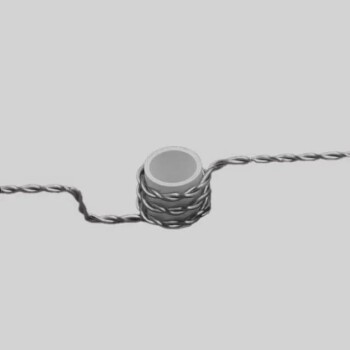
The system relies on a platinum-rhodium thermocouple for data acquisition. This specific type of sensor is chosen for its high accuracy and ability to withstand the reactive environments often found in chemical vapor deposition.
It provides real-time, continuous feedback regarding the actual temperature of the substrate.
The Controller: Precision Thermostat
The precision thermostat receives the temperature data provided by the thermocouple. It compares this real-time data against the desired target temperature (the setpoint).
If the substrate temperature deviates even slightly, the thermostat modulates the energy input to the heaters to correct the variance immediately.
Why Precision Matters for Titanium Dioxide
Dictating Phase Transformation
For materials like titanium dioxide ($TiO_2$), the deposition temperature is the primary variable that determines the material's phase.
The collaboration between the thermostat and thermocouple ensures the environment remains within the specific thermal window required to achieve the desired phase transformation.
Governing Grain Growth Kinetics
Thermal energy drives the kinetics of grain growth. Fluctuating temperatures can lead to erratic grain sizes and weak structural integrity.
By stabilizing the temperature, the system ensures that grain growth occurs at a constant rate. This results in a coating with uniform thickness and consistent structural properties.
Common Pitfalls to Avoid
Sensor Placement Errors
If the thermocouple is not positioned correctly relative to the substrate, it may measure the ambient environment rather than the deposition surface.
This leads to a "false positive" where the thermostat stabilizes the air temperature, but the substrate itself remains outside the critical range for proper phase transformation.
Thermal Gradients
A single point of measurement cannot always guarantee uniformity across a large deposition area.
While the thermostat may lock the setpoint at the sensor's location, ensuring that this thermal stability extends across the entire deposition area requires careful system design to avoid cool spots.
Making the Right Choice for Your Goal
To maximize the effectiveness of your AACVD process, consider these priorities:
- If your primary focus is Phase Purity: Ensure your thermostat is calibrated to hold the temperature within a tight tolerance ($\pm$1°C) to prevent the formation of unwanted secondary phases.
- If your primary focus is Coating Uniformity: Verify that the thermocouple placement accurately reflects the temperature of the substrate center to guarantee consistent grain growth kinetics.
True reliability in AACVD is achieved when the sensing precision matches the control capability.
Summary Table:
| Component | Role in AACVD | Primary Benefit |
|---|---|---|
| Platinum-Rhodium Thermocouple | High-accuracy sensor for real-time monitoring | Withstands reactive environments; provides precise substrate feedback |
| Precision Thermostat | Dynamic heater controller and modulator | Eliminates thermal variance; maintains rigorous setpoint stability |
| Integrated System | Feedback loop for thermal kinetics | Ensures phase purity and uniform crystalline grain growth |
Elevate Your Material Research with KINTEK Precision
Achieving consistent crystalline quality in AACVD requires more than just a heater—it demands a sophisticated thermal feedback system. KINTEK specializes in advanced laboratory solutions designed for rigorous research environments. Whether you are optimizing CVD/PECVD systems, exploring battery research, or requiring specialized high-temperature furnaces, our equipment provides the precision you need to master phase transformation and grain growth kinetics.
From high-performance platinum-rhodium sensors to our comprehensive range of crushing, milling, and hydraulic presses, KINTEK is your partner in achieving repeatable, high-purity results.
Ready to refine your deposition process? Contact our technical experts today to find the perfect equipment for your laboratory.
References
- Megan Taylor, Clara Piccirillo. Nanostructured titanium dioxide coatings prepared by Aerosol Assisted Chemical Vapour Deposition (AACVD). DOI: 10.1016/j.jphotochem.2020.112727
This article is also based on technical information from Kintek Solution Knowledge Base .
Related Products
- RF PECVD System Radio Frequency Plasma-Enhanced Chemical Vapor Deposition RF PECVD
- Chemical Vapor Deposition CVD Equipment System Chamber Slide PECVD Tube Furnace with Liquid Gasifier PECVD Machine
- Split Chamber CVD Tube Furnace with Vacuum Station Chemical Vapor Deposition System Equipment Machine
- HFCVD Machine System Equipment for Drawing Die Nano-Diamond Coating
- Microwave Plasma Chemical Vapor Deposition MPCVD Machine System Reactor for Lab and Diamond Growth
People Also Ask
- What is plasma enhanced chemical vapour deposition PECVD used for? Enable Low-Temp Thin Films for Electronics & Solar
- What is an example of PECVD? RF-PECVD for High-Quality Thin Film Deposition
- What is the role of RF-PECVD in VFG preparation? Mastering Vertical Growth and Surface Functionality
- What is plasma enhanced chemical Vapour deposition process used for fabrication of? A Guide to Low-Temperature Thin Films
- What is plasma chemical vapor deposition? A Low-Temperature Thin Film Coating Solution