Choosing the right heat treatment process is not a matter of picking from a list; it is a critical engineering decision driven by three factors: the alloy you are using, the final mechanical properties you need, and the physical geometry of your part. Understanding the interplay between these elements is the key to achieving the desired performance and avoiding costly failures.
The core principle is this: heat treatment is not an afterthought but an integral part of component design. Your choice is a deliberate manipulation of the material’s internal microstructure to produce a predictable and reliable outcome, whether that is extreme hardness, ductility, or internal stability.
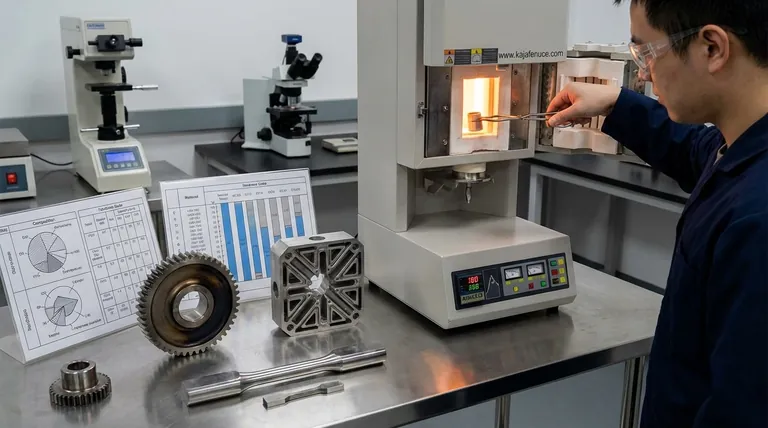
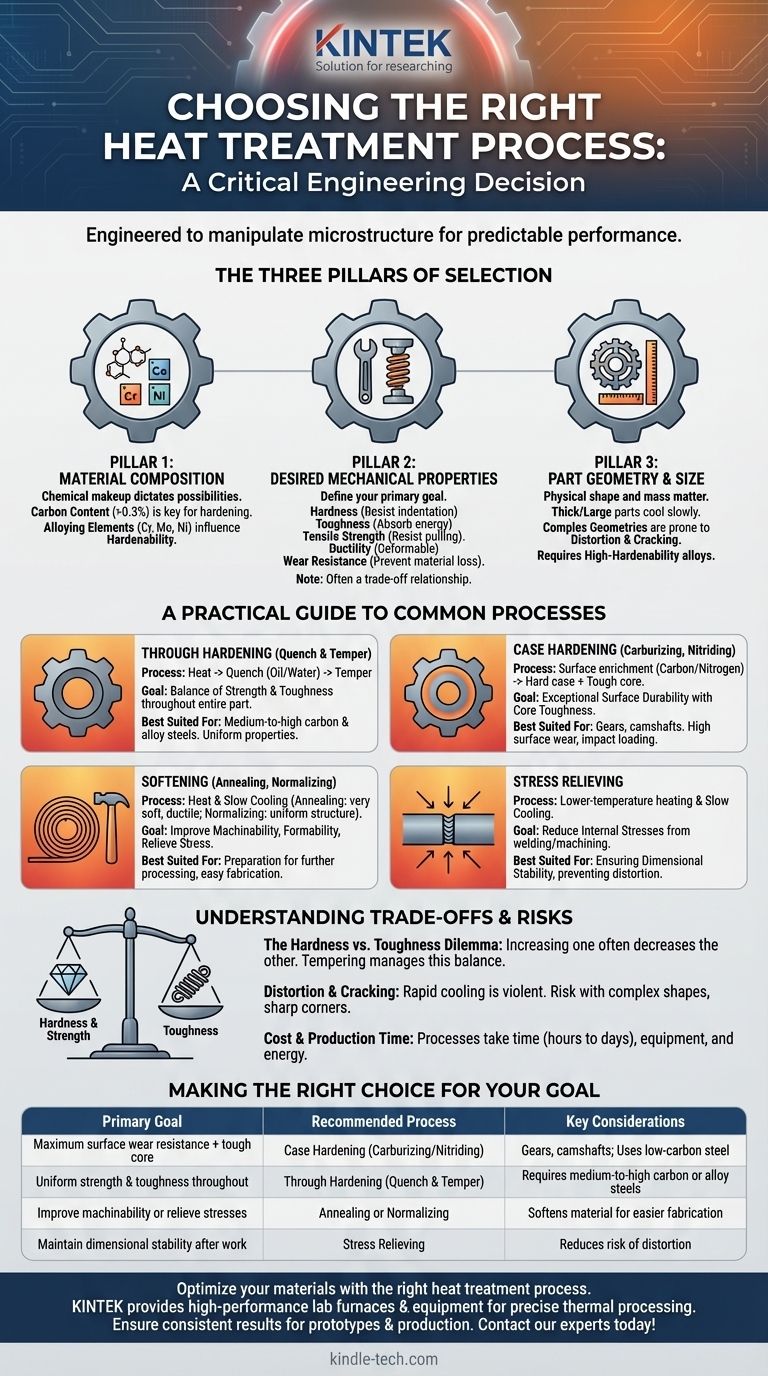
The Three Pillars of Heat Treatment Selection
Every heat treatment decision rests on a foundation of three interconnected factors. Answering the questions raised by each pillar will naturally guide you to the most appropriate process.
Pillar 1: The Material Composition
The chemical makeup of your metal dictates which processes are even possible. The single most important element in steel, for example, is carbon.
Without sufficient carbon content (typically >0.3%), steel cannot be significantly hardened through quenching. This is why a low-carbon steel like 1018 will not respond to a quench and temper process in the same way as a high-carbon steel like 1095 or an alloy steel like 4140.
Alloying elements like chromium, molybdenum, and nickel also play a crucial role. They influence a material's hardenability, which is its ability to be hardened to a significant depth, making them essential for larger or thicker components.
Pillar 2: The Desired Mechanical Properties
You must clearly define the goal of the treatment. What problem are you trying to solve with the final component?
Common goals include:
- Hardness: The ability to resist indentation and abrasion.
- Toughness: The ability to absorb energy and deform without fracturing.
- Tensile Strength: The resistance to being pulled apart.
- Ductility: The ability to deform under tensile stress, like being drawn into a wire.
- Wear Resistance: A combination of hardness and other properties that prevent material loss from friction.
Defining your primary goal is essential because, as we will see, many of these properties exist in a trade-off relationship.
Pillar 3: The Part's Geometry and Size
The physical shape and mass of the component are critical. A thick, large part will cool much more slowly during quenching than a thin, small one.
This slower cooling rate in the core of a large part may prevent it from achieving the same hardness as the surface. This is where materials with high hardenability (i.e., alloy steels) become necessary.
Furthermore, complex geometries with sharp corners, holes, or rapid changes in thickness are prone to distortion and cracking during the rapid temperature changes of quenching.
A Practical Guide to Common Processes
With the three pillars in mind, we can map common goals to specific processes.
Through Hardening (Quench and Temper)
This is the most common method for achieving a good balance of strength and toughness throughout the entire part.
The part is heated to a critical temperature, rapidly cooled (quenched) in a medium like oil or water to create a very hard but brittle structure, and then reheated to a lower temperature (tempered) to reduce that brittleness and increase toughness.
Best suited for: Medium-to-high carbon steels and alloy steels where uniform mechanical properties are needed through the entire cross-section.
Case Hardening (Carburizing, Nitriding)
This process creates a component with two distinct zones: an extremely hard, wear-resistant surface layer (the "case") and a softer, tougher interior (the "core").
It is ideal for parts that experience high surface wear but must also withstand impact loading without fracturing, such as gears or camshafts. Carburizing adds carbon to the surface of low-carbon steel, while Nitriding uses nitrogen, often at lower temperatures, resulting in less distortion.
Best suited for: Applications needing exceptional surface durability combined with core toughness.
Softening (Annealing and Normalizing)
Not all heat treatment is for hardening. Sometimes, the goal is to make a material softer and more workable.
Annealing involves heating and slow cooling to produce a very soft, ductile state, making the material easy to machine or form. Normalizing uses a slightly faster air-cooling process to refine the grain structure and produce a more uniform material, often as a preparatory step for further hardening.
Best suited for: Improving machinability, relieving internal stresses from prior work, and preparing a part for subsequent heat treatment.
Stress Relieving
This is a lower-temperature process used to reduce internal stresses locked into a part from processes like welding, heavy machining, or cold working.
By heating the part well below its critical temperature and cooling it slowly, these stresses can relax. This is vital for preventing distortion during subsequent manufacturing steps or when the part is put into service.
Best suited for: Ensuring dimensional stability in components that have been welded or heavily machined.
Understanding the Trade-offs and Risks
Choosing a process also means accepting its inherent compromises. Objectivity here is critical for success.
The Hardness vs. Toughness Dilemma
This is the most fundamental trade-off in metallurgy. As you increase a steel's hardness and strength, you almost always decrease its toughness, making it more brittle.
The tempering process after quenching is a direct manipulation of this balance. A high-temperature temper results in a softer but much tougher part, while a low-temperature temper retains more hardness at the expense of toughness.
The Risk of Distortion and Cracking
Rapid cooling is a violent process on a microstructural level. The thermal stress it induces can cause parts to warp, twist, or even crack.
This risk is highest in parts with sharp internal corners, non-uniform cross-sections, or when using an overly aggressive quenchant (e.g., water instead of oil). Careful design and process selection are key to mitigating this.
The Impact on Cost and Production Time
Heat treatment processes are not instantaneous or free. A simple stress relief cycle might take a few hours. A deep case-hardening cycle like gas nitriding can take over 40 hours.
The time, specialized equipment, and energy required add significant cost to the final part. This operational reality must be factored into your decision.
Making the Right Choice for Your Goal
To select the correct process, anchor your decision in the primary engineering goal for the component.
- If your primary focus is maximum wear resistance on the surface with a shock-resistant core: Case hardening (Carburizing or Nitriding) is the correct path.
- If your primary focus is achieving a uniform balance of high strength and good toughness throughout the part: Through hardening (Quench and Temper) is the industry standard.
- If your primary focus is improving machinability or preparing a material for further processing: Annealing or Normalizing are the appropriate choices.
- If your primary focus is maintaining dimensional stability after welding or heavy machining: Stress Relieving is the essential final or intermediate step.
By treating this choice as an integral part of your design, you transform a material's potential into predictable performance.
Summary Table:
| Goal | Recommended Process | Key Considerations |
|---|---|---|
| Maximum surface wear resistance with a tough core | Case Hardening (Carburizing/Nitriding) | Ideal for gears, camshafts; uses low-carbon steel |
| Uniform strength & toughness throughout part | Through Hardening (Quench & Temper) | Requires medium-to-high carbon or alloy steels |
| Improve machinability or relieve internal stresses | Annealing or Normalizing | Softens material for easier fabrication |
| Maintain dimensional stability after welding/machining | Stress Relieving | Reduces risk of distortion in critical components |
Optimize your materials with the right heat treatment process. KINTEK specializes in providing high-performance lab furnaces and equipment for precise thermal processing. Whether you're developing prototypes or scaling up production, our solutions ensure consistent results for metals and alloys. Contact our experts today to discuss your specific application needs!
Visual Guide
Related Products
- Vacuum Heat Treat Furnace with Ceramic Fiber Liner
- 1400℃ Controlled Atmosphere Furnace with Nitrogen and Inert Atmosphere
- 600T Vacuum Induction Hot Press Furnace for Heat Treat and Sintering
- Laboratory Rapid Thermal Processing (RTP) Quartz Tube Furnace
- Touchscreen Automatic Vacuum Heat Press
People Also Ask
- What are the three primary cooling methods for a vacuum heat treatment furnace? Optimize Hardness & Surface Finish
- What is a vacuum heat treatment furnace? Achieve Unmatched Purity and Control
- What is a vacuum heat treatment furnace? The Ultimate Guide to Controlled Atmosphere Processing
- How does a vacuum heat treatment work? Achieve Superior Material Properties in a Pristine Environment
- What is the principle of vacuum heat treatment? Achieve Superior Material Properties with Total Control