Knowledge How do you prepare samples for SEM analysis? Achieve Clear, Accurate Imaging Every Time
Author avatar

Tech Team · Kintek Solution

Updated 1 week ago

How do you prepare samples for SEM analysis? Achieve Clear, Accurate Imaging Every Time


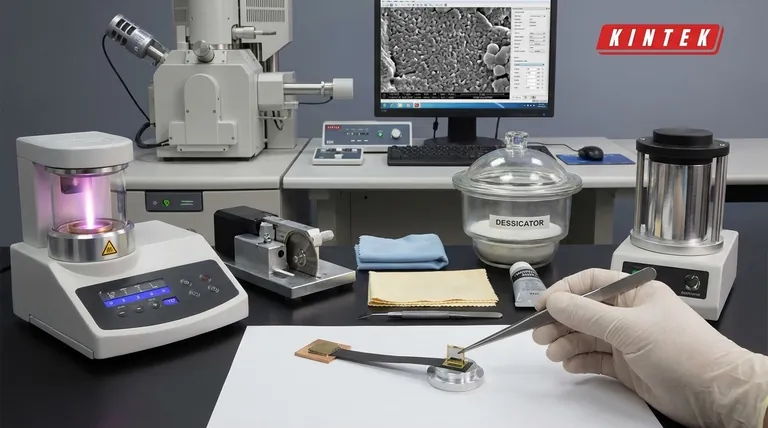
Properly preparing a sample for Scanning Electron Microscopy (SEM) is centered on two fundamental requirements: ensuring the sample is physically sized to fit within the microscope's chamber and making it electrically conductive to prevent image-distorting charge build-up. For materials that are not inherently conductive, this is most often accomplished by applying a thin, conductive coating to the surface.

The core objective of SEM sample preparation is to create a physically stable, electrically conductive target for the electron beam. This prevents imaging artifacts caused by electrical charging and sample movement, which are the most common sources of poor-quality results.
How do you prepare samples for SEM analysis? Achieve Clear, Accurate Imaging Every Time

The Two Pillars of SEM Sample Preparation

Effective preparation isn't about a single, complex procedure but rather about satisfying two basic physical principles. Getting these right is essential for acquiring a clear and accurate image.

Pillar 1: Physical Sizing and Stability

The sample must first and foremost fit inside the SEM's vacuum chamber. While this seems obvious, it's a hard physical constraint that dictates the initial preparation steps.

Most SEM chambers accommodate a maximum horizontal dimension of around 10 cm (100 mm) and a vertical height of no more than 40 mm.

Crucially, the sample must be securely mounted to a specimen stub, typically using an adhesive carbon tab or epoxy. Any movement during analysis, even on a microscopic scale, will result in a blurry, unusable image.

Pillar 2: Electrical Conductivity

The SEM works by scanning a focused electron beam across the sample. For a clear image, these electrons must have a path to an electrical ground.

On conductive materials like metals, this happens naturally. However, on insulating samples (e.g., polymers, ceramics, biological specimens), the electrons accumulate on the surface.

This phenomenon, known as "charging," deflects the incoming electron beam, causing severe image distortion, bright patches, and a loss of detail.

To prevent this, insulating samples are coated with a thin layer of a conductive material. This coating provides a path for the electrons to travel from the point of impact to the grounded specimen stub, neutralizing the charge.

Common Pitfalls and Key Decisions

Simply following the steps is not enough; understanding the potential issues and making the right choices for your specific sample is what separates good analysis from bad.

The Problem of Charging Artifacts

If an insulating sample is not coated properly, you will see distinct and disruptive artifacts in your image.

These often appear as exceptionally bright, smeared areas or as horizontal bands that drift across the screen. This is a clear indicator that your sample's conductivity is insufficient.

Choosing the Right Conductive Coating

The most common method for making a sample conductive is sputter coating. The choice of material is critical and depends on your analytical goal.

A thin layer of gold or a gold-palladium alloy is excellent for general high-resolution imaging because it produces a fine-grained, highly conductive film.

However, if you plan to perform elemental analysis (such as EDS/EDX), carbon coating is the preferred method. Gold's own signal can interfere with and mask the signals from elements within your actual sample.

Making the Right Choice for Your Sample

Your preparation strategy should be directly dictated by your sample material and your analytical goals.

  • If your sample is inherently conductive (e.g., a metal alloy): Your primary focus is simply on cutting it to the correct size and mounting it securely to the specimen stub.
  • If your sample is non-conductive and your goal is high-resolution imaging: You must apply a thin, conductive coating, with gold or gold-palladium being the standard choice.
  • If your sample is non-conductive and your goal is elemental analysis: You must use a carbon coat to prevent signal interference that would obscure your results.

By addressing the core needs of physical stability and electrical conductivity, you ensure your sample preparation enables clear, accurate, and insightful analysis.

Summary Table:

Preparation Step Key Consideration Purpose
Physical Sizing Max size ~10cm x 40mm Ensure sample fits in SEM chamber
Secure Mounting Use adhesive carbon tab or epoxy Prevent sample movement and blurry images
Conductive Coating Gold for imaging; Carbon for EDS/EDX Prevent charging artifacts and signal interference

Ready to optimize your SEM sample preparation?

KINTEK specializes in providing high-quality laboratory equipment and consumables, including sputter coaters and mounting supplies, to ensure your SEM analysis is a success. Our experts can help you select the right tools to achieve clear, accurate, and reliable imaging for your specific materials and analytical goals.

Contact our team today to discuss your SEM preparation needs and discover how KINTEK can support your laboratory's success.

Visual Guide

How do you prepare samples for SEM analysis? Achieve Clear, Accurate Imaging Every Time Visual Guide

Related Products

People Also Ask

Related Products

Metallographic Specimen Mounting Machine for Laboratory Materials and Analysis

Metallographic Specimen Mounting Machine for Laboratory Materials and Analysis

Precision metallographic mounting machines for labs—automated, versatile, and efficient. Ideal for sample prep in research and quality control. Contact KINTEK today!

Laboratory Hydraulic Press Lab Pellet Press for Button Battery

Laboratory Hydraulic Press Lab Pellet Press for Button Battery

Efficiently prepare samples with our 2T Button Battery Press. Ideal for material research labs and small-scale production. Small footprint, lightweight, and vacuum-compatible.

Vacuum Cold Mounting Machine for Sample Preparation

Vacuum Cold Mounting Machine for Sample Preparation

Vacuum Cold Mounting Machine for precise sample prep. Handles porous, fragile materials with -0.08MPa vacuum. Ideal for electronics, metallurgy, and failure analysis.

Lab Infrared Press Mold

Lab Infrared Press Mold

Easily release samples from our lab infrared press mold for accurate testing. Ideal for battery, cement, ceramics, and other sample preparation research. Customizable sizes available.

Automatic Laboratory Hydraulic Press for XRF & KBR Pellet Press

Automatic Laboratory Hydraulic Press for XRF & KBR Pellet Press

Fast and easy xrf sample pellet preparation with KinTek Automatic Lab Pellet Press. Versatile and accurate results for X-ray fluorescence analysis.

Automatic Laboratory Heat Press Machine

Automatic Laboratory Heat Press Machine

Precision automatic heat press machines for labs—ideal for material testing, composites, and R&D. Customizable, safe, and efficient. Contact KINTEK today!

Manual High Temperature Heated Hydraulic Press Machine with Heated Plates for Lab

Manual High Temperature Heated Hydraulic Press Machine with Heated Plates for Lab

The High Temperature Hot Press is a machine specifically designed for pressing, sintering and processing materials in a high temperature environment. It is capable of operating in the range of hundreds of degrees Celsius to thousands of degrees Celsius for a variety of high temperature process requirements.

Manual Heated Hydraulic Press Machine with Heated Plates for Laboratory Hot Press

Manual Heated Hydraulic Press Machine with Heated Plates for Laboratory Hot Press

The Manual Heat Press is a versatile piece of equipment suitable for a variety of applications, operated by a manual hydraulic system that applies controlled pressure and heat to the material placed on the piston.

Laboratory Manual Hydraulic Pellet Press for Lab Use

Laboratory Manual Hydraulic Pellet Press for Lab Use

Efficient sample preparation with small footprint Manual Lab Hydraulic Press. Ideal for material researching labs, pharmacy, catalytic reaction, and ceramics.

Heated Hydraulic Press Machine with Integrated Manual Heated Plates for Lab Use

Heated Hydraulic Press Machine with Integrated Manual Heated Plates for Lab Use

Efficiently process heat-pressing samples with our Integrated Manual Heated Lab Press. With a heating range up to 500°C, it's perfect for various industries.

Automatic High Temperature Heated Hydraulic Press Machine with Heated Plates for Lab

Automatic High Temperature Heated Hydraulic Press Machine with Heated Plates for Lab

The High Temperature Hot Press is a machine specifically designed for pressing, sintering and processing materials in a high temperature environment. It is capable of operating in the range of hundreds of degrees Celsius to thousands of degrees Celsius for a variety of high temperature process requirements.

Double Plate Heating Press Mold for Lab

Double Plate Heating Press Mold for Lab

Discover precision in heating with our Double Plate Heating Mold, featuring high-quality steel and uniform temperature control for efficient lab processes. Ideal for various thermal applications.

XRF & KBR steel ring lab Powder Pellet Pressing Mold for FTIR

XRF & KBR steel ring lab Powder Pellet Pressing Mold for FTIR

Produce perfect XRF samples with our steel ring lab powder pellet pressing mold. Fast tableting speed and customizable sizes for accurate molding every time.

Automatic Lab Cold Isostatic Press CIP Machine Cold Isostatic Pressing

Automatic Lab Cold Isostatic Press CIP Machine Cold Isostatic Pressing

Efficiently prepare samples with our Automatic Lab Cold Isostatic Press. Widely used in material research, pharmacy, and electronic industries. Provides greater flexibility and control compared to electric CIPs.

Warm Isostatic Press WIP Workstation 300Mpa for High Pressure Applications

Warm Isostatic Press WIP Workstation 300Mpa for High Pressure Applications

Discover Warm Isostatic Pressing (WIP) - A cutting-edge technology that enables uniform pressure to shape and press powdered products at a precise temperature. Ideal for complex parts and components in manufacturing.

No Demolding Lab Infrared Press Mold for Laboratory Applications

No Demolding Lab Infrared Press Mold for Laboratory Applications

Effortlessly test your samples with no demolding required using our lab infrared press mold. Enjoy high transmittance and customizable sizes for your convenience.

Electric Lab Cold Isostatic Press CIP Machine for Cold Isostatic Pressing

Electric Lab Cold Isostatic Press CIP Machine for Cold Isostatic Pressing

Produce dense, uniform parts with improved mechanical properties with our Electric Lab Cold Isostatic Press. Widely used in material research, pharmacy, and electronic industries. Efficient, compact, and vacuum-compatible.

Automatic Heated Hydraulic Press Machine with Heated Plates for Laboratory Hot Press

Automatic Heated Hydraulic Press Machine with Heated Plates for Laboratory Hot Press

The Automatic High Temperature Heat Press is a sophisticated hydraulic hot press designed for efficient temperature control and product quality processing.

Single Punch Electric Tablet Press Machine Laboratory Powder Tablet Punching TDP Tablet Press

Single Punch Electric Tablet Press Machine Laboratory Powder Tablet Punching TDP Tablet Press

The single-punch electric tablet press is a laboratory-scale tablet press suitable for corporate laboratories in pharmaceutical, chemical, food, metallurgical and other industries.

Rubber Vulcanizer Vulcanizing Machine Plate Vulcanizing Press for Lab

Rubber Vulcanizer Vulcanizing Machine Plate Vulcanizing Press for Lab

The Plate vulcanizing press is a kind of equipment used in the production of rubber products, mainly used for the vulcanization of rubber products. Vulcanization is a key step in rubber processing.


Leave Your Message