In short, identifying an HPHT-treated diamond cannot be done with the naked eye or a standard jeweler's loupe. Definitive identification requires a trained gemologist using specialized laboratory equipment to detect the subtle microscopic and spectroscopic clues left behind by the high-pressure, high-temperature process. These tests focus on characteristics like magnetism, specific fluorescence patterns, and altered internal inclusions.
The core challenge is that HPHT treatment permanently alters a diamond's color by mimicking the natural conditions of its formation. Therefore, detection relies not on finding a coating or filler, but on identifying the permanent, subtle fingerprints the treatment process leaves on the diamond’s atomic structure and inclusions.
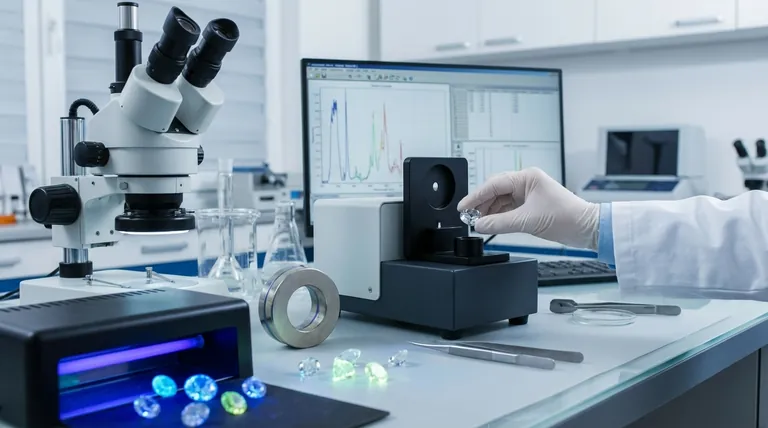
Why HPHT Treatment is Difficult to Detect
High-Pressure, High-Temperature (HPHT) treatment is a sophisticated process that finishes the job nature started. It subjects a diamond—typically a brownish Type IIa—to the same intense heat and pressure that formed it deep within the Earth.
This process can dramatically improve a diamond's color, often turning a less desirable brownish stone into a valuable colorless one. Because it fundamentally alters the diamond's structure rather than adding a foreign substance, the changes are permanent and challenging to identify without the right tools.
Key Indicators Used by Gemologists
Professional gem labs look for a combination of factors. No single indicator is always present, so identification is a process of assembling evidence.
### Microscopic Inclusions
A powerful microscope is the first line of defense. The intense heat of HPHT treatment can affect the natural inclusions trapped within the diamond.
Gemologists look for tiny, dark clouds of graphite surrounding mineral inclusions, sometimes called "black umbrellas" or graphitized feathers. The treatment can also give inclusions a "frosted" or hazy appearance.
### Unusual Fluorescence
While many diamonds fluoresce, HPHT-treated stones can exhibit unusual reactions to ultraviolet (UV) light.
Under a gemological UV lamp, they may show a distinctive chalky greenish-yellow or blue fluorescence. They can also sometimes exhibit phosphorescence—continuing to glow for a short time after the UV light is turned off—which is very rare in untreated diamonds.
### Magnetic Properties
This is a highly reliable, though not universal, indicator. The equipment used in the HPHT process can leave microscopic metallic flux particles embedded in the diamond.
These particles can make the diamond slightly magnetic. Gemologists can detect this property using extremely powerful magnets, a clear sign that the diamond has been through a treatment process.
### Advanced Spectroscopic Analysis
This is the most definitive method for identification and is standard practice in major labs like the GIA.
FTIR (Fourier Transform Infrared) spectroscopy is used to determine the diamond's type. HPHT is most effective on Type IIa diamonds, so identifying a colorless diamond as Type IIa immediately raises suspicion and triggers further testing.
Photoluminescence (PL) spectroscopy at cryogenic temperatures can detect specific features in the diamond's light spectrum that are known to be created by the HPHT annealing process.
Common Pitfalls and Misconceptions
Understanding the nuances is key to avoiding costly mistakes. The technology is complex and often misunderstood.
### Confusing Treatment with Synthesis
HPHT treatment improves a natural, earth-mined diamond. HPHT synthesis, on the other hand, is a method used to grow a diamond in a laboratory from scratch. They are two distinct products, though they rely on similar technology.
### Relying on a Loupe Alone
A standard 10x jeweler's loupe is completely insufficient for identifying HPHT treatment. The indicators are far too subtle and require high-powered magnification and specialized analytical tools.
### Misinterpreting Fluorescence as Proof
Fluorescence is a clue, not a conclusion. While HPHT diamonds often have characteristic fluorescence, many natural, untreated diamonds also fluoresce strongly. It is only one piece of a larger diagnostic puzzle.
Making the Right Choice for Your Goal
Ultimately, certainty in a diamond's origin and treatment history comes down to independent, expert verification.
- If your primary focus is buying a diamond: Always insist on a recent grading report from a top-tier, reputable gemological lab (such as GIA, AGS, or IGI) that explicitly discloses any and all treatments.
- If your primary focus is verifying a diamond you already own: The only way to be certain is to submit the stone to a professional gem lab for a full identification and grading report.
- If your primary focus is appraising diamonds as a professional: Invest in advanced training and equipment, including a high-quality microscope and UV lamp, and establish a relationship with a major lab for definitive testing of suspicious stones.
Relying on professional, scientific verification is the only way to ensure the authenticity, and true value, of your diamond.
Summary Table:
| Detection Method | What Gemologists Look For | Key Indicator |
|---|---|---|
| Microscopic Analysis | Graphitized inclusions ("black umbrellas"), frosted feathers | Altered internal features |
| UV Fluorescence | Chalky greenish-yellow or blue glow, phosphorescence | Unusual light patterns |
| Magnetic Testing | Slight attraction to powerful magnets | Metallic flux residue |
| FTIR Spectroscopy | Diamond type (e.g., Type IIa) | Atomic structure clues |
| Photoluminescence (PL) | Specific spectral features at low temperatures | HPHT treatment signatures |
Ensure the integrity of your gemological analysis with precision equipment from KINTEK.
Whether you're a professional gemologist, appraiser, or laboratory, having the right tools is essential for accurate diamond verification. KINTEK specializes in high-quality lab equipment and consumables designed to meet the rigorous demands of gemological testing.
Contact us today via our Contact Form to explore our range of spectroscopic tools, microscopes, and UV lamps that empower you to detect HPHT treatments with confidence and precision. Let KINTEK be your trusted partner in upholding the highest standards of diamond authenticity and value.
Visual Guide

Related Products
- Customizable High Pressure Reactors for Advanced Scientific and Industrial Applications
- Automatic Laboratory Heat Press Machine
- Filter Testing Machine FPV for Dispersion Properties of Polymers and Pigments
- Laboratory Sterilizer Lab Autoclave Vertical Pressure Steam Sterilizer for Liquid Crystal Display Automatic Type
- CVD Diamond Cutting Tool Blanks for Precision Machining
People Also Ask
- What reactor is used for high pressure reactions? Select the Right Autoclave for Your Lab
- What is the temperature range of a stainless steel reactor? Understand the Real-World Limits for Your Process
- Does pressure affect melting and boiling? Master Phase Changes with Pressure Control
- What are the advantages of a chemical reactor? Unlock Precision, Efficiency, and Safety in Your Process
- How is high pressure generated in an autoclave? Unlock the Science of Sterilization & Synthesis