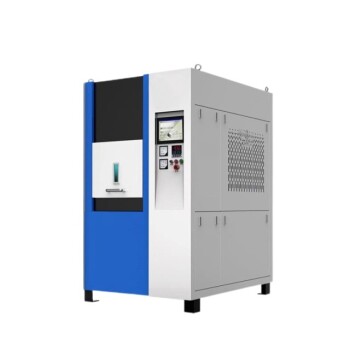
A dual-stage split-tube furnace creates a controlled environment for ammonia research by utilizing independently managed heating zones and a modular "clamshell" design. This configuration ensures a highly uniform temperature field and provides the necessary residence time for gases to reach thermal equilibrium. By integrating multi-point temperature monitoring with high-performance insulation, the system maintains the precise thermal stability required for sensitive ammonia reaction studies.
The success of ammonia thermal effect research depends on achieving a flat temperature profile and sufficient gas-to-heat exposure. A dual-stage split-tube furnace solves this by decoupling temperature control across the reaction path while offering easy access for internal sensor placement.
The Mechanics of Multi-Zone Thermal Control
Independent Temperature Zone Management
Ammonia thermal reactions are highly sensitive to temperature gradients that can lead to inconsistent data. Dual-stage control allows researchers to set different temperatures for the entry and reaction phases of the tube. This independence compensates for natural heat loss at the tube ends, ensuring the reaction zone remains perfectly uniform.
Optimizing Gas Residence Time
The furnace typically features a sufficiently long heating zone, often 200 mm or more. This length is critical because it ensures that ammonia gas has adequate residence time to reach the targeted reaction temperature. Without this duration, the gas might exit the furnace before the thermal effects being studied can fully stabilize.
Precision Feedback and Monitoring
Control systems use thermocouples to monitor internal temperatures and provide real-time feedback. This loop allows the system to adjust the power sent to the resistance wire heating elements instantly. This constant adjustment is necessary to counteract external environmental changes and maintain a steady-state environment.
Design Advantages for Ammonia Research
The Split-Tube Configuration
The furnace is designed with a hinged split-case architecture that allows it to open like a clamshell. This facilitates the rapid installation and positioning of the reaction tube and internal components. Researchers can easily integrate complex multi-point temperature measurement probes directly into the heart of the reaction area.
Advanced Thermal Insulation
To maintain stability, these furnaces use materials like ceramic fiber insulation. Ceramic fiber is valued for its low thermal conductivity, which significantly reduces heat loss to the outside environment. This high-efficiency insulation ensures that the energy generated is focused entirely on the reaction tube, preventing cold spots.
Understanding the Trade-offs and Limitations
Addressing Thermal Drift
While resistance wire heating is effective for achieving high temperatures, it is susceptible to thermal drift over long periods. This means the heating characteristics of the wire may change as it ages or through repeated cycling. Regular calibration and the use of high-quality PID controllers are necessary to mitigate this effect in long-term ammonia studies.
Thermal Stress on Reaction Tubes
The use of dual zones can create sharp temperature gradients at the interface between the two stages. These gradients can cause mechanical stress on quartz or ceramic reaction tubes, potentially leading to cracks. It is vital to manage the temperature transition between zones carefully to protect the integrity of the reactor.
Applying This Technology to Your Research
How to Select Your Configuration
Selecting the right furnace depends on the specific parameters of your ammonia thermal study.
- If your primary focus is high-throughput screening: Prioritize the split-tube design to allow for rapid switching of reaction tubes and catalysts between runs.
- If your primary focus is kinetic precision: Invest in a furnace with longer independent heating zones to maximize gas residence time and ensure a perfectly flat thermal profile.
- If your primary focus is long-duration stability: Choose a system with advanced ceramic fiber insulation and high-grade resistance wires to minimize thermal drift over time.
By aligning the furnace's multi-zone capabilities with your specific gas-flow requirements, you can ensure a stable and repeatable environment for complex ammonia research.
Summary Table:
| Feature | Benefit for Ammonia Research |
|---|---|
| Dual Heating Zones | Decouples entry/reaction phases to eliminate gradients and ensure uniformity. |
| Split-Tube Design | Enables rapid tube swapping and easy integration of multi-point internal sensors. |
| Long Reaction Path | Maximizes gas residence time to ensure ammonia reaches thermal equilibrium. |
| Ceramic Fiber Insulation | High thermal efficiency that prevents cold spots and focuses energy on the reaction. |
| PID Control Systems | Provides real-time feedback to mitigate thermal drift and maintain steady-state heat. |
Elevate Your Chemical Kinetics with KINTEK Precision
Achieving repeatable results in ammonia thermal research requires more than just heat—it requires total environmental control. KINTEK specializes in advanced laboratory solutions, offering high-performance split-tube, vacuum, and atmosphere furnaces specifically designed for uniform thermal profiles.
Beyond furnaces, our expertise extends to high-temperature high-pressure reactors, autoclaves, and specialized ceramics, ensuring your entire reaction path is optimized for accuracy. Whether you are a researcher focused on kinetic precision or an industrial lab seeking high-throughput reliability, our team provides the technical support and custom configurations you need.
Contact our specialists today to find the perfect furnace or reactor system for your next breakthrough!
References
- Samuel Ronald Holden, Dongke Zhang. An Experimental Observation of the Thermal Effects and NO Emissions during Dissociation and Oxidation of Ammonia in the Presence of a Bundle of Thermocouples in a Vertical Flow Reactor. DOI: 10.4236/aces.2023.133018
This article is also based on technical information from Kintek Solution Knowledge Base .
Related Products
- Rotary Tube Furnace Split Multi Heating Zone Rotating Tube Furnace
- Split Chamber CVD Tube Furnace with Vacuum Station Chemical Vapor Deposition System Equipment Machine
- 1200℃ Split Tube Furnace with Quartz Tube Laboratory Tubular Furnace
- Multi Heating Zones CVD Tube Furnace Machine Chemical Vapor Deposition Chamber System Equipment
- Multi-zone Laboratory Tube Furnace
People Also Ask
- What are the process advantages of using a rotary tube furnace for WS2 powder? Achieve Superior Material Crystallinity
- What are the advantages of using a rotary tube furnace for MoVOx catalysts? Elevate Uniformity and Crystallinity
- Why is a rotary tube furnace recommended for the calcination stage of potassium vanadium oxide catalysts? Optimize Purity
- Why is a rotary tube furnace preferred over a fixed tube furnace for the carbonization of asphaltenes? Superior Quality
- What is a rotary tube furnace? Achieve Superior Uniformity for Powders and Granules