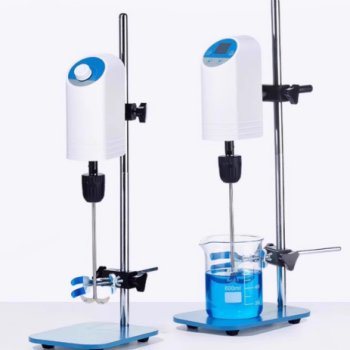
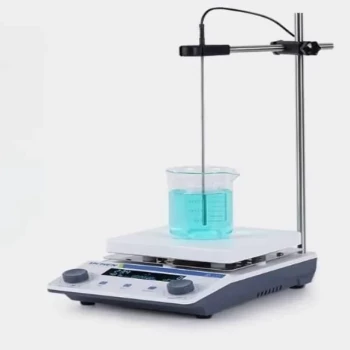
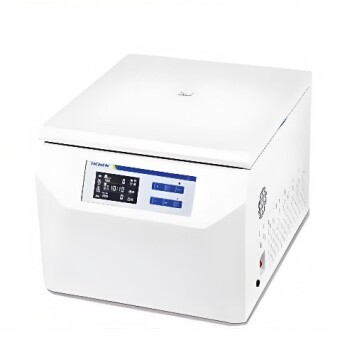
High-power magnetic stirring fundamentally alters the efficiency of electrolysis by generating a high-speed rotating vortex that forces rapid, uniform contact between oxidants and microorganisms. This intense mechanical action is critical for overcoming the mass transfer resistance inherent in complex water matrices, preventing contaminants from escaping oxidative attack.
In complex water sources like irrigation water, oxidants often fail to reach pathogens due to poor diffusion. A high-power stirrer neutralizes this issue by creating a dynamic vortex that eliminates "dead zones" and guarantees thorough inactivation.
Overcoming Physical Barriers in Complex Water
The Challenge of Mass Transfer Resistance
Real-world water sources, such as irrigation water, contain high levels of Total Organic Carbon (TOC) and high turbidity.
These impurities create physical and chemical barriers that impede the movement of oxidants. This phenomenon, known as mass transfer resistance, slows down the reaction rate and reduces treatment efficiency.
The Power of the Rotating Vortex
A standard mixer often fails to penetrate these dense matrices.
A high-power magnetic stirrer, however, generates a high-speed rotating vortex. This intense turbulence physically forces the water to circulate rapidly within the irradiation tank.
Breaking Down Local Gradients
Without vigorous mixing, local concentration gradients form where oxidants are depleted quickly in one area while remaining untouched in another.
The vortex ensures that oxidants are distributed evenly and instantly. This effectively bridges the gap between the generated chemical species and the target microorganisms.
Ensuring Thorough Inactivation
Preventing Microorganism Avoidance
In stagnant or poorly mixed systems, microorganisms can effectively "hide" in areas of low oxidant concentration.
The high-power stirrer removes this possibility by subjecting the entire volume of water to uniform oxidative stress. This prevents microorganisms from avoiding contact with the disinfecting agents.
Dealing with High Turbidity
Turbidity (cloudiness) usually shields pathogens from treatment.
By maintaining a homogenized mixture, the stirrer ensures that suspended solids do not create safe havens for bacteria. This leads to consistent inactivation rates even when water quality fluctuates.
Understanding the Trade-offs
Mechanical vs. Chemical Limitations
While high-power stirring drastically improves the distribution of oxidants, it does not increase the generation of oxidants.
If the electrolysis system itself is underpowered and produces insufficient oxidants, increasing mixing speed will yield diminishing returns. The stirrer optimizes the use of available oxidants but cannot compensate for a lack of chemical production.
Operational Considerations
Implementing high-power magnetic stirring requires more energy than passive or low-speed mixing methods.
Operators must balance the energy cost of the motor against the efficiency gains in treatment time. For water with low turbidity or low TOC, extreme high-speed mixing may be excessive.
Making the Right Choice for Your Goal
To maximize the efficiency of your electrolysis treatment, assess your specific water conditions:
- If your primary focus is treating high-TOC or turbid water: Prioritize high-power stirring to overcome mass transfer resistance and prevent pathogen survival in "dead zones."
- If your primary focus is energy efficiency in clean water: You may be able to reduce stirring intensity, as the mass transfer resistance will be naturally lower.
The most effective electrolysis systems do not just generate powerful oxidants; they use high-speed mechanics to ensure those oxidants never miss their target.
Summary Table:
| Feature | Impact on Electrolysis Efficiency | Benefit for Complex Water Matrices |
|---|---|---|
| High-Speed Vortex | Forces rapid contact between oxidants and pathogens | Eliminates "dead zones" in dense irrigation water |
| Turbulence Generation | Overcomes mass transfer resistance | Ensures uniform treatment despite high TOC and turbidity |
| Homogenization | Breaks down local concentration gradients | Prevents microorganisms from escaping oxidative attack |
| Mechanical Action | Bridges gap between chemicals and targets | Consistent inactivation even in fluctuating water quality |
Maximize Your Electrolysis Efficiency with KINTEK
Don't let mass transfer resistance compromise your water treatment results. KINTEK specializes in advanced laboratory equipment designed to handle the most demanding research and industrial applications. Whether you are treating high-turbidity irrigation water or conducting complex electrochemical synthesis, our high-performance magnetic stirrers, electrolytic cells, and electrodes provide the mechanical precision and chemical durability you need.
From high-temperature high-pressure reactors to specialized battery research tools and homogenizers, KINTEK delivers comprehensive solutions that ensure your oxidants never miss their target.
Ready to optimize your lab’s performance? Contact our technical experts today to find the perfect equipment for your specific water matrix challenges!
References
- Paula Andrea Espinosa-Barrera, Alejandro Moncayo‐Lasso. Synergistic effects of a sequential recirculation electrochemical system combined with low-cost UV-LEDs on the gram-negative bacteria inactivation. DOI: 10.1007/s11356-024-35297-0
This article is also based on technical information from Kintek Solution Knowledge Base .
Related Products
- High Performance Laboratory Stirrers for Diverse Applications
- Laboratory Small Constant Temperature Heated Magnetic Stirrer Heater and Stirrer
- Custom PTFE Teflon Parts Manufacturer for Magnetic Stirring Bar
- Three-dimensional electromagnetic sieving instrument
- High Energy Vibratory Ball Mill for Lab Use
People Also Ask
- How does a laboratory stirrer influence MOF product quality? Master Precision in Non-Solvothermal Synthesis
- What critical role does a Laboratory Stirrer play during leaching? Enhance Titanium-Magnesium Waste Recovery
- What is the primary function of laboratory stirring equipment in the preparation of compost leachate? Optimize Extraction
- What is a laboratory mixer? A Guide to Achieving Perfect Sample Homogeneity
- What is a laboratory mixer used for? Choose the Right Tool for Liquids or Solids