Hot Isostatic Pressing (HIP) transforms standard Chemical Vapor Deposition Zinc Sulfide (CVD-ZnS) by subjecting the material to extreme thermal and barometric stress in a controlled environment. By treating the zinc sulfide at temperatures between 800°C and 1000°C and pressures ranging from 90 to 250 MPa, the process fundamentally alters the material's microstructure to remove optical defects.
Core Takeaway The HIP process functions as a post-deposition purification step that converts standard "yellow" ZnS into a water-clear, multispectral material. It achieves this by physically collapsing internal micropores and chemically eliminating zinc-hydride complexes and sulfur vacancies, thereby unlocking light transmission across the visible and infrared spectrums.
The Physics of the Transformation
The transformation from standard-grade to multispectral ZnS is not merely a surface treatment; it is a structural modification driven by heat and pressure.
The Isostatic Environment
The process utilizes an inert gas, typically Argon, within a pressure vessel. Unlike mechanical pressing which applies force from one direction, this gas applies isostatic pressure, meaning the force is applied uniformly from all directions simultaneously.
Plastic Deformation and Bonding
Under the combination of high heat and pressure, the solid ZnS material enters a plastic state. This allows the material to flow at a microscopic level. Internal voids and micropores collapse under the differential pressure, and the surfaces of these voids diffusion bond together, effectively healing the material to near-theoretical density.
Critical Process Parameters
Precision is paramount. The material must be held at specific conditions—800°C to 1000°C and 90 to 250 MPa—for a set duration to ensure complete densification without melting or chemically reacting with the atmosphere.
Eliminating Optical Defects
Standard CVD-ZnS appears yellow and opaque to visible light due to specific internal defects. The HIP process targets and removes these three primary barriers to transparency.
Removing Micropores
Standard CVD processes often leave microscopic gaps or pores within the crystal lattice. These scatter light. The HIP process physically crushes these pores out of existence, creating a dense, uniform solid.
Eliminating Zn-H Complexes
A key cause of light absorption in standard ZnS is the presence of Zinc-Hydride (Zn-H) complexes. The high-temperature treatment dissociates these complexes, removing the "fog" that blocks visible light.
Correcting Sulfur Vacancies
The process also addresses sulfur vacancies, which are atomic-level defects in the crystal structure. Eliminating these vacancies is critical for removing the material's characteristic yellow tint.
The Result: Multispectral Performance
The physical and chemical changes induced by the HIP process result in a dramatic shift in optical performance.
From Yellow to Clear
By removing the absorption centers (Zn-H complexes and vacancies), the material loses its yellow appearance. It becomes visually clear, looking similar to glass.
Full-Spectrum Transmittance
While standard ZnS is effective primarily in the infrared, HIP-treated ZnS becomes multispectral. It provides high transmission capabilities ranging continuously from the visible light spectrum deep into the infrared band.
Understanding the Trade-offs
While the optical benefits are significant, the HIP process introduces specific complexities that must be managed.
Intensity of Processing
This is not a simple annealing step. It requires extreme pressures (up to 250 MPa), necessitating heavy industrial pressure vessels and specialized furnaces.
Strict Environmental Control
The environment must be strictly controlled using inert gas. Any deviation could fail to eliminate defects or introduces new chemical reactions that compromise the material's purity.
Making the Right Choice for Your Goal
The decision to use HIP-treated ZnS depends entirely on the spectral requirements of your optical system.
- If your primary focus is strictly Thermal Imaging (LWIR): Standard CVD-ZnS is likely sufficient, as the internal defects do not significantly hamper long-wave infrared transmission.
- If your primary focus is Multi-Mode Systems (Visible + IR): You require HIP-treated (multispectral) ZnS to ensure the optic is transparent to visible cameras, lasers, and near-infrared sensors.
The HIP process is the definitive bridge between a single-band infrared material and a high-performance, multispectral window.
Summary Table:
| Feature | Standard CVD-ZnS | HIP-Treated (Multispectral) ZnS |
|---|---|---|
| Appearance | Yellow, opaque to visible light | Water-clear, transparent |
| Microstructure | Contains micropores and Zn-H complexes | Dense, pore-free, diffusion-bonded |
| Process Temp | N/A | 800°C to 1000°C |
| Process Pressure | N/A | 90 to 250 MPa (Isostatic) |
| Spectral Range | Primarily Infrared (LWIR) | Visible through Infrared band |
| Applications | Simple thermal imaging | Multi-mode systems, visible + IR cameras |
Elevate Your Optical Precision with KINTEK
Transition from standard infrared components to high-performance multispectral systems with KINTEK’s advanced processing solutions. Our expertise in Hot Isostatic Pressing (HIP) and laboratory equipment ensures your materials achieve near-theoretical density and superior optical clarity.
Whether you are developing multi-mode sensors or advanced thermal imaging, KINTEK provides the critical tools you need, including:
- High-Pressure Isostatic Presses for material densification.
- High-Temperature Vacuum and Atmosphere Furnaces for precise thermal treatment.
- Specialized Ceramics and Consumables to maintain purity in extreme environments.
Ready to transform your material performance? Contact our technical experts today to find the perfect equipment for your research or production requirements.
Related Products
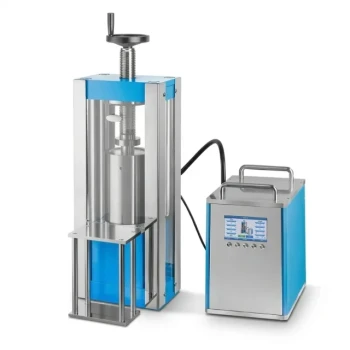
- Warm Isostatic Press for Solid State Battery Research
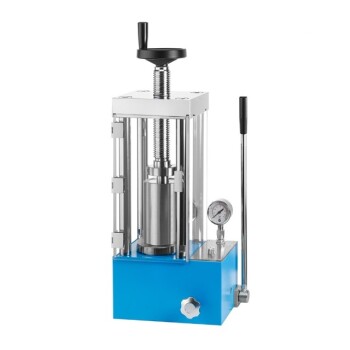
- Electric Split Lab Cold Isostatic Press CIP Machine for Cold Isostatic Pressing
- Manual Cold Isostatic Pressing Machine CIP Pellet Press
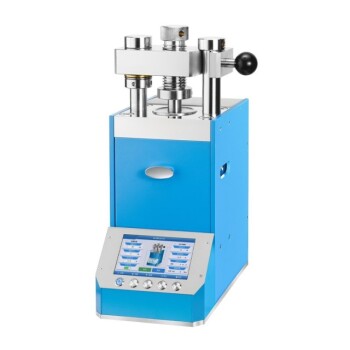
- Automatic High Temperature Heated Hydraulic Press Machine with Heated Plates for Lab
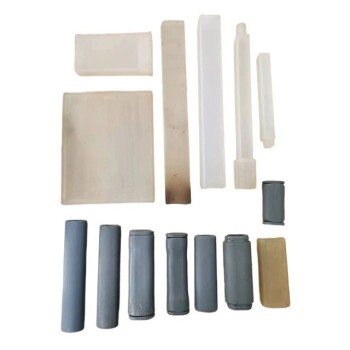
- Isostatic Molding Pressing Molds for Lab
People Also Ask
- What is the temperature of a warm isostatic press? Achieve Optimal Densification for Your Materials
- What is the function of a Warm Isostatic Press (WIP) in all-solid-state pouch cells? Optimize Battery Density
- Why are Warm Isostatic Presses (WIP) necessary for solid-state batteries? Achieve Atomic-Level Contact
- What advantages does a warm isostatic press offer over a traditional uniaxial press for Li6PS5Cl electrolyte sheets?
- How do warm isostatic presses improve dry electrode performance? Enhance ASSB Conductivity with Heat & Pressure