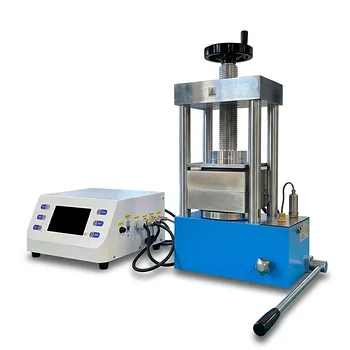
The laboratory hot press serves as the definitive tool for structural densification during the post-treatment of nanocellulose membranes. By applying precise temperature and mechanical pressure simultaneously, it forces nanocellulose chains into closer proximity, thereby maximizing the efficiency of hydrogen bonding. This process is essential for converting a loose fiber network into a mechanically robust, defect-free composite suitable for high-performance applications.
Core Takeaway The hot press does not merely flatten the material; it fundamentally alters its internal physics. By eliminating micro-voids and strengthening intermolecular bonds, it transforms a fragile membrane into a dense, smooth "nanopaper" with the stability required for advanced filtration and mechanical stress.
Transforming the Internal Structure
To understand the value of the hot press, you must look beyond the visible flattening of the material and focus on the microscopic interactions occurring between the fibers.
Strengthening Hydrogen Bonding
The primary mechanism at work is the enhancement of hydrogen bonding. Nanocellulose relies on these bonds for its strength.
By applying heat and pressure, the hot press reduces the distance between nanocellulose chain segments. This proximity allows for a denser network of hydrogen bonds to form, acting as the "glue" that holds the membrane together.
Eliminating Internal Defects
Raw membranes often contain microscopic voids or air pockets that act as failure points under stress.
The simultaneous application of thermal energy and mechanical force compresses the material, effectively squeezing out these internal micro-defects. This results in a homogeneous structure with significantly improved integrity.
Densification of the Matrix
Similar to how polymer matrices flow to encapsulate particles in other composites, the hot press promotes a tighter packing of the nanocellulose.
This densification creates a unified barrier, which is critical for ensuring consistent performance in filtration applications where bypass or leakage through defects cannot be tolerated.
Optimizing Physical Properties
The structural changes induced by the hot press directly translate into measurable improvements in the membrane's physical characteristics.
Boosting Mechanical Strength
The most immediate benefit is a dramatic increase in tensile strength.
Because the hydrogen bonds are reinforced and defects are removed, the membrane can withstand significantly higher physical loads without tearing or deforming.
Reducing Surface Roughness
Post-treatment with a hot press irons out surface irregularities.
This process significantly reduces surface roughness, creating a smooth, uniform finish. This is vital for applications requiring precise surface interactions or subsequent coating layers.
Understanding the Trade-offs
While hot pressing is highly beneficial, it is a process of exchange. You are trading porosity for strength and density.
Density vs. Permeability
The process of eliminating micro-defects and tightening the fiber network inevitably reduces the pore size and total pore volume.
While this makes the membrane mechanically stable for filtration, it may increase flow resistance. You must balance the pressing parameters to achieve the necessary strength without completely sealing the membrane if high permeability is required.
Thermal Sensitivity
Precision is key. The temperature must be high enough to facilitate bonding and densification but must remain below the degradation threshold of the nanocellulose.
Excessive heat can scorch or degrade the fibers, compromising the very mechanical properties you aim to improve.
Making the Right Choice for Your Goal
The parameters you choose for the hot press should be dictated by the specific requirements of your final application.
- If your primary focus is Mechanical Durability: Maximize the pressure and optimize the temperature to achieve the highest density of hydrogen bonding, creating a rigid, unbreakable nanopaper.
- If your primary focus is Filtration Stability: Use moderate pressure to eliminate structural defects and ensure surface smoothness, while being careful not to over-densify the internal pores needed for fluid flow.
By controlling the heat and pressure, you dictate the final balance between the membrane's structural integrity and its functional porosity.
Summary Table:
| Feature | Impact on Nanocellulose | Benefit to Membrane Performance |
|---|---|---|
| Hydrogen Bonding | Maximum chain proximity | Dramatic increase in tensile strength |
| Micro-void Removal | Elimination of internal defects | Improved structural integrity and uniformity |
| Matrix Densification | Reduced pore size and volume | Creation of high-performance filtration barriers |
| Surface Smoothing | Ironing out irregularities | Enhanced finish for coating and surface interaction |
| Thermal Precision | Controlled heat application | Prevents fiber degradation while facilitating bonding |
Elevate Your Material Research with KINTEK Precision
Maximize the mechanical strength and structural integrity of your nanocellulose membranes with KINTEK’s high-performance laboratory hot presses. Whether you are developing advanced filtration systems or robust nanopaper, our hydraulic presses—including pellet, hot, and isostatic models—provide the precise temperature and pressure control essential for perfect hydrogen bonding and defect-free densification.
Beyond our industry-leading presses, KINTEK offers a comprehensive suite of laboratory solutions, including high-temperature furnaces, crushing and milling systems, and specialized consumables like PTFE products and ceramics.
Ready to transform your research into high-performance composites? Contact KINTEK today to find the ideal equipment for your laboratory needs.
References
- Sandrine Mbakop, Maurice S. Onyango. Recent Advances in the Synthesis of Nanocellulose Functionalized–Hybrid Membranes and Application in Water Quality Improvement. DOI: 10.3390/pr9040611
This article is also based on technical information from Kintek Solution Knowledge Base .
Related Products
- Automatic Laboratory Heat Press Machine
- Electric Heated Hydraulic Vacuum Heat Press for Lab
- Manual Lab Heat Press
- Double Plate Heating Press Mold for Lab
- 30T 40T Split Automatic Heated Hydraulic Press Machine with Heated Plates for Laboratory Hot Press
People Also Ask
- What are the core advantages of using a laboratory hot press to produce Bi2Se3? Achieve 93% Density & High Conductivity
- Why is a laboratory hot press necessary for all-solid-state battery assembly? Reduce Impedance and Enhance Performance
- How does a three-stage pressure program affect rice husk particleboards? Optimize Bond Strength & Stability
- What is the primary function of a laboratory hot press in MEA assembly? Optimize Fuel Cell Bonding & Performance
- How does a laboratory hot press improve alloy performance? Optimize Liquid Phase Sintering for High-Strength Materials