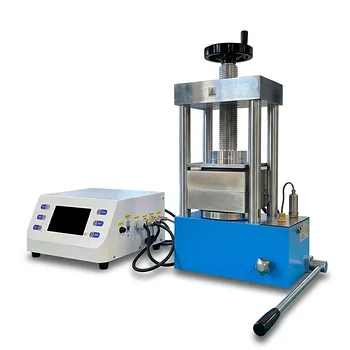
A laboratory hydraulic pellet press acts as the fundamental mechanical tool for transforming loose perovskite powders into solid, workable samples. It applies high uniaxial pressure and precise pressure-holding control to compact these powders into dense, shaped pellets—known as "green bodies"—ready for high-temperature treatment.
Core Insight: The hydraulic press does more than shape the powder; it dictates the material's future performance. By forcing particles into tight contact and reducing voids, the press minimizes shrinkage and micro-cracks during sintering, which is the absolute prerequisite for achieving the low grain boundary resistance and high total conductivity required for effective perovskite electrolytes.
The Mechanism of Densification
Precise Particle Rearrangement
Loose perovskite powder contains significant air gaps and voids. The hydraulic press applies precise, stable pressure to force these particles to rearrange and pack tightly within a steel mold.
Eliminating Inter-Particle Voids
As pressure increases, the contact area between powder particles expands. This physical compaction eliminates macro-defects and reduces the porosity that naturally exists in the bulk powder.
Establishing Green Strength
The process results in a "green body" (an unfired ceramic object) with sufficient handling strength. This structural integrity ensures the pellet can be removed from the mold and transferred to a furnace without crumbling or breaking.
Impact on Sintering and Conductivity
Minimizing Thermal Defects
The quality of the green body dictates the success of the subsequent sintering (heating) process. A highly dense green body significantly minimizes shrinkage and deformation when heat is applied.
Preventing Micro-Cracking
By ensuring sufficient contact between particles before heating, the press prevents the formation of internal micro-cracks. If the green body is too porous, the uneven mass transport during sintering often leads to structural failure.
Enhancing Electrical Performance
For perovskite electrolytes, density is directly linked to efficiency. The press creates the foundation for low grain boundary resistance, which facilitates superior ion transport and high total conductivity in the final ceramic.
Common Pitfalls to Avoid
Inconsistent Pressure Application
While high pressure is necessary, uniformity is equally critical. If the hydraulic press applies pressure unevenly, density gradients will form across the pellet, leading to warping or cracking during the sintering phase.
Ignoring Pressure-Holding Times
Simply reaching a target pressure is often insufficient. The pressure-holding control feature of the press allows time for the powder to settle and lock into place, preventing "spring-back" effects where the material expands after pressure release.
Making the Right Choice for Your Goal
To maximize the effectiveness of your hydraulic press in perovskite preparation:
- If your primary focus is Electrical Conductivity: Prioritize a press with precise pressure-holding capabilities to maximize green density, as this directly correlates to lower resistance.
- If your primary focus is Structural Integrity: Ensure your mold and press alignment deliver uniform static pressure to eliminate macro-defects and handling failures.
The hydraulic press is not just a shaping tool; it is the gatekeeper of your perovskite electrolyte's final electrochemical performance.
Summary Table:
| Feature | Impact on Perovskite Electrolyte | Benefit |
|---|---|---|
| Uniaxial Pressure | Eliminates inter-particle voids and air gaps | Higher density & reduced porosity |
| Pressure Holding | Allows powder to settle and lock into place | Prevents 'spring-back' and expansion |
| Uniform Compaction | Minimizes density gradients across the pellet | Prevents warping and cracks during sintering |
| Structural Integrity | Establishes superior green body strength | Safe handling and transfer to high-temp furnaces |
Elevate Your Material Research with KINTEK Precision
Achieving the low grain boundary resistance required for high-performance perovskite electrolytes starts with the perfect green body. KINTEK specializes in advanced laboratory solutions, offering high-precision hydraulic pellet presses (manual, electric, and isostatic) designed to provide the stable, uniform pressure your research demands.
Beyond compaction, we support your entire workflow with:
- High-Temperature Furnaces: Muffle, vacuum, and atmosphere furnaces for flawless sintering.
- Processing Tools: Crushing, milling, and sieving equipment for optimal powder preparation.
- Specialized Consumables: High-purity ceramics, crucibles, and PTFE products.
Ready to minimize defects and maximize conductivity in your samples? Contact KINTEK today for a tailored equipment consultation.
References
- Pikee Priya, N. R. Aluru. Accelerated design and discovery of perovskites with high conductivity for energy applications through machine learning. DOI: 10.1038/s41524-021-00551-3
This article is also based on technical information from Kintek Solution Knowledge Base .
Related Products
- Laboratory Hydraulic Pellet Press for XRF KBR FTIR Lab Applications
- Automatic Laboratory Hydraulic Pellet Press Machine for Lab Use
- Laboratory Manual Hydraulic Pellet Press for Lab Use
- Automatic Laboratory Hydraulic Press for XRF & KBR Pellet Press
- Laboratory Manual Hydraulic Pellet Press for Lab Use
People Also Ask
- What is the role of a laboratory hydraulic pellet press and stainless steel molds in the fabrication of RuO2/NbC anodes?
- How does a laboratory hydraulic pellet press contribute to SiCw/2024 aluminum composite preforms? Optimize Densification
- What is the necessity of using a laboratory hydraulic pellet press in the preparation of biomass fuel pellets? Guide
- What is the significance of applying 200 MPa of pressure with a laboratory hydraulic pellet press for composite ceramics?
- What key role does a laboratory pellet press play in FTIR analysis? Master KBr Sample Preparation Excellence