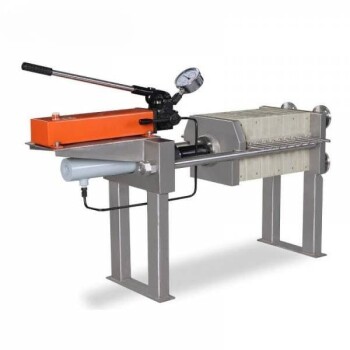
A laboratory hydraulic press ensures quality in Natural Fiber Reinforced Polymer Composites (NFPCs) by delivering precise, uniform pressure control that dictates the internal structure of the material. This controlled force is the primary mechanism for facilitating the thorough rearrangement of fiber reinforcements and ensuring tight bonding with the resin matrix, whether thermosetting or thermoplastic.
By effectively eliminating entrapped air and reducing porosity, the press prevents the formation of micro-cracks during curing. This results in a final composite product characterized by high mechanical strength, superior density, and consistent structural integrity.
The Mechanics of Quality Assurance
Eliminating Porosity and Entrapped Air
The most critical function of the hydraulic press in NFPC preparation is the reduction of voids. Natural fibers often have complex surfaces that can trap air when mixed with resin.
By applying high, consistent pressure, the press forces these air pockets out of the mold. This creates a dense material structure, which is essential because retained air leads to porosity that significantly weakens the composite.
Ensuring Uniform Fiber Distribution
Quality NFPCs require that the fiber reinforcement be evenly distributed within the resin.
The press facilitates the rearrangement of fibers under pressure, preventing clumping or resin-rich areas. This ensures that mechanical loads are distributed evenly across the finished sheet, rather than concentrating stress on weak points.
Preventing Micro-Cracking
The structural integrity of a composite is often compromised during the transition from a wet mixture to a solid state.
By maintaining pressure during the curing or molding stages, the hydraulic press prevents the formation of micro-cracks. These microscopic defects often act as initiation sites for material failure, so their prevention is vital for ensuring the longevity of the product.
Optimizing Interlaminar Bonding
For composites involving layered structures or prepregs, the press ensures vertical integration between layers.
The application of uniform pressure forces the resin to flow sufficiently through complex fiber orientations. This achieves tight interlaminar bonding, eliminating voids between layers and ensuring the component can withstand complex mechanical loads.
Understanding the Trade-offs
The Balance of Pressure
While high pressure is necessary to remove voids, excessive pressure can be detrimental. Applying too much force may crush the natural fibers, degrading their individual mechanical properties and weakening the overall composite.
Temperature and Pressure Synchronization
Many laboratory presses used for composites are heated (compression molding machines).
Ideally, pressure must be maintained while the temperature is regulated to cure the resin (for thermosets) or melt and cool it (for thermoplastics). A failure to synchronize pressure release with the thermal cycle can lead to warping or "spring-back," where the material attempts to return to its original shape, compromising dimensional accuracy.
Making the Right Choice for Your Goal
To ensure the highest quality NFPC sheets, align your processing parameters with your specific performance objectives:
- If your primary focus is maximum mechanical strength: Prioritize high-pressure settings that maximize density and eliminate even microscopic porosity to prevent stress concentrators.
- If your primary focus is dimensional stability: focus on the precise synchronization of pressure and temperature cycles to prevent warping during the cooling or curing phase.
Precision in the pressing stage is the single biggest determinant of an NFPC's final structural performance.
Summary Table:
| Quality Factor | Mechanism of Action | Impact on Final Product |
|---|---|---|
| Porosity Reduction | Forced expulsion of entrapped air | Prevents micro-cracks and structural failure |
| Fiber Distribution | Mechanical rearrangement under load | Ensures uniform load bearing and eliminates weak points |
| Interlaminar Bonding | Resin flow through fiber layers | Maximizes structural integrity and prevents delamination |
| Dimensional Accuracy | Synchronized thermal and pressure cycles | Prevents warping and ensures precise geometric tolerances |
Elevate Your Material Research with KINTEK Precision
At KINTEK, we understand that the integrity of your Natural Fiber Reinforced Polymer Composites (NFPC) depends on the precision of your equipment. Our advanced range of laboratory hydraulic presses, including manual, electric, and heated pellet presses, is engineered to provide the exact pressure control and thermal synchronization required to eliminate porosity and maximize mechanical strength.
Whether you are developing sustainable materials or advanced polymers, KINTEK offers a comprehensive portfolio of laboratory solutions—from high-temperature furnaces and crushing systems to isostatic presses and vacuum autoclaves.
Ready to achieve superior density and structural integrity in your composite sheets? Contact our technical experts today to find the perfect pressing solution for your laboratory's needs.
References
- Kamrun N. Keya, Ruhul A. Khan. Natural fiber reinforced polymer composites: history, types, advantages, and applications. DOI: 10.25082/mer.2019.02.006
This article is also based on technical information from Kintek Solution Knowledge Base .
Related Products
- Laboratory Hydraulic Press Split Electric Lab Pellet Press
- Laboratory Hydraulic Press Lab Pellet Press Machine for Glove Box
- Laboratory Hydraulic Press Lab Pellet Press for Button Battery
- Automatic Laboratory Hydraulic Pellet Press Machine for Lab Use
- Automatic Laboratory Hydraulic Press for XRF & KBR Pellet Press
People Also Ask
- What role does a laboratory hydraulic press play in platinum recovery research? Enhancing Sample Precision
- What are the specific applications of a lab hydraulic press in biochar evaluation? Optimize density and data accuracy.
- What are the roles of a laboratory hydraulic press and stainless steel molds in the preparation of graphite samples?
- What is the role of a laboratory hydraulic press in electrode prep? Maximize Energy Density & Sealing Precision
- Why must a laboratory hydraulic press equipped with cylindrical molds be used when preparing BZY green bodies? High Density