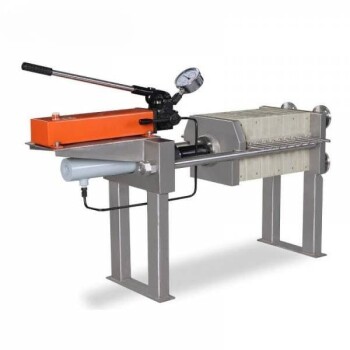
A laboratory hydraulic press is the critical instrument used to transform loose powder into a solid, optical-grade medium for analysis. By applying substantial pressure (often around 10 tons) to a mixture of cellulose citrate and potassium bromide (KBr), the press creates a dense, transparent pellet suitable for infrared transmission.
Core Insight: The hydraulic press ensures the physical integrity and optical transparency of the sample. By eliminating air voids and maximizing particle contact, it enables the high-resolution detection of specific functional groups, such as the ester group (C=O), without interference from light scattering.
The Mechanics of Pellet Formation
Creating the KBr Matrix
The process begins by mixing the cellulose citrate sample with potassium bromide (KBr) powder. KBr serves as a carrier matrix because, once compressed, it becomes transparent to infrared light.
Application of High Pressure
The hydraulic press applies high, balanced axial pressure to this powder mixture. According to standard protocols for this material, a load of approximately 10 tons is typically applied to the die.
Particle Bonding
Under this immense pressure, the powder particles are forced into tight contact. This mechanical force causes the distinct particles of the cellulose citrate and the KBr to bond into a single, cohesive unit.
Why Pressure is Non-Negotiable for Accuracy
Eliminating Light Scattering
Loose powders naturally scatter infrared light, which creates significant noise in analytical data. The hydraulic press eliminates the air gaps and irregularities between particles that cause this scattering.
Achieving Optical Transparency
The primary goal of the pressing process is to produce a high-transparency pellet. A clear pellet allows the infrared beam to transmit through the sample rather than reflecting off the surface.
Resolving Critical Chemical Bonds
High transparency is essential for obtaining clear, high-resolution infrared absorption peaks. This clarity allows for the precise identification of key chemical structures, specifically the ester group (C=O) within the cellulose citrate.
Common Pitfalls in Sample Pressing
Insufficient Densification
If the pressure applied is too low, the particles will not fuse completely. This results in a cloudy or opaque pellet that scatters the IR beam, obscuring the spectral peaks needed for analysis.
Air Inclusions
Failing to maintain pressure long enough to exclude air results in microscopic voids. These voids interrupt the path of the infrared beam, reducing the signal-to-noise ratio and potentially masking delicate spectral features.
Ensuring Analytical Success
To obtain the highest quality infrared spectrum for cellulose citrate, align your pressing technique with your specific analytical goals:
- If your primary focus is spectral resolution: Apply sufficient pressure (e.g., 10 tons) to maximize pellet transparency, ensuring sharp definition of the C=O ester group peaks.
- If your primary focus is signal consistency: Ensure the pressure is applied axially and evenly to eliminate scattering effects across the entire sample area.
Proper hydraulic pressing transforms a physical mixture into a clear analytical window, ensuring your chemical data is both accurate and reproducible.
Summary Table:
| Feature | Requirement for Cellulose Citrate | Benefit for IR Analysis |
|---|---|---|
| Applied Pressure | Approx. 10 Tons | Ensures particle bonding and cohesive pellet formation |
| Matrix Material | Potassium Bromide (KBr) | Provides an infrared-transparent carrier medium |
| Pellet Quality | High Optical Transparency | Minimizes light scattering for clear spectral peaks |
| Key Target | Ester Group (C=O) Detection | Enables high-resolution identification of chemical bonds |
| Consistency | Balanced Axial Pressure | Eliminates air voids and improves signal-to-noise ratio |
Elevate Your Analytical Precision with KINTEK
Achieving high-resolution infrared spectra for cellulose citrate requires more than just chemistry—it requires the perfect physical sample. KINTEK specializes in high-performance laboratory hydraulic presses (pellet, hot, and isostatic) designed to provide the precise, uniform pressure needed for optical-grade pellet preparation.
Whether you are focusing on battery research, material science, or chemical analysis, our comprehensive range of laboratory equipment—including crushing and milling systems, PTFE consumables, and high-temperature furnaces—ensures your lab operates at peak efficiency.
Ready to eliminate light scattering and improve your signal consistency? Contact KINTEK today to find the ideal pressing solution for your research needs!
References
- Isabella Romeo, Antonio De Nino. Totally green cellulose conversion into bio-oil and cellulose citrate using molten citric acid in an open system: synthesis, characterization and computational investigation of reaction mechanisms. DOI: 10.1039/d0ra06542k
This article is also based on technical information from Kintek Solution Knowledge Base .
Related Products
- Laboratory Hydraulic Press Split Electric Lab Pellet Press
- Laboratory Hydraulic Press Lab Pellet Press Machine for Glove Box
- Laboratory Hydraulic Press Lab Pellet Press for Button Battery
- Automatic Laboratory Hydraulic Pellet Press Machine for Lab Use
- Automatic Laboratory Hydraulic Press for XRF & KBR Pellet Press
People Also Ask
- What role does a laboratory hydraulic press play in platinum recovery research? Enhancing Sample Precision
- What are the specific applications of a lab hydraulic press in biochar evaluation? Optimize density and data accuracy.
- What are the roles of a laboratory hydraulic press and stainless steel molds in the preparation of graphite samples?
- What is the role of a laboratory hydraulic press in electrode prep? Maximize Energy Density & Sealing Precision
- Why must a laboratory hydraulic press equipped with cylindrical molds be used when preparing BZY green bodies? High Density